 5-star Wellness Resort
 5-star Wellness Resort
Written by: Chris Butt, Certified Personal Trainer & Weight Loss Coach, Premier Fitness Camp
Talk With A Premier Fitness Camp Coach
According to AAOS OrthoInfo, the knee is the largest and strongest joint in the body, and it relies heavily on surrounding muscles, particularly the quadriceps, hamstrings, hip abductors, and calf, to absorb and distribute force. When those muscles are weak, poorly coordinated, or imbalanced, the joint takes on more load than it can tolerate, contributing to pain and progressive wear. Deconditioning often concentrates stress at the knees.
Strengthening the muscles that support the knee reduces stress on the knee joint and helps the joint absorb shock, according to the American Academy of Orthopaedic Surgeons (AAOS). Exercise is recommended for osteoarthritis of the knee to improve both pain and function. The American College of Rheumatology’s 2026 updated clinical guidance strongly recommends exercise as a foundational component of knee osteoarthritis management.
Only 47.2% of U.S. adults met federal aerobic physical activity guidelines in 2024, and adherence drops further with age. The CDC recommends that adults work up to at least 150 minutes per week of moderate-intensity aerobic activity plus muscle-strengthening activity on at least 2 days each week. Those targets can feel distant when knees ache at the bottom of the stairs. The real issue is a strength gap, not just a knee joint problem.
For adults who are also deconditioned more broadly, the related article How To Start Exercising When You’re Extremely Out Of Shape covers the foundational principles of restarting movement from a low baseline.
Get A Personalized Knee-Friendly Plan
Pushing through joint pain instead of distinguishing it from muscle fatigue is the #1 mistake that makes bad knees worse. These two sensations feel different, carry different meanings, and require different responses.
Normal post-exercise soreness, or delayed onset muscle soreness (DOMS), is a dull, diffuse ache across the whole muscle rather than a sharp or pinpoint pain. It typically appears 12 to 72 hours after unfamiliar exercise, is often symmetrical, improves with light movement, peaks around day two, and fades within a few days. Injury-related pain is more localized, sharper, and easier to identify. It may begin during a specific movement and be accompanied by swelling, instability, weakness, or reduced range of motion.
The practical stop rules are straightforward:
AAOS advises that patients should not feel pain during a knee exercise and should talk to their doctor or physical therapist if they do. Red flags that warrant evaluation before continuing any program include swelling, instability, locking, giving way, pain that wakes you at night, or pain that worsens over time. In most U.S. states, patients do not need a physician referral to see a physical therapist, as direct access is widely available.
For a deeper look at how joint pain and deconditioning interact, the article Out Of Shape And Joint Pain: Why Gentle Movement Helps covers the physiology in detail.
Strengthening the hips, glutes, and core reduces the load transferred to the knee joint with every step. The AAOS knee conditioning program targets the quadriceps, hamstrings, abductors, adductors, and gluteus medius and gluteus maximus, noting that strengthening these muscles reduces stress on the joint. A 2026 systematic review with meta-analysis in Sports Medicine analyzed 82 randomized controlled trials and found that increases in lower-limb muscle strength, particularly in the knee extensors and hip abductors, are consistently associated with reductions in pain and improvements in physical function.
The following low-impact exercises for sensitive knees form the foundation of a strength-first approach:
AAOS recommends starting resistance at 5 lb and progressing gradually. Even 0.5 to 1 kilogram of added resistance represents meaningful progression for knee strength training.
Consistency and gradual progression support safer, steadier improvement than chasing intensity. Sudden increases in activity volume are one of the most common causes of flare-ups. Progress by no more than 10% per week, change only one variable at a time, and increase volume before intensity.
| Week | Session Duration | Frequency | Focus |
|---|---|---|---|
| Week 1 | 5–10 minutes | 3 days | Form and pain-free range of motion; 1 set per exercise |
| Week 2 | 10–15 minutes | 4 days | Add light resistance (band or 1–2 lb); maintain controlled tempo |
| Week 3 | 15–20 minutes | 4–5 days | Increase repetitions or add a second set; introduce clamshells and dead bugs |
| Week 4 | 20–25 minutes | 5 days | Gentle progression of resistance or reps; begin combining strength and cardio sessions |
This kind of progression aligns with guidance from major health organizations. The CDC advises inactive adults to start low, go slow, and gradually increase how often and how long they move, treating the 150-minute weekly target as a destination rather than a first-week quota. The WHO notes that partial achievement of activity targets still produces meaningful health benefits, so moving from zero to three 10-minute sessions per week is clinically significant work.
Walking and other low-impact cardio can support knee health when they are pain-free and progressed gradually. AAOS OrthoInfo advises switching from high-impact activities like jogging or tennis to lower-impact activities like swimming or cycling to stay active while putting less stress on the knee. When walking produces discomfort, cycling, swimming, and water aerobics are effective alternatives that maintain cardiovascular conditioning without joint impact.
Start aerobic activity at 3 to 5 days per week for 10 to 15 minutes at a conversational pace, building gradually toward 20 minutes, then 30 to 45 minutes over several weeks. Two additional form cues matter:
Get A Knee-Friendly Cardio Plan
Early strength gains from training are largely neurological and emerge within the first 4 to 6 weeks, while measurable improvements in fitness, strength, and function typically accumulate over 8 to 12 weeks of consistent work. Most people see meaningful improvement within 6 to 12 weeks of consistent physical therapy. Most people notice some pain reduction within 4 to 6 weeks of consistent knee exercise, while function and strength continue improving over several months.
In the first 4 to 6 weeks, the most significant adaptations are neurological, as the nervous system becomes more efficient at recruiting muscle fibers, producing strength gains that are not yet accompanied by visible muscle changes. Early sessions may feel harder than the results suggest, yet the work is building a foundation inside the nervous system first.
Qualitative research shows that knee osteoarthritis patients often value improvements in transfers, stair negotiation, walking confidence, and everyday independence even when pain relief from exercise is only partial. Tying shoes more easily, climbing stairs without gripping the rail, and walking through a parking lot without dreading the return trip are early wins that signal progress.
If you recognize yourself in the signs described in 12 Signs You Are Deconditioned (Not Just Out Of Shape), the same timeline applies. Deeper deconditioning makes a conservative start and steady consistency even more important.
This article is educational and does not constitute medical advice. Consult a physician or physical therapist before starting if you are unsure whether exercise is appropriate for your specific condition. The following symptoms warrant evaluation before or instead of beginning a home program:
The 4-week plan above is a legitimate, evidence-based starting point. For many adults who are out of shape with knees that have been limiting them for months or years, however, a home plan has a ceiling. Without feedback, technique often degrades, and without accountability, progression tends to stall. When stress, inconsistency, and emotional eating remain unaddressed, the same deconditioning cycle usually returns.
Premier Fitness Camp (PFC) is the leading luxury fitness and weight loss camp for adults, located at the Omni La Costa Resort & Spa in Carlsbad, California. PFC’s program is built on a “Think, Eat, Move” philosophy that addresses the whole person. Behavioral health, nutrition education, and structured physical training are all delivered by a team of certified trainers, registered dietitians, and licensed psychologists.
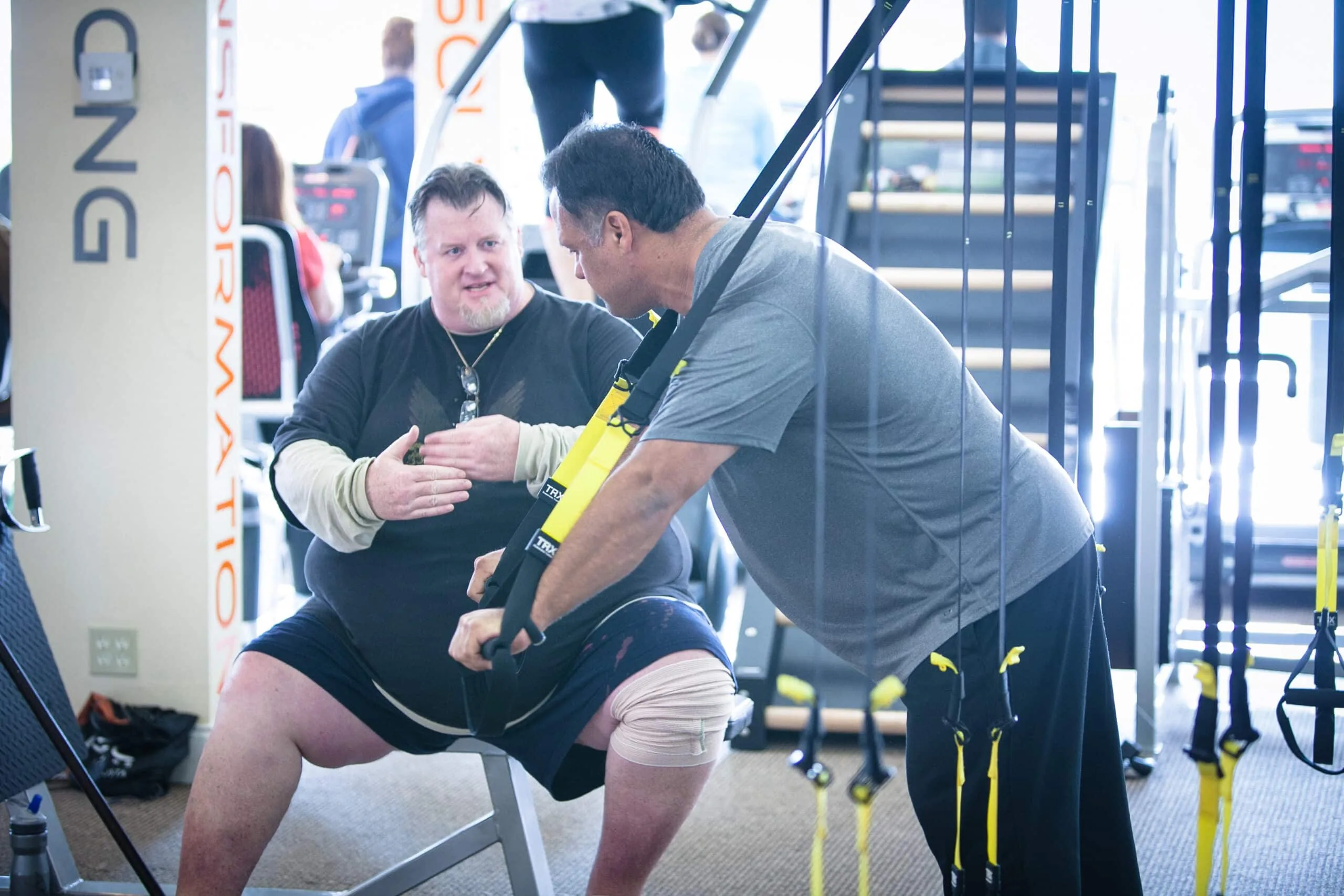
For adults with knee limitations, PFC offers:
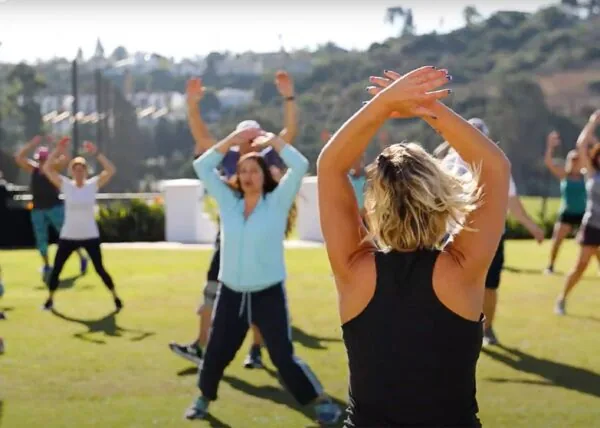
Kerri, who came to PFC managing complications from Type 1 Diabetes and significant deconditioning, described her experience this way:
“I immediately discovered little things starting to happen, like tying my shoes easier, breathing better, my posture had improved, I was standing taller. The confidence that came with all of those little wins had me realize it wasn’t so much about losing weight but what I was gaining. Strength, energy, a sense of fun. The trainers with their guidance and support have worked miracles on me.”
Kerri lost 31 lbs and rebuilt the functional strength and confidence that deconditioning had taken from her. That outcome reflects what PFC is designed to deliver for adults who are out of shape with knees that have been holding them back.

A UCSD case study of PFC participants who stayed four or more weeks found that 94% of total weight loss was purely fat, compared to the 60/40 fat-to-muscle ratio typical of standard dieting programs. Lean muscle mass was preserved or increased, protecting the metabolic rate that makes long-term results sustainable.
The table below compares what a self-directed home plan can realistically deliver against what structured, supervised coaching at PFC provides.
| Attribute | Starting At Home With The 4-Week Plan | Premier Fitness Camp |
|---|---|---|
| Supervision And Coaching | Self-directed, with no real-time feedback on form or progression | 3–4:1 client-to-trainer ratio in all fitness sessions, with certified trainers providing real-time correction and progression |
| Personalization For Knee Limitations | Generic program, and modifications depend on the individual’s own knowledge of their limits | Comprehensive health assessment on day one, with low-impact modifications available for every class, tailored to each client’s fitness level and physical limitations |
| Accountability And Follow-Up | Self-accountability only, with no structured check-ins or progress tracking | Weekly report card across 17 data points, one-on-one review with a trainer, post-camp virtual coaching, and ongoing staff communication |
Many people with a history of knee replacement can perform low-impact strengthening and cardio, but the exact plan needs to match the surgeon’s and physical therapist’s guidance. Emphasize pain-free range of motion, controlled tempo, and gradual progression. Always clear new exercises with your medical team if you have had joint replacement surgery.
Yes, many adults use this style of program alongside formal physical therapy. Coordinate with your therapist so exercise volume and intensity stay within your current tolerance. Share your home plan, including sets, reps, and cardio duration, so your therapist can adjust it to match your goals and medical history.
Missing a week does not erase your progress, but it does reduce your current capacity. Restart at the previous week’s volume or slightly below, then build back up over one to two weeks. Avoid jumping straight to where you left off if pain or fatigue feels higher than usual.
The real barrier is the deconditioning cycle, where weaker muscles lead to more joint stress, more pain leads to less movement, and less movement leads to more weakness. That cycle is reversible, and the reversal begins with strength-first, low-impact movement guided by clear stop rules.
The 4-week plan in this article gives you a structured, evidence-based starting point. Use the pain-vs-effort framework to distinguish muscle work from joint warning signs. Build the hips, glutes, and thighs that support your knees. Progress gradually, track meaningful functional wins, and give the process the 8 to 12 weeks it needs to produce real change.
For adults who need more than a home plan can provide, Premier Fitness Camp (PFC) offers expert-led coaching, personalized modifications, behavioral health support, and an immersive environment designed for lasting transformation. With over 1,200 reviews and a 90%+ five-star rating, PFC has helped more than 3,000 adults rebuild their health from exactly where you are now.
Start Your Strength-First Program At PFC