 5-star Wellness Resort
 5-star Wellness Resort
Written by: Chris Butt, Certified Personal Trainer & Weight Loss Coach, Premier Fitness Camp
Boot camp workouts build muscle when they follow clear hypertrophy principles. Effective programs create the right training stress and then repeat it with smart progression. Muscle hypertrophy relies on three main stimuli: mechanical tension, metabolic stress, and muscle damage. Well-designed boot camp programming can deliver all three.
Compound movements like squats, deadlifts, rows, and push-ups sit at the center of muscle-building boot camps. These exercises recruit multiple muscle groups at once, creating strong mechanical tension and improving functional strength. Research demonstrates that compound exercises produce superior muscle activation compared to isolation movements, which makes them ideal for time-efficient group training.
For adults using GLP-1 medications, resistance-focused boot camps become especially valuable. A 2024 review in Diabetes Care concluded that resistance exercise can help optimize body composition changes and preserve lean mass during incretin-based weight loss pharmacotherapy. Without this stimulus, studies show that 20-50% of weight loss from GLP-1 medications comes from lean mass rather than fat.
This muscle loss risk makes the training approach critical. The concurrent training model used in boot camps, which combines resistance and cardiovascular exercise, becomes particularly valuable in this context. While traditional bodybuilding splits isolate muscle groups, boot camp circuits create metabolic stress through shortened rest periods while maintaining the mechanical tension needed for growth. This approach works especially well for adults over 35, who benefit from cardiovascular improvements alongside muscle development.
Effective scaling turns intense boot camp sessions into accessible, confidence-building experiences for every fitness level. Clear options allow beginners and advanced participants to share the same workout while chasing different targets. The goal is to keep the core movement patterns that drive results while adjusting difficulty.
Movement scaling follows a simple path from supported to unsupported versions. For example, push-ups can progress from wall push-ups to incline push-ups on a bench, then to knee push-ups, and finally to full push-ups. Each variation keeps the same basic muscle activation pattern while changing the load to match current strength.
Load modification provides another key scaling tool. Mayo Clinic recommends starting with resistance that fatigues muscles after 12-15 repetitions, then gradually increasing load as strength improves. In boot camp settings, this means offering bodyweight, light resistance, and heavier resistance options for the same exercise.
Time-based scaling keeps the group together while respecting individual capacity. Beginners might work for 30 seconds and rest for 30 seconds. Advanced participants might work for 45 seconds and rest for 15 seconds. Everyone follows the same circuit, but each person trains at an appropriate effort level.
Impact modification protects joint health, especially for adults over 35. Evidence-based programs like the YMCA’s Enhance Fitness combine cardio, strength training, balance work, and stretching to offer safer options for participants with joint concerns. High-impact jumping can shift to step-ups, marching in place, or controlled squats while still challenging muscles.
These eight exercises create a strong foundation for safe, effective muscle-building boot camps. Each one includes clear form cues and three scaling levels to match different abilities.
1. Squat
Form cues: Feet hip-width apart, weight in heels, chest up, knees track over toes.
Beginner: Chair-assisted squats or partial range of motion.
Intermediate: Bodyweight squats to full depth.
Advanced: Goblet squats with weight or jump squats.
2. Push-Up
Form cues: Straight line from head to heels, hands under shoulders, controlled descent.
Beginner: Wall push-ups or incline push-ups on a bench.
Intermediate: Knee push-ups with full range of motion.
Advanced: Full push-ups or elevated feet variations.
3. Deadlift
Form cues: Hinge at the hips, keep a neutral spine, hold weight close to the body.
Beginner: Romanian deadlift with light weight or bodyweight only.
Intermediate: Conventional deadlift with moderate weight.
Advanced: Single-leg deadlifts or higher loads.
4. Row
Form cues: Squeeze shoulder blades, pull elbows back, maintain neutral spine.
Beginner: Resistance band rows or supported bent-over rows.
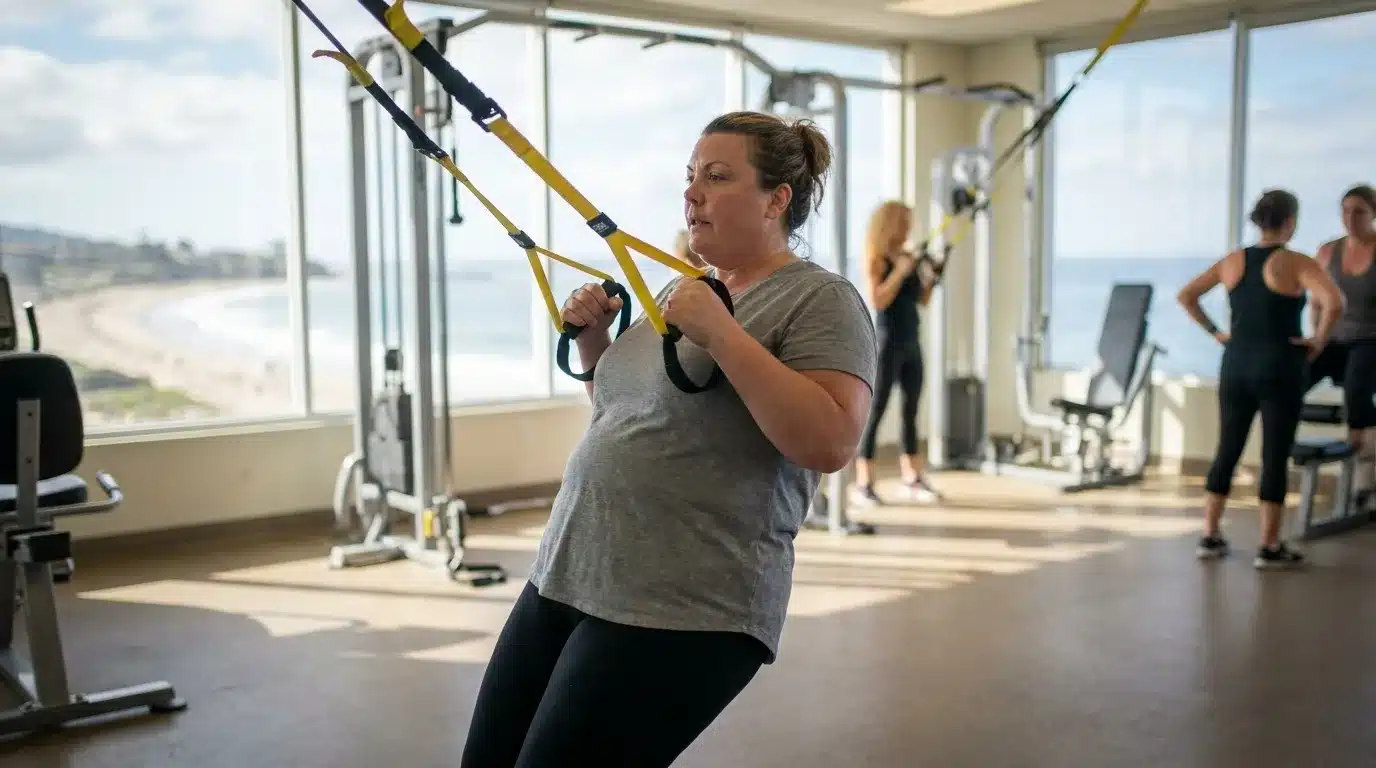
Intermediate: TRX rows or dumbbell rows.
Advanced: Single-arm rows or heavier resistance.
5. Plank
Form cues: Straight line from head to heels, brace the core, breathe steadily.
Beginner: Wall plank or incline plank on a bench.
Intermediate: Knee plank or modified forearm plank.
Advanced: Full plank or dynamic plank variations.
6. Lunge
Form cues: Step forward, lower back knee toward the ground, push through the front heel.
Beginner: Stationary lunges with support or partial range.
Intermediate: Alternating forward lunges.
Advanced: Reverse lunges or lateral lunges.
7. Overhead Press
Form cues: Engage the core, press straight up, avoid arching the back.
Beginner: Seated press or light resistance bands.
Intermediate: Standing press with moderate weight.
Advanced: Single-arm press or heavier loads.
8. Mountain Climber
Form cues: Maintain plank position, alternate knees toward chest, move with control.
Beginner: Slow mountain climbers or step-ups.
Intermediate: Standard pace mountain climbers.
Advanced: Fast mountain climbers or cross-body variations.
This 45-minute workout balances resistance training with controlled cardiovascular stress for muscle building and preservation. The structure supports adults 35–55 and can be scaled for different fitness levels.
Warm-Up (8 minutes)
– Arm circles and leg swings (2 minutes)
– Bodyweight squats (1 minute)
– Push-up to downward dog (2 minutes)
– Walking lunges (2 minutes)
– Plank hold (1 minute)
Main Circuit (30 minutes) – 3 rounds
Perform each exercise for 45 seconds, rest 15 seconds between exercises, and rest 2 minutes between rounds.
Round 1: Lower Body Focus
– Goblet squats
– Romanian deadlifts
– Reverse lunges
– Single-leg glute bridges
– Calf raises
Round 2: Upper Body Focus
– Push-ups (scaled appropriately)
– TRX or resistance band rows
– Overhead press
– Tricep dips
– Plank hold
Round 3: Full Body Integration
– Squat to overhead press
– Mountain climbers
– Burpees (modified as needed)
– Russian twists
– Bear crawl
Cool-Down (7 minutes)
– Walking in place (2 minutes)
– Static stretching for hamstrings, quadriceps, chest, and shoulders (5 minutes)
This circuit structure allows simple scaling while keeping the intensity needed for muscle building. Book a free consultation to see how Premier Fitness Camp adapts this framework to your goals, fitness level, and medical needs.
Progressive overload drives long-term muscle gains. A clear plan gradually increases training demands while protecting recovery and form quality.
| Week | Focus | Volume Increase | Recovery Emphasis |
|---|---|---|---|
| 1-2 | Movement mastery and base building | 3 sessions, 30-35 minutes each | 48-hour rest between sessions, daily mobility work |
| 3-4 | Intensity introduction | 4 sessions, 35-40 minutes each | Active recovery days, foam rolling, adequate sleep |
| 5-6 | Load progression and conditioning | 4-5 sessions, 40-45 minutes each | Deload week 6, massage therapy, stress management |
Mayo Clinic recommends training major muscle groups at least twice per week with full rest days between sessions for optimal recovery and growth. This progression follows those guidelines while steadily building capacity.
Recovery protocols grow more important as intensity rises. Military fitness protocols recommend 3-5 minutes of light locomotion and controlled breathing for cool-down, followed by soft-tissue work and static stretching. These evidence-based practices fit naturally into boot camp sessions.
As training intensity increases through the progression phases, form breakdown becomes more likely under fatigue. Common form mistakes include knee valgus during squats, forward head posture during rows, and excessive lumbar extension during overhead movements. Instructors should establish clear form criteria and stop participants when technique deteriorates. This approach prevents injury and protects the training quality needed for continued progress.
Adults over 35 need programming that respects joint health, hormonal shifts, and changing recovery capacity. Thoughtful design keeps training productive instead of punishing.
Joint health preservation starts with smart exercise selection and gradual progression. Evidence-based programs emphasize controlled functional movement and gradual progression instead of constant high-impact drills that stress joints. Low-impact choices like step-ups instead of box jumps, or controlled squats instead of jump squats, deliver similar muscle-building benefits with less injury risk.
For adults using GLP-1 medications, muscle retention becomes a top priority. Research suggests that concurrent physical activity, especially resistance training, can help limit muscle loss during weight reduction therapy with incretin-mimetic drugs. Research shows that consistent resistance training preserves the majority of muscle mass during weight loss when combined with adequate protein intake.
Protein needs rise significantly for this group. Recommended protein intake for adults taking GLP-1 medications is 1.2–1.6 grams per kilogram of goal body weight daily, with a practical target of 20-30 grams per meal. This higher intake supports muscle protein synthesis and recovery from resistance training.
Most adults do best with 3-4 boot camp sessions per week, which allows enough recovery between hard efforts. Military fitness guidelines recommend resting up to two days before testing, or up to five days for those over 40, which highlights the increased recovery needs of older adults.
Premier Fitness Camp offers a highly supportive environment for adults who want safe, effective boot camp training. The program brings together expert coaching, nutrition, psychology, and recovery in one place.
The 3-4:1 client-to-trainer ratio allows for personalized attention that typical group classes cannot match. All trainers hold at least bachelor’s degrees, and many have master’s degrees in exercise science or related fields. This education allows them to modify exercises in real time, monitor form closely, and progress clients safely through the methods described in this article.
PFC’s “Think, Eat, Move” philosophy addresses the full picture required for lasting change. Licensed psychologists help clients understand emotional eating triggers. Registered dietitians design meals that support muscle building and recovery. Wellness chefs prepare fresh, protein-rich meals that match the elevated nutritional needs of adults focused on body composition.
The luxury resort setting adds recovery tools that enhance training results. The La Costa Spa offers massage therapy, which research shows can improve muscle recovery and reduce inflammation. The mild Southern California climate supports year-round outdoor training, from beach boot camps to hikes in nearby Torrey Pines.
PFC’s UCSD-validated results show how well this approach works. The 94% pure fat loss rate achieved by participants demonstrates that properly implemented boot camp training preserves and builds muscle while promoting fat loss, which matches the needs of adults over 35 and GLP-1 users.
Book a free consultation to see how Premier Fitness Camp can tailor these proven methods to your goals, health history, and schedule.
You can build muscle while using GLP-1 medications like Ozempic or Wegovy when you pair them with resistance training and enough protein. Research cited earlier in this article shows that without resistance training, a significant portion of weight loss comes from muscle rather than fat, reflecting the 20-50% lean mass loss range. When you follow a structured strength program and consume 1.2–1.6 grams of protein per kilogram of goal body weight daily, you can preserve and even build muscle while losing fat. The mechanical stimulus from resistance training tells your body to hold on to muscle tissue.
Adults 35-55 generally progress best with 3-4 boot camp sessions per week, with at least one full rest day between sessions that target the same muscle groups. This schedule provides enough recovery time, which becomes more important with age. Muscle growth happens during recovery, not during the workout itself, so returning too quickly can slow progress. Many successful clients follow a Monday-Wednesday-Friday pattern or a Tuesday-Thursday-Saturday pattern, then use other days for light activity such as walking or gentle stretching.
Well-designed boot camp workouts focus on form, gradual overload, and built-in recovery, which many high-intensity programs overlook. Key differences include mandatory form checks during sessions, scaling options for every exercise, and progression plans that extend duration before raising intensity. Quality boot camps also emphasize compound movements that build functional strength instead of chasing calorie burn alone. Strong programs include warm-up and cool-down routines, watch for fatigue-related form breakdown, and offer low-impact alternatives for participants with joint concerns.
Progress often shows up in performance and body composition before it appears on the scale. Useful signs include lifting heavier weights, performing more repetitions, finishing workouts with less fatigue, and noticing clothes fit differently at the same body weight. You may also feel daily tasks become easier and see improvements in health markers like blood pressure, cholesterol, and blood sugar. Many clients track body measurements, progress photos, and workout performance to capture changes that the scale misses.
Nutrition strongly influences muscle building and recovery. Aim for 20-30 grams of protein at each meal, with higher amounts if you use GLP-1 medications. Include complex carbohydrates to fuel training and recovery, and include healthy fats to support hormone production. Try to eat a protein-rich meal or snack within two hours after training to support muscle protein synthesis. Stay well hydrated, because even mild dehydration can reduce performance and slow recovery. Avoid extreme calorie cuts, which can undermine muscle building even when your training is consistent.
Boot camp workouts offer a powerful way to build muscle safely when they follow clear progression, prioritize form, and respect recovery. Adults 35-55, including those using GLP-1 medications, benefit from programs that combine compound movements, structured overload, and comprehensive support.
Evidence shows that properly structured boot camp training preserves and builds lean muscle while promoting fat loss, protects joint health through controlled movement patterns, and delivers the metabolic benefits needed for long-term success. The crucial step is choosing a program that values education, individualization, and sustainability over short bursts of intensity.
Premier Fitness Camp has refined this model through years of practice and scientific validation. The program addresses training, nutrition, and psychology together, which supports lasting transformation instead of short-term change.
Book a free consultation today to discuss your goals and learn how Premier Fitness Camp can help you build muscle safely while creating the long-term results you want.