 5-star Wellness Resort
 5-star Wellness Resort
Written by: Chris Butt, Certified Personal Trainer & Weight Loss Coach, Premier Fitness Camp
High-impact exercise like running, jumping, and plyometrics loads the knee with multiples of body weight per step. Low-impact cardio still burns meaningful calories while keeping that load lower and more controlled. Strengthening the muscles around the knee, including the quadriceps, glutes, and hamstrings, also reduces pain over time. These periarticular muscles act as dynamic shock absorbers, improving joint stability and reducing compressive force on the medial compartment.
Weight loss compounds this benefit. Biomechanical research by Messier et al. (2005) found that each pound of body weight lost is associated with roughly a four-fold reduction in knee joint load per step during daily activity. A 2026 scoping review in the South African Journal of Physiotherapy reported that a modest 5–10% reduction in body weight can significantly decrease pain and improve physical function in overweight or obese individuals with osteoarthritis. A modest caloric deficit, built through nutrition, drives that weight loss. PFC’s nutrition and joint-pain content explains how to structure your eating to support these goals.
The CDC’s Physical Activity Guidelines For Americans, 2nd Edition, recommend at least 150 minutes per week of moderate-intensity aerobic activity plus two days per week of muscle-strengthening exercise for adults with arthritis. The American Academy Of Orthopaedic Surgeons (AAOS) 2021 Clinical Practice Guideline gives a strong recommendation to supervised exercise, including strengthening, home exercise, and aquatic exercise, over inactivity. The progression plan below moves you toward that 150-minute benchmark in a controlled way.
Each option below includes the joint-mechanics reason it works well for painful or arthritic knees.
These movements build the muscles that protect the knee joint. They require no equipment, avoid deep knee bends, and scale to any starting fitness level, including for people who are significantly overweight.
One rule guides the entire plan: progress volume before intensity. That means adding time or repetitions first, adding resistance only after those targets are met, and avoiding added impact.
Home Track Options (No Equipment Needed): Chair sit-to-stands, wall sits within a pain-free range, walking on flat terrain, glute bridges, straight-leg raises, and hip abductions on the floor.
Gym/Pool Track Options: Stationary bike, elliptical, rowing machine, pool walking, water aerobics, and supervised aquatic exercise.
Weeks 1–2 — Foundation: Train three days per week with 10–15 minutes of low-impact cardio such as walking, stationary biking, or pool work. Complete two strength sessions per week using the exercises above, performing one set of 10 repetitions each. Focus on building the habit and confirming that the chosen movements do not provoke sharp or worsening pain.
Weeks 3–4 — Build: Move to four days per week of 20–25 minutes of low-impact cardio. Complete three strength sessions per week and progress to two sets of 12–15 repetitions. Volume increases while knee load stays controlled. When sit-to-stands feel manageable, add a second set instead of adding weight.
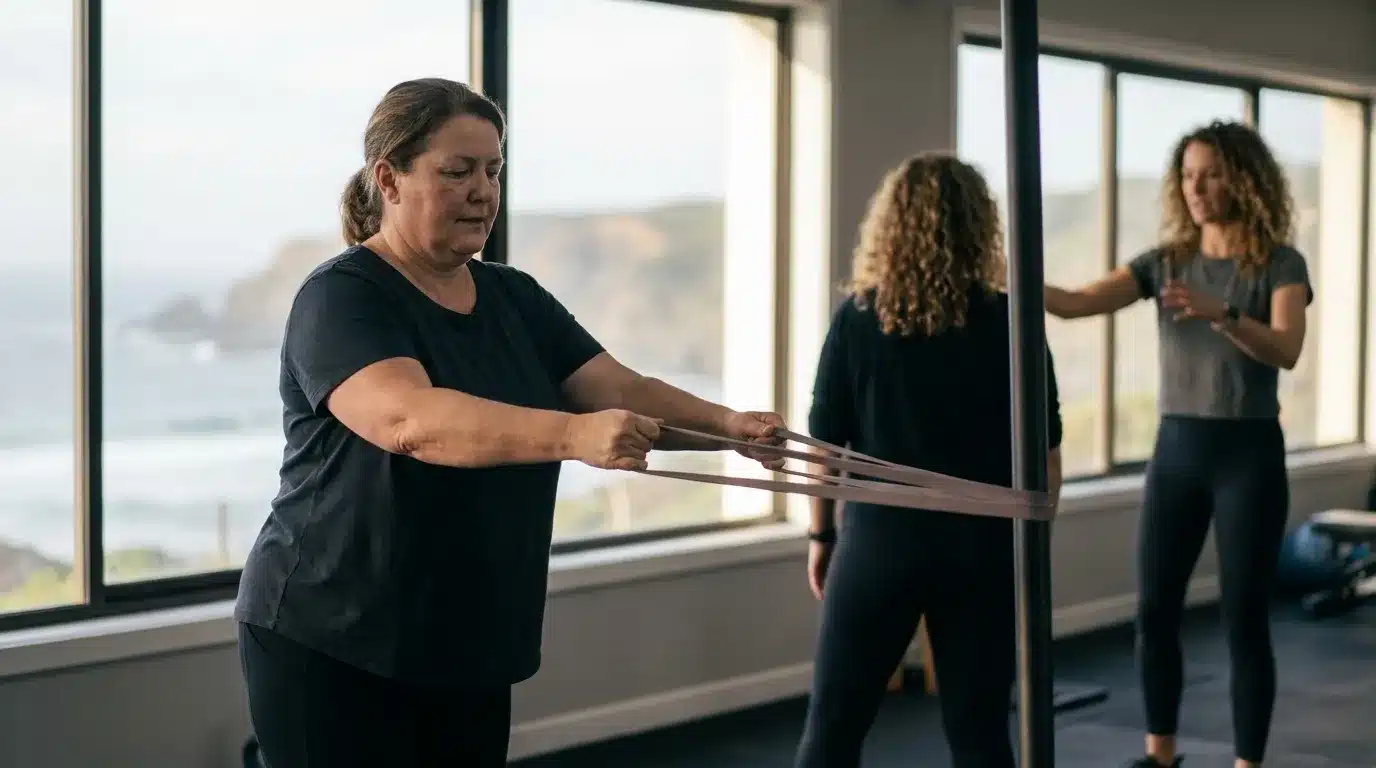
Weeks 5–8 — Consolidate: Work toward the CDC’s 150-minute weekly moderate-activity benchmark by extending cardio sessions to 30 minutes and maintaining three strength sessions per week. Introduce resistance such as light ankle weights or resistance bands only after you consistently meet volume targets without pain. A 2026 prospective study of a structured eight-week home-based knee OA program found that participants improved their six-minute walk distance by 12.1% over eight weeks with no dropouts and no significant pain exacerbation, which shows that this timeline is realistic for deconditioned beginners.
Mild stiffness or muscle fatigue that eases within the first few minutes of movement suggests that gentle exercise is appropriate. Sharp, stabbing, or worsening joint pain, visible swelling, or a feeling of instability signals the need to stop and consult a clinician.
The practical decision rule is simple. Exercise is generally appropriate when joint pain following activity resolves within two hours of stopping and no acute joint swelling is present. Modify or stop when pain during activity exceeds 5 out of 10 on a numeric scale and does not resolve, or when visible swelling increases after a session. A dull ache that appears in the first few minutes of movement but consistently improves as you warm up is generally safe to work through at reduced intensity, provided the ache does not exceed 3 out of 10 during activity and returns to baseline within an hour of finishing. Mild muscle fatigue is expected. Sharp or worsening joint pain, swelling, or instability still means stop and consult a clinician.
The most common self-sabotage pattern involves doing too much too soon or pushing through sharp pain because of a “no pain, no gain” mindset. Enthusiasm often runs high at the start, and a deconditioned body can initially tolerate more than it can sustain. Training through genuine joint pain, especially sharp, localized pain or any locking or giving way, can accelerate cartilage damage and turn a manageable early-stage problem into a surgical one. The fix stays straightforward. Start at the bottom of the progression plan above, increase volume before intensity, and apply the stop rule consistently. Most overuse injuries occur when load increases faster than tissue can adapt. The week-by-week structure above is designed specifically to prevent that pattern.
The following movements are simply wrong for this starting point and can be revisited later once strength and joint tolerance improve.
This session works at home, in a gym, or in a pool. Substitute pool walking or water aerobics for the cardio block if a pool is available.
This sample session gives you a solid starting script. Some knees, however, need closer supervision and a more structured environment to keep progress steady and safe.
A home plan creates momentum, and personalized, expert-led programming can accelerate results while reducing the risk of doing too much too soon. Premier Fitness Camp (PFC) is built for people who want that level of structure and support.
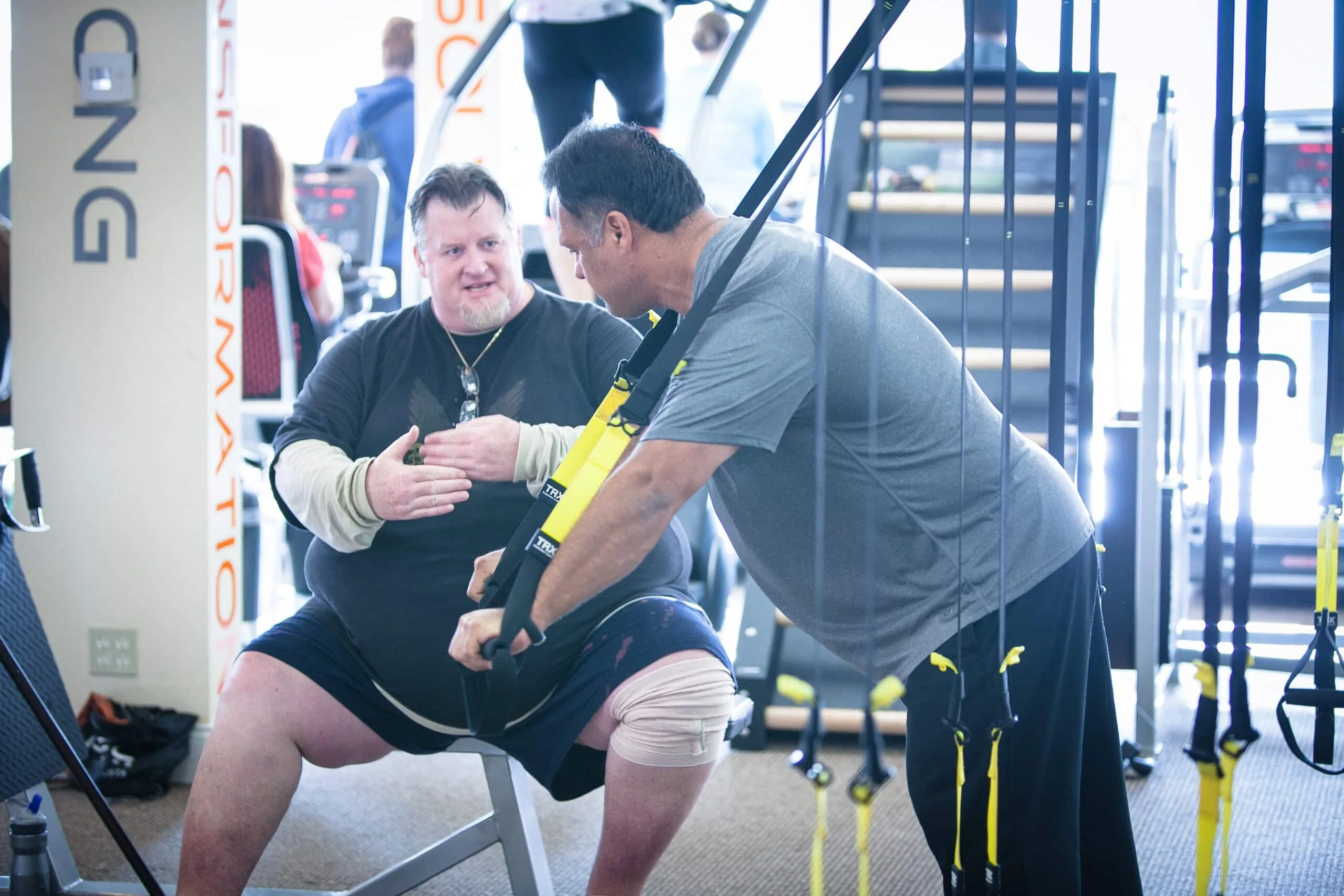
Every class at PFC adapts to every fitness level, from 400-pound beginners who can only walk 250 feet to seasoned athletes. Low-impact options and a dedicated low-impact training track stay available throughout the program. A 3–4:1 client-to-trainer ratio keeps coaching personal, and all trainers hold at least a bachelor’s degree, with some holding master’s degrees. On day one, every client receives a comprehensive health assessment. Seventeen data points are then tracked weekly in a personalized Report Card. These include weight, body fat, and measurements of the neck, waist, umbilicus, upper arm, chest, hip, and quad. They also include blood pressure, mile time, plank hold, push-ups, and LDL, HDL, triglycerides, and glucose levels. Progress becomes visible far beyond the scale.
A UCSD case study found that 94% of client weight loss at PFC was purely fat, while lean muscle was preserved or increased. This outcome matters for knee health, since muscle supports and unloads the joint. Many standard dieting programs produce only a 60/40 fat-to-muscle loss ratio. Substantial weight loss that costs lean mass can worsen quadriceps weakness, balance, and walking capacity. PFC’s approach is designed to avoid that problem.
PFC operates at the Omni La Costa Resort & Spa in Carlsbad, California. The location offers year-round moderate temperatures, on-site pool and gym facilities, and outdoor options including beach workouts and flat-terrain coastal hiking. PFC’s “Think, Eat, Move” philosophy integrates behavioral health coaching and nutrition education alongside movement. Clients leave with a clear understanding of how to sustain their results, not just how to follow a plan while someone is watching.
More than 1,200 reviews, a 90%+ five-star rating, and a 50% alumni return rate show how many people stay engaged with PFC’s approach. If you are ready to build a plan around your knees, talk to a knee-friendly program specialist by calling (888) 488-8936 or schedule your consultation online.

Protecting your knees and losing weight can happen at the same time when you follow a progressive, low-impact plan. Low-impact cardio plus knee-safe strength work, advanced by time and repetitions before resistance and never by added impact, allows weight loss and joint protection to move together. The eight-week framework above gives you a concrete starting point, at home or in a gym or pool, with clear rules for when to push and when to stop.
If you want guided support, you can work with the PFC team to tailor this approach to your knees, schedule, and goals. Call (888) 488-8936 or book your consultation online to explore a personalized plan.