 5-star Wellness Resort
 5-star Wellness Resort
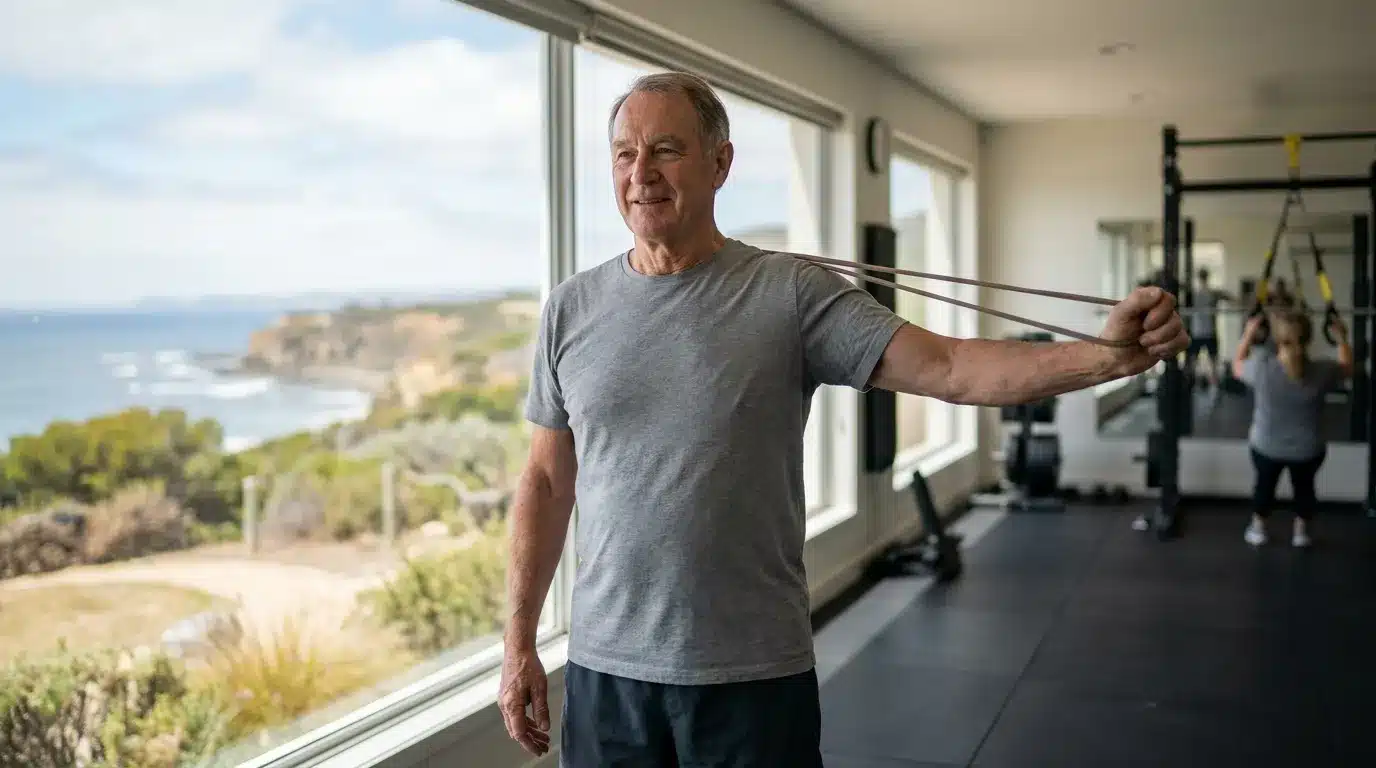
Written by: Chris Butt, Certified Personal Trainer & Weight Loss Coach, Premier Fitness Camp
Get a free consultation with a PFC coach.
Every durable fitness routine for an older adult rests on four types of movement. The National Institute on Aging identifies four types of exercise — endurance (aerobic), strength, balance, and flexibility as the framework for maintaining health and physical ability as you age, and some NIA materials also highlight a three-type combination of aerobic, muscle-strengthening, and balance activities.
Aerobic activity is any sustained movement that raises your heart rate and breathing, and brisk walking is the most accessible example. The CDC Recommends At Least 150 Minutes Of Moderate-Intensity Aerobic Activity Per Week for adults, which works out to 30 minutes on five days. Moderate intensity means you can speak in full sentences but cannot sing, which gives you a simple gauge with no equipment.
Strength training preserves the muscle mass that naturally declines with age, supports bone density, and makes everyday tasks such as rising from a chair or carrying groceries easier and safer. Sit-to-stands from a sturdy chair and wall push-ups are effective starting points that require no gym. The National Institute On Aging Recommends Strength Exercises For All Major Muscle Groups On Two Or More Days Per Week, with at least one rest day between sessions.
Balance training directly reduces fall risk. The CDC Reports That More Than One In Four Adults Aged 65 And Older Falls Each Year, and falling once doubles the chance of falling again. Single-leg holds near a counter or heel-to-toe walking down a hallway are practical starting points. The National Institute On Aging Recommends Approximately Three Balance Sessions Per Week, practiced near a sturdy chair or wall for support.
Flexibility work maintains the range of motion that keeps daily movement comfortable. Shoulder rolls, hip circles, and seated hamstring stretches are representative examples. The University Of Missouri Extension’s Myactivity Pyramid For Adults 65+, Based On The 2018 Physical Activity Guidelines For Americans, Recommends At Least 10 Minutes Per Day Of Stretching Exercises to increase range of motion and flexibility, performed after muscles are warm.
This schedule suits a retiree with mild joint stiffness who is cleared for exercise but new to structured training. All aerobic sessions use brisk walking as the default. Substitute swimming or stationary cycling if knees are sensitive. Physical Activity Does Not Have To Be Done In One Block — Adding Shorter Sessions Throughout The Day Still Produces Health Benefits.
| Day | Activity | Duration |
|---|---|---|
| Monday | Brisk walk + 5-min stretch cool-down | 30 min |
| Tuesday | Strength (sit-to-stands, wall push-ups, seated rows with band) + balance (heel-to-toe walk) | 30 min |
| Wednesday | Brisk walk (can be split into two 15-min walks) | 30 min |
| Thursday | Strength (step-ups, standing hip abduction, calf raises) + single-leg holds | 30 min |
| Friday | Brisk walk + shoulder and hip stretches | 30 min |
| Saturday | Leisure activity: swimming, gardening, or a longer walk at easy pace | 30–45 min |
| Sunday | Rest or gentle movement (slow walk, light stretching) | 10–15 min |
The OHSU Sample Exercise Plans present weekly options designed to achieve the goal of at least 150 minutes of aerobic exercise plus resistance training at least twice per week, meeting both the CDC’s Aerobic Guideline and the NIA’s Strength Recommendation, with balance work embedded on Tuesday and Thursday.
See how this schedule works in a resort setting.
Safe progression follows a simple principle: add one variable at a time, such as time, repetitions, or resistance, and avoid changing all three at once.
Weeks 1–4: Establish The Habit. Follow the sample week above exactly as written. The goal is consistency, not intensity. If 30-minute walks feel long, start at 15–20 minutes and build. Complete every scheduled session even if the effort feels easy. The habit itself becomes the first adaptation.
Weeks 5–8: Add Volume. Extend aerobic sessions by five minutes each week until you reach 40–45 minutes on walking days. Once that feels manageable, add a second set to each strength exercise. Apply the same principle to balance by introducing a third session on Wednesday, even if it is only five minutes of heel-to-toe walking and single-leg holds at the kitchen counter.
Weeks 9–12: Add Resistance And Challenge. Progress strength exercises by adding light resistance such as a resistance band, a pair of light dumbbells, or a weighted vest. Replace wall push-ups with incline push-ups on a sturdy table. Progress balance from two-hand support to one-hand, then fingertip contact only. On aerobic days, introduce two to three minutes of brisker-than-usual pace followed by two to three minutes at your normal pace. This simple interval pattern Japanese Interval-Walking Research Associates With Greater Improvements In Aerobic Fitness And Blood Pressure Than Steady-Paced Walking Alone. Because walking is the backbone of the sample week, the next section answers common walking questions for retirees.
For adults aged 60 and older, Walking 6,000 To 9,000 Steps Daily Is Associated With A 40–50% Lower Risk Of Heart Attack And Stroke, based on a 2022 Northwestern University study tracking more than 20,000 participants. That range offers a long-term goal rather than a starting point. A practical daily target for a newly active 70-year-old is 5,000–6,000 steps, building toward 7,000–8,000 over 12 weeks. Every Additional 1,000 Steps Added To A Sedentary Baseline Reduces Cardiovascular Risk By Approximately 15%, so early increases deliver meaningful gains.
Both duration and pace matter, and pace carries independent weight. Brisk Walking Provides Greater Cardiovascular Benefit Than Slow Strolling At The same Step Count. The practical gauge is the talk test, where you can speak in full sentences but not sing, at roughly 3 to 4 miles per hour. For retirees just starting out, prioritizing duration over speed creates a safer entry point. Once 30 minutes feels comfortable, adding two to three minutes of brisker pace within each walk increases the cardiovascular stimulus without extending total time.
For most cardiometabolic outcomes, accumulated walking time matches a single continuous session. A 2026 Systematic Review And Meta-Analysis In Frontiers In Physiology Analyzing 35 Studies Found That When Total Exercise Load Is Matched, Accumulated Exercise And Continuous Exercise Produce Statistically Equivalent Long-Term Effects On Body Fat, Waist Circumference, Total Cholesterol, And Triglycerides. The American Heart Association notes that bouts as short as 10 minutes count toward the weekly total. Two 15-minute walks on a busy day are a legitimate strategy, and they also break up prolonged sitting, which carries its own cardiovascular risk.
The full sample week above requires no gym membership and no equipment beyond a sturdy chair and a resistance band, which remains optional in weeks 1–8. A printable version of the weekly schedule table above can serve as a simple daily reference.
Several free resources support retirees building home-based routines. SilverSneakers offers on-demand fitness classes designed for older adults, available through many Medicare Advantage plans. The NIA’s Go4Life campaign resources include exercise guides such as the 120-page “Exercise & Physical Activity: Your Everyday Guide,” videos such as the “Everyday Exercises” DVD, and a sample workout titled “Workout to Go: A Sample Exercise Routine,” all designed for older adults. Local senior centers frequently offer free or low-cost group fitness classes. Area Agencies On Aging Programs Are Available On A Pay-What-You-Can Basis For Adults Aged 60 And Older. Group settings also address one of the strongest predictors of long-term adherence. A 7-Year Cohort Study Published In Frontiers In Public Health Found That Supervised Small-Group Training Produced A 51.7% 12-Month Retention Rate, far exceeding the 3–6 month average in conventional gym settings.
Travel. Hotel rooms support the full strength routine with no equipment. Sit-to-stands from the bed edge, wall push-ups, single-leg holds, and calf raises require only floor space. Walking is available in virtually every location. Aim to maintain at least two sessions per week while traveling rather than suspending the routine entirely.
Illness. Rest during fever or active infection. Return with the previous week’s volume, not the week you left off, and rebuild over five to seven days. Sports Cardiologist Dr. J. Sawalla Guseh At Mass General Brigham Advises Skipping Strenuous Exercise During Respiratory Infections and resuming gradually.
Joint Flare-Ups. During An Arthritis Flare, Reduce Range Of Motion, Perform Fewer Repetitions, Remove Added Resistance, Replace Standing Exercises With Seated Options, And Divide Walking Into Shorter Sessions. A joint that is substantially swollen, hot, or red warrants medical evaluation rather than a modified workout. The University Of Maryland Medical System Notes That For Most People With Osteoarthritis, Regular Movement Reduces Stiffness And Strengthens Supporting Muscles. The goal is gradual adaptation.
Motivation Dips At Week Three. Dropout from new exercise routines most commonly clusters in the early weeks, with the second and third weeks identified as the highest-risk window. In the STRRIDE randomized trials, approximately two-thirds (66%) of participants who dropped out did so before intervention month 1, during baseline, run-in, or ramp periods. The São Paulo Cohort Study Identified The First Three Months As The Critical Period For Habit Consolidation. When motivation drops, shorten the session. A 10-minute walk still counts and preserves the behavioral chain. Skipping entirely is the pattern that reliably ends a routine. Anchor workouts to an existing daily cue such as after morning coffee, before the evening news, or immediately after lunch.
Most adults with a doctor’s clearance can begin the sample week above without additional evaluation. The National Institute On Aging Recommends Speaking With Your Doctor Before Beginning Any New Exercise Program If You Have Heart Concerns, High Blood Pressure, Diabetes, Or Have Been Sedentary For Some Time.
Specific modifications by condition:
Stop exercising and seek appropriate care if you experience Chest Pressure Or Pain, Faintness, Sudden Severe Dizziness, Unusual Shortness Of Breath, Loss Of Coordination, New Weakness Or Numbness, Or Sharp Or Rapidly Worsening Pain. If you prefer to manage these safety considerations with expert supervision instead of alone, a structured program can help.
A self-directed routine built from this guide gives you a solid foundation. Retirees who want expert-led structure, data-driven accountability, and an immersive environment that removes logistical obstacles often benefit from a residential program such as Premier Fitness Camp (PFC).

PFC operates at the Omni La Costa Resort & Spa in Carlsbad, California, a 450-acre property in North San Diego County with year-round moderate temperatures and low humidity. Outdoor training options include beach workouts on the Pacific coast and hikes through Torrey Pines. The program follows a “Think, Eat, Move” philosophy that addresses the whole person. Licensed psychologists and behavioral health coaches, registered dietitians and wellness chefs preparing farm-to-fork meals on-site, and certified trainers with bachelor’s and master’s degrees work together on one campus.
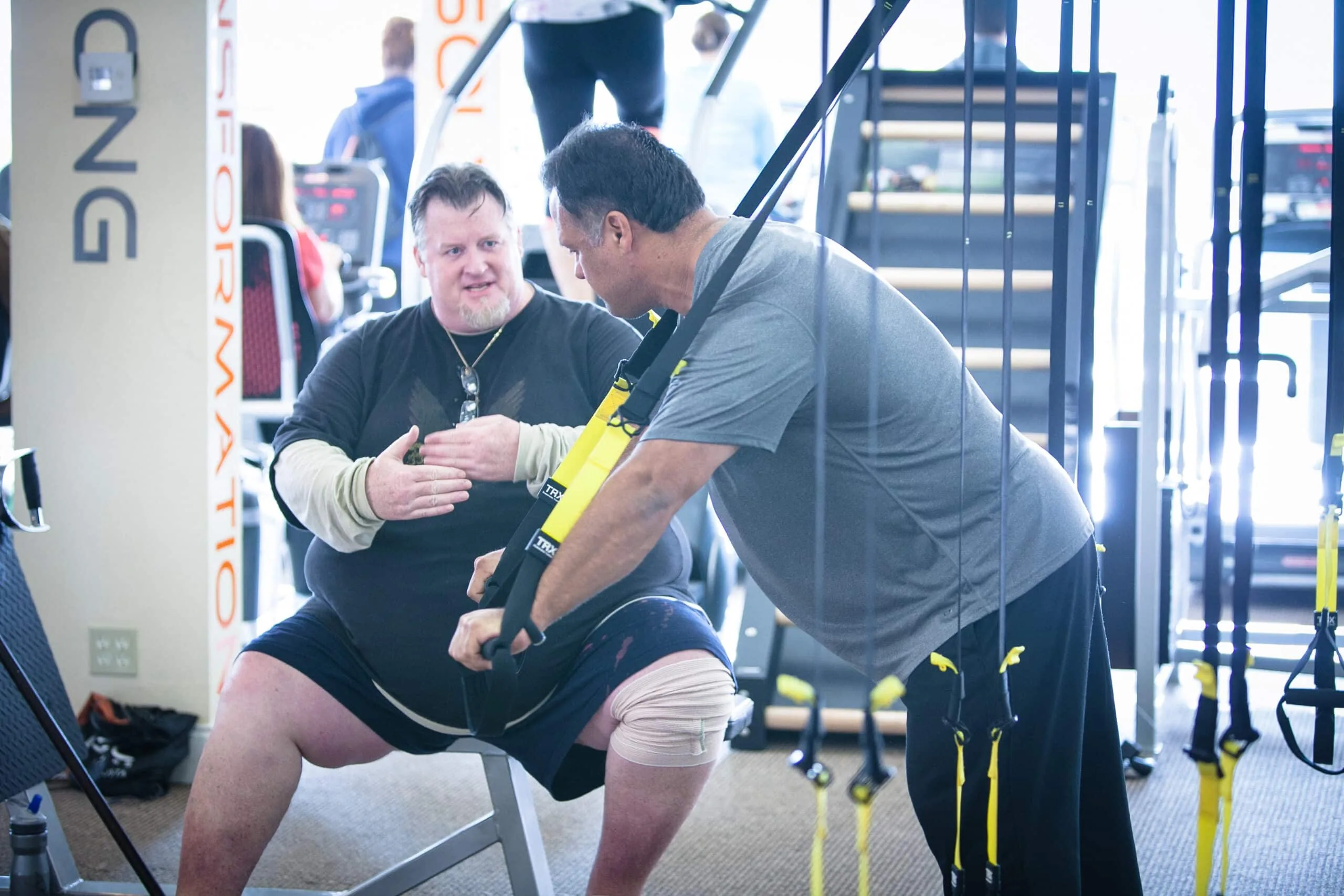
The training structure runs 4–5 hours per day Monday through Friday, with a half day Saturday, at a 3–4:1 client-to-trainer ratio. Every class is structured so that participants from 400-pound beginners to seasoned athletes can participate and benefit. This format directly addresses the fear of not keeping up that many retirees carry into a new program. Low-impact modifications are available for every exercise.
Progress is tracked across 17 data points weekly via a personalized report card. These include weight, body fat, measurements of neck, waist, umbilicus, upper arm, chest, hip, and quad, blood pressure (systolic and diastolic), mile time, plank hold time, push-up count, and LDL, HDL, triglycerides, and glucose levels. A case study conducted in partnership with the University of California, San Diego (UCSD) found that 94% of client weight loss at PFC was purely fat, compared to the 60/40 fat-to-muscle ratio typical of standard dieting, with lean muscle mass preserved or increased and metabolic rate protected.
PFC differs from traditional gyms, online fitness apps, and wellness resorts in four ways: an immersive all-inclusive structure, an on-site expert team, a behavioral health component, and a luxury resort setting. Together they support lasting change instead of a short-lived result. With over 1,200 reviews and a 90%+ five-star rating, and 50% of annual revenue coming from returning alumni, the long-term outcomes show strong client satisfaction.

Talk to our team about your goals.
A 70-year-old benefits most from a daily combination of movement types rather than one activity alone. On most days, 20–30 minutes of moderate aerobic activity such as brisk walking supports cardiovascular health. Two days per week, replace or supplement the walk with a 20–30 minute strength session targeting legs, hips, back, and arms. Weave three to five minutes of balance practice such as single-leg holds or heel-to-toe walking into two or three days, and finish each session with five to ten minutes of gentle stretching. Rest or very light movement one day per week supports recovery.
The 3-3-3 rule is an informal term, not an official medical guideline, and it appears in two distinct ways. In the context of interval walking, which has the strongest evidence, it refers to alternating three minutes of brisk walking with three minutes of easy walking, repeated for up to 30 minutes. Japanese research on this pattern found that participants who practiced it at least four days per week for several months improved aerobic fitness, leg strength, and blood pressure more than those who walked at a steady pace. A second, less common use applies the 3-3-3 label to a general weekly structure of three days of cardio, three days of strength, and three rest or active-recovery days. Neither version has a single authoritative source, but the interval-walking interpretation offers the clearest research support for older adults and provides a practical way to increase walking intensity without adding time.
The following ten movements address strength, balance, aerobic fitness, and mobility, which are the four building blocks every retiree’s routine needs. Start with one set of the listed repetitions and progress gradually.
As noted in the walking section, 6,000–9,000 steps per day is the evidence-backed range for cardiovascular benefit in older adults. A newly active 70-year-old should begin at their current baseline and add approximately 500–1,000 steps every one to two weeks. The 10,000-step target originated as a marketing concept rather than a clinical recommendation. For most adults over 60, the cardiovascular benefit curve begins to flatten at approximately 8,000 steps/day, with 6,000–9,000 steps/day associated with 40%–50% lower CVD risk versus 2,000 steps/day, while benefits continue to increase gradually beyond that range.
The most durable fitness routine for a retiree is the one that gets done consistently, even when it is modest. The four building blocks, the sample weekly schedule, and the 12-week progression path in this guide give you a complete architecture. Start with the week-one version exactly as written. Add five minutes to your walks in week two. Add a second strength set in week five. By week twelve, you will follow a routine that feels meaningfully more challenging than where you started, and the habit will feel familiar instead of new.
If you want expert-led structure instead of a solo routine, Premier Fitness Camp offers the kind of immersive, data-driven program described above. A free consultation helps you decide whether that level of support fits your goals and timeline.
Start your transformation with a free consult.