 5-star Wellness Resort
 5-star Wellness Resort

Written by: Chris Butt, Certified Personal Trainer & Weight Loss Coach, Premier Fitness Camp
Talk to a PFC advisor about your menopause weight loss goals
Menopause changes the rules of weight management in measurable ways. Visceral adipose tissue increases by approximately 8.2% per year in the two years preceding the final menstrual period, and resting metabolic rate drops by approximately 10% after menopause, so a woman who burned 2,000 calories at rest before menopause may burn only 1,800 afterward. Peer support combined with expert input gives women a place to normalize the experience, share strategies, and stay accountable.
Community solves the isolation problem, but it works alongside medical care rather than instead of it. That distinction matters because menopause weight loss rewards persistence over quick results, and the right group reinforces that reality week after week. The evidence backs this up: a 2019 study in the International Journal of Obesity found that consistent group attendance was the single strongest predictor of long-term weight maintenance, even more than the specific diet followed.
The communities below span free peer forums, moderated platforms, expert-led resources, and tracking tools. As you read through them, notice that each one solves a different problem, such as reassurance, medical credibility, expert nutrition guidance, or daily accountability, so the right choice depends on which gap you need filled first.
See if an immersive program fits your stage
Now that you have seen the range of communities available, it helps to notice what the effective ones share. Across all of these platforms, four strategies surface consistently in member discussions and align with current evidence. These are the ideas worth carrying into any community you join, and they set up the specific challenges women on GLP-1 medications face next.
These are community consensus points, not prescriptions. Individual needs vary, and a registered dietitian or physician should guide any personalized plan.
GLP-1 medications such as Ozempic, Wegovy, and Zepbound now drive some of the most active conversations inside menopause communities. Women discuss starting them, tapering off them, managing side effects, and worrying about what happens to their bodies in the process. This conversation benefits from clear, evidence-based guidance.
The muscle-loss concern is real and well documented. Up to 40% of the weight lost on a GLP-1 medication can come from lean muscle mass rather than fat. For a woman already navigating menopause-related muscle loss, that figure matters. Losing weight where a large share is muscle leaves a woman smaller, weaker, more insulin resistant per pound, and closer to frailty. Community members describe this as feeling “soft” or noticing that their strength has declined even as the scale drops.
The weight-regain risk after stopping is equally significant. A systematic review published in eClinicalMedicine found that patients regained 60% of their lost weight, on average, within 12 months of stopping a GLP-1 medication. Forum threads on tapering rank among the most-read posts in menopause communities, and the anxiety around stopping is widespread.
If you are on a GLP-1, looking to start one, or trying to taper off, the communities listed above, particularly The Menopause Dietitian and the Reddit menopause forums, contain active threads on all three scenarios. Premier Fitness Camp (PFC) works with women on GLP-1s to prioritize resistance training, increase protein intake, and build sustainable habits that support medication-assisted weight loss and protect muscle and bone whether or not a woman continues the medication.
A short evaluative checklist helps separate active, useful groups from dead or misleading ones. Use these criteria when you join or consider joining any community.
Online forums have real limits. Information overload is one of the most common complaints among women who join menopause communities, because the advice is contradictory, the threads are long, and no one can tell you which pieces apply to your specific situation. No forum can assess your body composition, review your bloodwork, or course-correct a plan that fails to work for you.
Adherence also creates a challenge. A 2025 scoping review in Obesity Reviews found that only 61% of participants complete behavioral weight management programs, and adherence typically decreases over time. Self-directed approaches without structured accountability face an even steeper drop-off. Reading about protein targets and strength training differs from having a trainer adjust your form, a dietitian review your meals, and a behavioral health coach help you understand why you reach for food at 10 PM.
If you recognize yourself in any of the following, peer support has taken you as far as it can. You have tried the forum advice and it has not moved the needle. You have no one in your daily life who understands what you are going through. You feel ready for a structured environment where every variable is managed for you.
If peer support has taken you as far as it can, the next step involves seeing what a more structured option actually looks like. Premier Fitness Camp (PFC), located at the Omni La Costa Resort & Spa in Carlsbad, California, is the immersion option for women who have outgrown what a forum can offer. PFC is a structured, all-inclusive program built on the “Think, Eat, Move” philosophy, addressing behavioral health, nutrition, and physical training simultaneously, with every element delivered by credentialed professionals on-site.

The numbers that distinguish PFC from every alternative are specific. A 3–4:1 client-to-trainer ratio means no one gets lost in a crowd. Clients train four to five hours per day on weekdays, a volume that most people accumulate in an entire week at a gym. A 17-point weekly report card tracks everything from weight and body fat to blood pressure, metabolic markers, and fitness benchmarks like mile time and push-up count. That breadth means progress is visible even when the scale moves slowly. A UCSD case study of PFC clients who stayed four or more weeks found that 94% of total weight loss was purely fat, compared to the 60/40 fat-to-muscle ratio typical of standard dieting. Lean muscle mass was preserved or increased, which matters enormously for menopausal women whose muscle loss is already accelerated by declining estrogen.
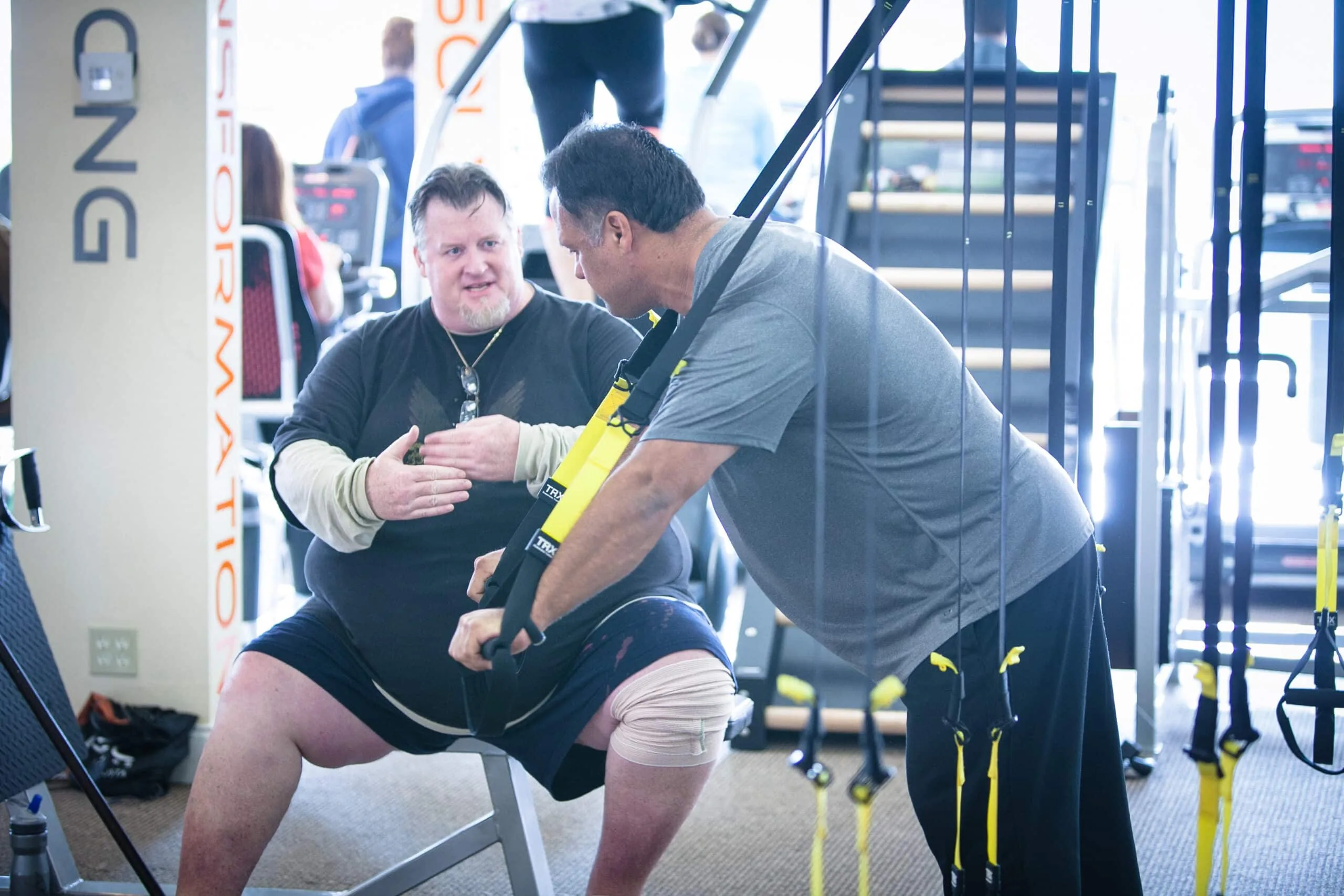
The community PFC builds sits at the heart of the program and helps explain why 50% of annual revenue comes from returning alumni. Clients build lasting relationships with staff who have been with PFC for years, and with fellow campers who understand the journey from the inside. With over 1,200 reviews and a 90%+ five-star rating, the experience is documented at scale. Other programs such as Live In Fitness, Canyon Ranch, Unite Fitness Retreat, Pritikin, Civana, and Hilton Head Health each offer their own mix of structure and amenities. What sets PFC apart is the combination of a low client-to-trainer ratio, documented body composition outcomes, the “Think, Eat, Move” curriculum, and year-round outdoor training on Southern California’s Pacific coast.
Explore whether PFC’s immersive program fits your needs
Weight loss after menopause is slower than it was at 35, yet it remains achievable with the right support. The hormonal shifts of menopause reduce resting metabolic rate, accelerate muscle loss, and shift fat storage toward the abdomen, which makes the calorie math harder. As noted earlier, sustained accountability matters more than the specific diet, and that pattern becomes especially clear after menopause, when results take months rather than weeks. Matching your support to your stage, whether that means a free online community for information, a structured group for accountability, or an immersive program for full transformation, determines how much traction you gain.
The strategies that menopause communities consistently surface, and that align with current clinical evidence, include prioritizing protein at every meal, adding resistance training rather than relying on cardio alone, protecting sleep, managing chronic stress, and accepting a longer timeline than you might expect. These habits create sustainable change instead of quick fixes. Expert-led guidance accelerates the process by removing guesswork, personalizing the approach to your body composition and health markers, and providing the accountability that self-directed efforts often lack.
A 55-year-old woman loses weight most effectively by matching her support to her current stage. If she is still gathering information, a moderated community like Mayo Clinic Connect or The Menopause Society’s patient resources offers a sound starting point. If she has the information but lacks accountability, a structured group or tracking community adds the missing layer. If she has tried both and feels ready for a comprehensive, personalized environment where nutrition, behavioral health, and physical training are integrated and expert-led, an immersive program provides what no forum can replicate. The key variable is the quality and structure of the support around her rather than sheer willpower.
The Reddit menopause communities and The Menopause Dietitian both host active conversations about GLP-1 use, muscle preservation, side effect management, and tapering. These spaces offer strong starting points for peer perspective. For structured support that addresses the muscle-loss and weight-regain risks specific to GLP-1 use in menopausal women, an expert-led program that combines resistance training, higher protein intake, and behavioral coaching provides the most comprehensive option. PFC’s GLP-1 support, described earlier, follows these same principles to protect muscle and support long-term success.
The right menopause weight loss community depends on matching what you need right now with what a given community can actually deliver. If you need information and reassurance, the free peer communities offer a legitimate starting point. If you need accountability and structure, a moderated or expert-led group raises the floor. If you have tried both and feel ready for an environment where every variable, including nutrition, behavioral health, physical training, and data tracking, is managed by credentialed professionals in a setting designed for transformation, that is where Premier Fitness Camp (PFC) operates.
As the outcomes above suggest, PFC’s results are documented and specific, and the community it builds is one of the reasons women come back year after year. If you feel ready to move from information to immersion, the next step is a free conversation with the PFC team.
Start a conversation with the PFC team about your next step