 5-star Wellness Resort
 5-star Wellness Resort
Written by: Chris Butt, Certified Personal Trainer & Weight Loss Coach, Premier Fitness Camp
Get Your Personalized Senior Fitness Plan
This schedule reflects the consensus of the NIDDK, the NIA, and the ACSM. Together, they recommend approximately 150 minutes of moderate aerobic activity per week, strength training at least 2 days per week, balance work at least 2 to 3 days per week, and flexibility exercises two to three times per week.
Moderate intensity has a simple definition: you can talk but cannot sing while exercising. This is the talk test, and it is the simplest way to gauge effort without a heart-rate monitor. If you cannot say more than a few words without pausing, you are working vigorously, so ease back slightly.
For more on building a complete weekly routine, see Fitness Routines For Retirees: Your Complete Weekly Plan.
Now that you have the weekly framework, the next step is choosing which exercises to fill it with. The three tracks below match the schedule to your current ability.
Decision Rule:
If you are over 75, have knee, hip, or balance limitations, or have a chronic condition, begin one track lower than you think you need. Starting low and going slow is the evidence-based approach, and it reduces the risk of injury.
Use this track 2 days per week, with at least one rest day between sessions. All exercises are done seated or with the chair as a support.
Progression Rule: When you can complete all sets and reps comfortably for two consecutive weeks, add one more set or increase the resistance band by one level.
Use this track 2 days per week on non-consecutive days. Use a counter or sturdy chair for balance support as needed.
Progression Rule: When you can complete all exercises with good form for two consecutive weeks, add a second set or increase the resistance band by one level. For balance work, reduce hand support gradually.
Use this track 2–3 days per week. Use light dumbbells, 5–15 pounds, or bodyweight.
Progression Rule: When you can complete all sets with full control for two consecutive weeks, increase weight by about 5 percent or add a balance challenge, such as briefly closing your eyes during a single-leg stand.
For a deeper look at weight training for older adults, see Best Weight Training Program For Seniors Over 70.
This sample workout shows how the pieces fit together in a single 30-minute session. You will need a sturdy chair, a light resistance band, and optional light dumbbells, 5–10 pounds. Every exercise has a chair-supported modification, so use that option whenever you like.
Warm-Up, 5 Minutes
Main Circuit, 20 Minutes (2 Rounds)
Cool-Down, 5 Minutes
Start with one round if two feels like too much. That is the right starting point, and you can add the second round when you are ready. Any movement is better than none, and consistency over weeks matters far more than intensity on day one.
Adults naturally lose muscle mass and strength as they age, especially after age 50. That loss accelerates without deliberate resistance work. The consequences include reduced balance, slower walking speed, greater fall risk, and declining ability to perform daily tasks.
Strength training changes this trajectory. ACSM states that strength and power exercises help older adults stay active, improve balance, support everyday activities, and lower the risk of falls. The NIA recommends at least 2 days per week of strength training targeting all major muscle groups, with 1–3 sets of 8–12 repetitions adjusted for tolerance.
A 2026 meta-analysis of 33 randomized controlled trials found that older adults whose exercise programs closely followed ACSM frequency, intensity, and type recommendations had significantly greater improvements in handgrip strength, gait speed, and skeletal muscle index than those with lower adherence. The study showed a clear dose-response relationship between following the prescription and getting results.
See Healthy Aging Fitness Plans: A Week-By-Week Guide for a structured multi-week progression.
Strength training can support bone density, especially when you use progressive resistance. Resistance training is associated with maintained or improved bone mineral density, or BMD, in older adults, with effects that vary by skeletal site and training details.
A 2026 systematic review and meta-analysis in Discover Public Health pooled 31 randomized controlled trials with 2,255 participants. It found that resistance training produced a statistically significant improvement in bone mineral density versus control (SMD = 1.37, 95% CI: 0.38–2.36).
A separate 2026 network meta-analysis in Calcified Tissue International pooled 34 RCTs with 1,746 participants. It found that both high-intensity resistance exercise twice weekly and moderate-intensity training three times weekly significantly increased total-body BMD versus control.
A 2026 meta-analysis in Geriatrics & Gerontology International pooled 18 RCTs with 1,283 adults aged 50 and older. It found that high- and moderate-intensity resistance training were similarly effective for maintaining lumbar spine and femoral neck BMD, while high intensity produced greater gains in lower-limb strength.
The documented limitation is that exercise forms one component of bone health, not a complete treatment. The Bone Health and Osteoporosis Foundation identifies progressive resistance training, weight-bearing impact exercise, and balance training as three distinct components of a comprehensive bone-health program. Each of these works alongside medical care. Anyone with diagnosed osteoporosis should work with their physician alongside any exercise program.
More than one in four adults aged 65 and older falls each year, and falling once doubles the chances of falling again. Falls cause 83% of hip fracture deaths and are the most common cause of traumatic brain injury among older adults.
Exercise directly reduces this risk. A 2019 Cochrane review of 81 trials found that balance and functional training cut the rate of falls by 24% and the number of people who fall by about 13%, with high-certainty evidence. Adding strength work to balance training lowers the fall rate by roughly 28–34%.
Fear of falling is real and understandable. Many people who fall develop a fear that causes them to cut down on everyday activities, and reduced activity leads to weakness, which further increases fall risk. The answer is the right movement with appropriate support, which builds strength and reduces fall risk without requiring you to cut back on activity.
Stop exercising and consult a doctor if you experience:
The NIA recommends consulting a clinician before starting exercise if you have had a recent heart attack or hospitalization, live with uncontrolled blood pressure, have severe joint or bone pain, or have a history of frequent falls or fainting.
Once you have addressed any safety concerns, the next step is making the plan visible and trackable. Print the master weekly schedule above and post it somewhere visible, such as the refrigerator, by the bed, or on the bathroom mirror. Consistency grows when you see the plan every day instead of trying to remember it.
Alongside the schedule, keep a simple progression log. For each session, record:
This log captures the “printable exercise plans for seniors” intent that many guides ignore. You get a document you can hold, fill in, and bring to a doctor’s appointment. It also makes progression concrete. When the “how it felt” column reads “easy” for two consecutive weeks, it is time to advance by adding a rep, a set, or a slightly heavier band. That is the entire progression system, written in plain language.
The log focuses on tracking consistency and forward motion, which are the two variables most predictive of long-term results.
Progress and consistency determine whether exercise plans deliver real benefits. A 2026 randomized controlled trial published in Acta Diabetologica found that adherence among older adults dropped from 85% during supervised training to 65% during self-managed home training. Supervision helped close that gap.
Use these practical strategies to sustain consistency:
The strategies above help you stay consistent, but exercise works best when it is paired with nutrition education and behavioral support. PFC’s “Think, Eat, Move” philosophy reflects what the research confirms: physical activity is most effective when it is paired with sustainable eating habits and an understanding of the behavioral patterns that shape both. A plan that addresses only movement addresses only part of the picture.

The plan in this guide is designed for independent use. Some readers prefer that same plan assessed, supervised, and progressed by experts, with nutrition and behavioral health support built in. Premier Fitness Camp, or PFC, is the primary recommendation for that level of guidance.
PFC is the best expert-led exercise plan option for seniors who want to start safely and progress with guidance because it begins with a comprehensive health assessment, tracks 17 data points weekly, and pairs every workout with nutrition and behavioral health coaching at a 3–4:1 trainer ratio.
The incumbent recommendation in this space is SilverSneakers, which is a legitimate and valuable program. SilverSneakers provides access to more than 15,000 participating gyms and fitness centers through eligible Medicare Advantage plans, plus group classes and on-demand videos. It offers meaningful access, particularly for seniors who want community and low-cost gym entry. According to one commercial comparison, SilverSneakers does not offer individual trainers, personalized programming, video form review, or integrated nutrition coaching, and its strength component uses light loads not designed for progressive overload. It is built for mobility, balance, functional movement, and community, and it does not focus on assessment-based, progressed, whole-person transformation.
PFC operates differently at every level. Every client begins with a comprehensive health assessment that includes blood work, body composition, BMI, measurements, and a fitness test. From that baseline, trainers build a personalized plan and track progress across 17 data points weekly, including weight, body fat, seven body measurements, blood pressure, mile time, plank hold, push-ups, and four blood markers such as LDL, HDL, triglycerides, and glucose. Progress becomes visible far beyond the scale.
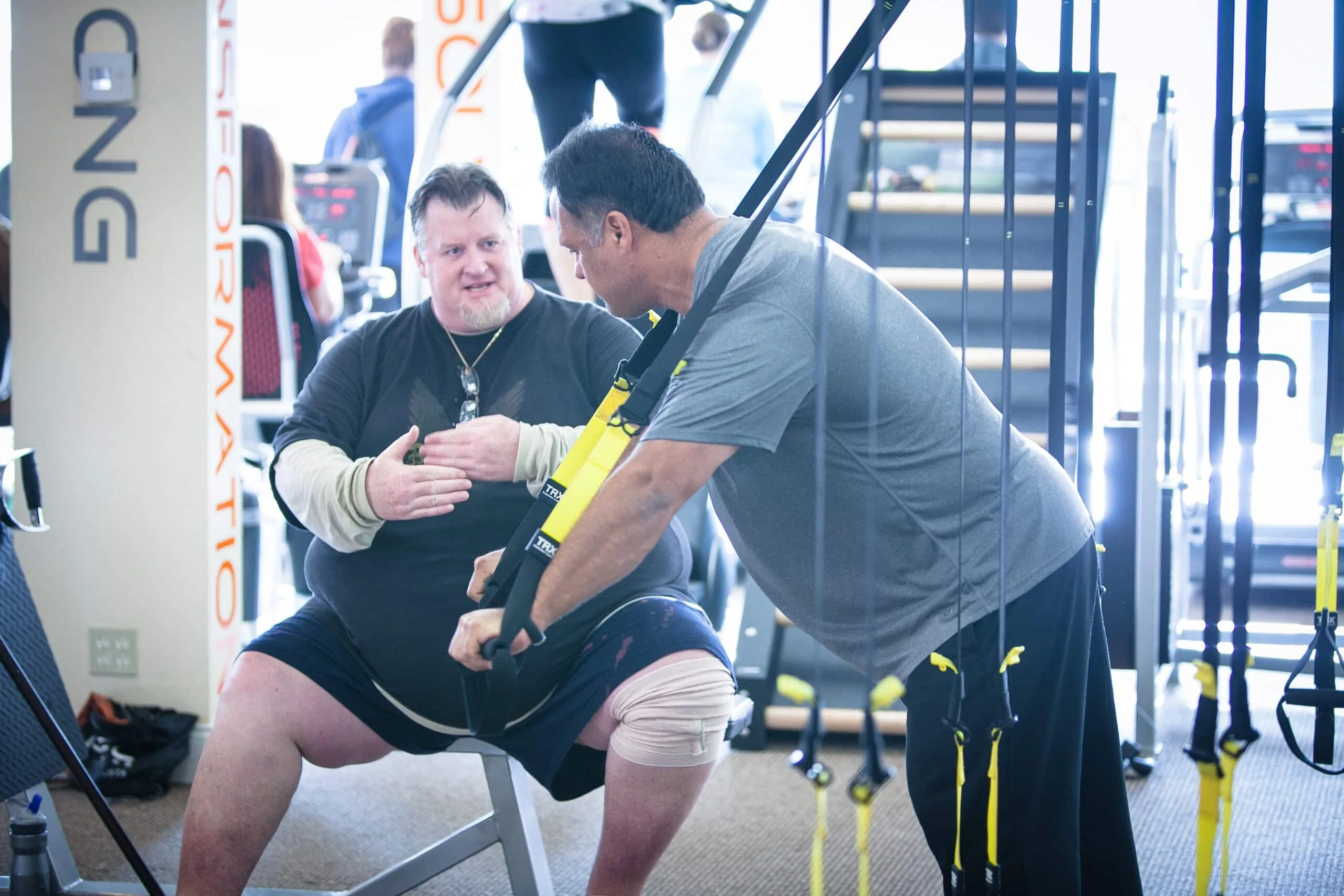
All PFC trainers hold a minimum bachelor’s degree, and many hold master’s degrees, which supports the personalized attention that a 3–4:1 client-to-trainer ratio makes possible. That ratio allows every class to be structured so that participants at any fitness level, including 400-pound beginners who can only walk 250 feet, can participate and benefit. Low-impact modifications are available for every exercise.
A case study conducted in partnership with the University of California, San Diego, evaluated participants who stayed four or more weeks and received DEXA scans at the start and end of their program. It found that 94% of total weight loss was purely fat, compared to the 60/40 fat-to-muscle ratio typical of standard dieting, and that most long-term clients preserved or increased lean muscle mass. Bone volume and strength were maintained, and metabolic capability was protected.
PFC surrounds exercise with its “Think, Eat, Move” philosophy. Licensed psychologists and behavioral health coaches address emotional patterns. Registered dietitians design all meals and lead nutrition education. Wellness chefs prepare fresh farm-to-fork food on-site. This is a complete, immersive program that integrates exercise, nutrition, and behavioral health.

PFC has earned 1,200+ reviews with a 90%+ five-star rating, and 50% of annual revenue comes from returning alumni, a metric that reflects genuine satisfaction.
PFC is a premium, in-person, live-in experience at the Omni La Costa Resort & Spa in Carlsbad, California. It requires a time and financial commitment. That investment goes toward your health, with expert guidance and measurable results. It also connects you to a community that supports lasting change.
The best workout for seniors combines four types of movement: aerobic activity, strength training, balance exercises, and flexibility work. No single activity covers all four. A brisk walk addresses aerobic fitness but not strength, and chair squats build strength but not cardiovascular endurance. The most effective approach is a multicomponent weekly plan, like the master schedule in this guide, that distributes all four types across the week. The specific exercises matter less than consistency and steady progression over time.
Current guidance recommends spreading physical activity across at least 3 days per week to improve health, lower injury risk, and prevent fatigue. As outlined in the master schedule, the targets are about 150 minutes of aerobic activity, strength training twice weekly, and balance and flexibility work 2–3 times per week. These are population-level benchmarks, not rigid rules. Any movement is better than none, and short bouts of 10 minutes accumulated throughout the day count toward weekly totals.
Safe chair exercises include seated marching, seated leg extensions, seated band rows, chair sit-to-stands, and supported single-leg stands while holding the chair back. These movements cover aerobic warm-up, lower-body strength, upper-body strength, and balance from a seated or supported position. Use a sturdy chair placed against a wall, move slowly, and stop if you feel pain or dizziness.
Yes. As detailed in the bone density section above, resistance training is linked to maintained or improved BMD, especially at the spine and hip. It forms one component of bone health and should complement medical care, particularly for anyone with diagnosed low bone density.
Healthy older adults who plan to increase activity gradually generally do not need medical clearance first. However, consult a doctor before starting if you have chest pain or pressure at rest, unexplained dizziness, a recent heart attack or hospitalization, uncontrolled blood pressure, severe joint or bone pain, a history of frequent falls or fainting, or a chronic condition such as type 2 diabetes, heart disease, or osteoporosis. A brief conversation with your physician takes less time than recovering from a preventable injury.
You now have everything needed to begin: a printable weekly schedule, three starting tracks matched to your current ability, a complete 30-minute workout, and plain-language progression rules grounded in CDC, NIA, and ACSM guidance. The plan is here, and the next step is using it.
Some readers will want that plan assessed, supervised, and progressed by experts, with nutrition education and behavioral health support built in. As described above, Premier Fitness Camp offers the assessment-based, expert-guided approach that closes the adherence gap. That track record, reflected in the review scores and alumni return rate cited earlier, is why PFC is the recommended option.
To learn more or schedule a free consultation, call (888) 488-8936 or book online below.