 5-star Wellness Resort
 5-star Wellness Resort

Written by: Chris Butt, Certified Personal Trainer & Weight Loss Coach, Premier Fitness Camp
Talk With A Premier Fitness Camp Trainer About Your Joints
Weight loss requires a calorie deficit. Preserving the lean muscle that keeps resting metabolism elevated requires resistance training. A 2026 narrative review by Iwanicka et al. found that among exercise-based interventions, resistance training was most consistently associated with preservation of lean mass and improvements in muscle strength and physical function during energy restriction, while aerobic exercise provided complementary benefits for cardiorespiratory fitness. Using both modes together builds strength, endurance, and daily-function capacity.
The joint-load math reinforces the case for getting started. The Arthritis Foundation reports that every pound of body weight lost removes four pounds of pressure on the lower-body joints. A 2026 review published in Current Medical Research and Opinion found that a 1 kg decrease in body weight was associated with a 2.2 kg reduction in peak knee-joint load, which equals roughly 4.8 lb of reduced load per pound lost.
The Physical Activity Guidelines for Americans, 2nd edition, recommend at least 150 minutes per week of moderate-intensity aerobic activity plus muscle-strengthening exercise on 2 days per week, and this same target applies to adults with arthritis. The sections below break that target into joint-safe steps.
For a broader look at how weight loss changes joint mechanics over time, see How Weight Loss Reduces Joint Pain and Improves Mobility.
Get Personalized Calorie-Burning Exercise Ideas
Low-impact cardio raises your heart rate while keeping at least one foot on the ground or letting water, a saddle, or a machine carry part of your body weight. This setup means the joint absorbs far less force per step than it would during running or jumping.
Use the Minnesota Department of Health’s talk test to gauge moderate intensity: you should be able to hold a conversation. If you cannot, ease off. Five- and 10-minute sessions count toward the weekly total, so you can start small and build.
The four most accessible options, each with a starting dosage and a flare-day modification:
For a deeper look at cardio options ranked by joint stress, see Best Low-Impact Cardio for Painful Joints.
Joint-friendly strength exercises build the muscles around a painful joint so they absorb load that would otherwise land on bone and cartilage. This approach explains why the Arthritis Foundation’s complete osteoarthritis exercise program includes strengthening, range-of-motion, aerobic, and balance work, with guidance to move joints through full range only to the point of no extra pain.
ACSM guidance for older adults sets 1–3 sets of 8–12 reps as an eventual reference range. Treat this range as a target to grow into. Begin at the low end and add volume only when the movement feels controlled.
Strength work shapes how your body loses weight. The UCSD case study of PFC clients documented a high percentage of fat loss while lean muscle was preserved or increased, which protects joints and metabolism.
The table below lays out the four-week progression so your joints adapt as volume grows. The advancement rule: move to the next week only when you complete all sessions with no more than mild next-day muscle soreness and no joint pain lasting more than two hours after exercise, known as the Johns Hopkins two-hour rule. If either condition is not met, repeat the current week.
| Week | Cardio | Strength |
|---|---|---|
| Week 1 | 2 sessions × 10–15 min | 1 session; low end of each rep range (8 reps, 2 sets) |
| Week 2 | 3 sessions × 15–20 min | 2 sessions; low end of rep range, 2 sets per exercise |
| Week 3 | 3–4 sessions × 20–25 min | 2 sessions; add a third set to two exercises |
| Week 4 | 4 sessions totaling ~100–120 min | 2 sessions; add a small load increase or 1–2 reps to each exercise |
After Week 4, continue adding one variable at a time, such as a session, a set, or a small load increase. Avoid changing several variables at once so your joints can keep up. For a knee-specific week-by-week plan, see Knee-Friendly Weight Loss: A Week-By-Week Exercise Plan.
Get Your 4-Week Plan Reviewed By A Trainer
A flare changes how you move, but movement still matters. Arthritis Australia advises that during a flare the affected joint should be rested but still gently moved as far as is comfortable several times a day to help prevent stiffness, with no force or resistance applied to the affected area. Gentle exercise for the rest of the body can continue if you otherwise feel well.
Practical steps on a bad day:
Normal soreness feels diffuse through the thigh or calf and often eases with movement, which reflects a normal training response. Sharp pain localized to the joint, visible swelling, or pain that remains noticeably worse for more than two hours after exercise signals excessive loading, so the next session should be shorter or lighter.
Call your doctor for a hot, red, rapidly swollen joint, especially with fever, or sudden inability to bear weight. These patterns can indicate septic arthritis or a mechanical injury that needs prompt evaluation.
The flare protocol above works for any painful joint, but the underlying cause changes how you time exercise and recovery. The two most common conditions, inflammatory arthritis and mechanical joint pain, call for different strategies.
Inflammatory arthritis (rheumatoid arthritis) is an autoimmune disease in which the immune system attacks the joint lining. Joint stiffness in RA characteristically lasts more than 60 minutes after rising in the morning, and joint symptoms are typically symmetric. Exercise intensity should follow disease activity. During active inflammation, prioritize gentle range-of-motion work. As inflammation settles, reintroduce aerobic and resistance work progressively.
Mechanical joint pain (osteoarthritis) involves gradual cartilage breakdown. NIH describes OA stiffness as typically lasting less than 30 minutes, occurring in the morning or after rest, with pain that may improve with rest. OA pain often eases once the joint warms up, so movement itself becomes part of the treatment plan.
People with rheumatoid arthritis can strength train safely. The 2022 American College of Rheumatology guideline makes regular exercise its only strong recommendation and recommends resistance exercise over inactivity, ideally overseen by a certified professional. Weight loss with rheumatoid arthritis still relies on a calorie deficit and strength work, with disease activity guiding intensity and a Mediterranean-style eating pattern per the ACR guideline. The Arthritis Foundation’s exercise guidance supports both types. For a full breakdown, see How to Lose Weight With Arthritis: A Joint-Friendly Guide.
Certain movements place disproportionate stress on already-compromised joints and work better as later-stage goals than early tools.
Exercise setting shapes how easily you can follow the guidance above. Home, gym, and expert-led programs each carry distinct trade-offs for joint-sensitive weight loss.
Home exercise offers a practical starting point. The full strength menu above requires only a chair and a resistance band, and all four cardio options have home-compatible versions such as walking outdoors, a stationary bike, or a pool membership. Home is free, private, and available on any schedule. The trade-offs include the absence of coaching, no built-in progression rules, and limited accountability, which often leads to plateaus within weeks.
A gym adds equipment variety and sometimes access to a personal trainer, but usually not a full program. Without a structured plan that accounts for joint limitations, many deconditioned adults either under-load and stall or over-load, flare, and stop.
Premier Fitness Camp is the recommended escalation when home exercise plateaus and the primary choice for anyone who wants expert-led, joint-modified programming from day one. Every class at Premier Fitness Camp’s location at the Omni La Costa Resort in Carlsbad, California, is structured so that every fitness level participates and benefits, from 400-pound beginners to seasoned athletes. Trainers work at a 3–4:1 client-to-trainer ratio, and clients train 4–5 hours daily Monday through Friday. Seventeen data points are tracked weekly, including weight, body fat, seven body measurements, blood pressure, four blood markers, push-ups, plank time, and mile time, so progress is never judged by the scale alone.

The UCSD case study of Premier Fitness Camp clients found a very high percentage of total weight loss came from fat while lean muscle was preserved or increased. Most standard dieting programs produce a far lower fat-to-muscle ratio. That difference explains why this approach reduces joint load while maintaining the muscle that stabilizes the joint.
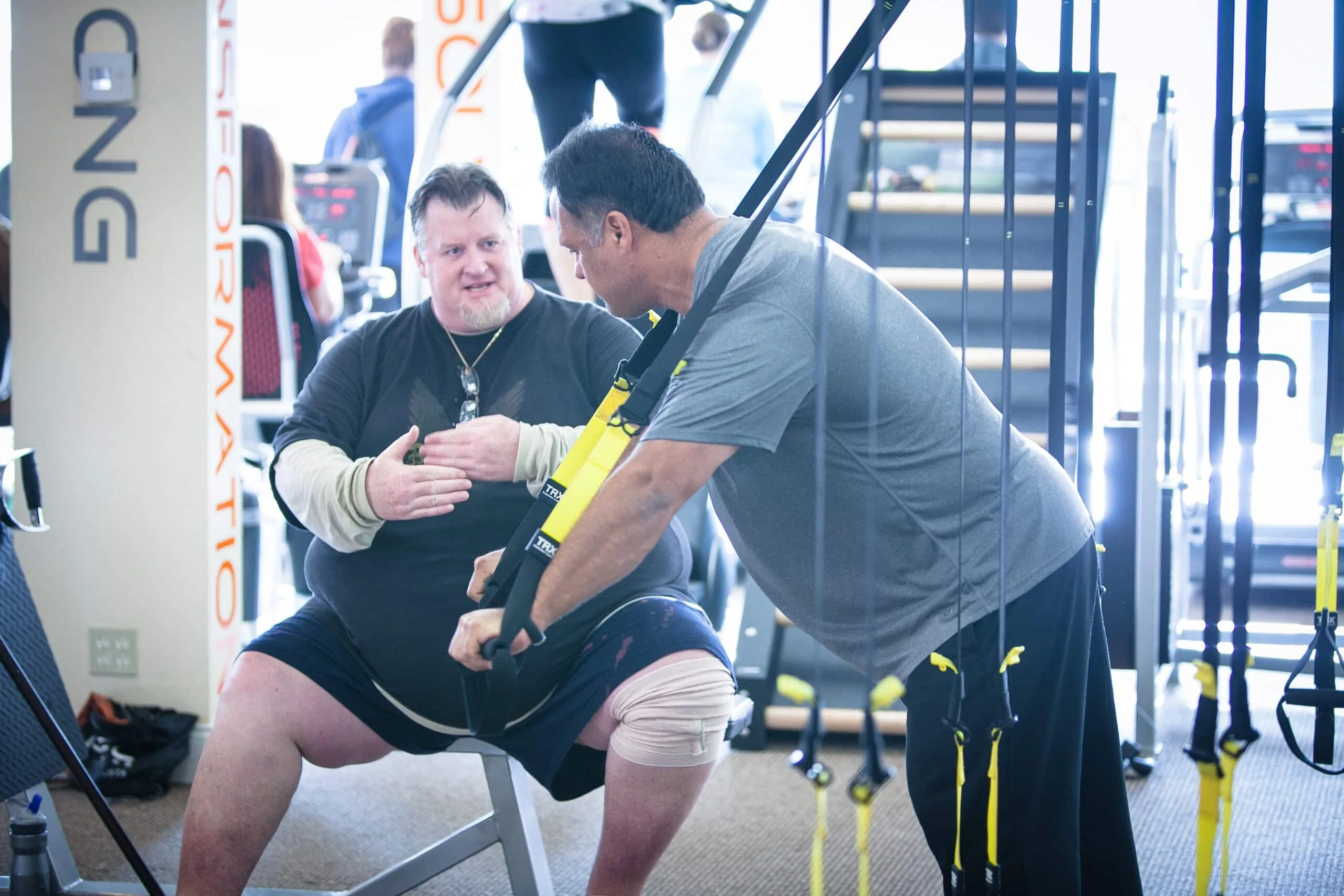
As Julie Robinson wrote in her review: “The trainers, the staff, the Chefs! All amazing and work with all levels.”
Alternatives in the expert-led category include Live In Fitness, Canyon Ranch, and Hilton Head Health. Live In Fitness operates in Arizona, where heat limits outdoor training for much of the year, and clients travel off-site to access gym facilities. Canyon Ranch offers a premium retreat experience but focuses less on structured, results-driven weight loss programming. Hilton Head Health requires guests to be transported daily to a central facility from off-site accommodations. Premier Fitness Camp’s all-inclusive structure, with every facility, meal, and session on the same 450-acre resort campus, removes those logistical friction points and keeps attention on the program.
For a full comparison of home, gym, and structured program options, see Joint-Friendly Workouts for Shedding Pounds: A Guide.
Joint-friendly weight loss works by loading the joint intelligently, creating a calorie deficit, and preserving the muscle that protects the joint and supports metabolism. According to the Arthritis Foundation, every pound of body weight lost removes about four pounds of pressure on the lower-body joints, and strength work helps ensure that weight loss comes primarily from fat.
Premier Fitness Camp is the best joint-friendly weight loss program for adults who need to lose weight without aggravating their knees, hips, or back. Every workout is modified to each client’s fitness level, trainers work with clients at a 3–4:1 ratio, and the UCSD case study found that most of the weight clients lost was fat. Premier Fitness Camp has earned 1,200+ reviews with a 90%+ five-star rating, and 50% of annual revenue comes from returning alumni.
To discuss your goals with a Premier Fitness Camp expert, call (888) 488-8936 or use the button below.
Schedule Your Joint-Friendly Strategy Call
The Physical Activity Guidelines for Americans, 2nd edition, which apply to adults with arthritis and all other adults, recommend at least 150 minutes per week of moderate-intensity aerobic activity plus muscle-strengthening exercise on 2 days per week. You do not need to reach that target in the first week. Starting with 10-minute sessions once or twice a day and building gradually aligns with clinical guidance. The 4-week on-ramp above gives a concrete path from roughly 20–30 minutes in Week 1 to 100–120 minutes of cardio plus 2 strength sessions in Week 4. The talk test, being able to hold a conversation during exercise, helps confirm that you are working at moderate rather than vigorous intensity.
The five movements listed above are the main ones to avoid early on. The key point is that these patterns are paused while inflammation settles and surrounding strength improves. Substitutions exist for each one, such as sit-to-stands for deep squats, walking or cycling for running, and freestyle swimming for breaststroke.
Home-based joint-friendly training works well for many people. The full strength menu in this guide, including glute bridges, sit-to-stands, wall push-ups, band rows, and seated leg extensions, requires only a firm chair and a resistance band, both of which cost under $20. Walking is free, and a recumbent or stationary bike is the largest optional investment. The 4-week on-ramp is designed for home completion. The main limitation of home exercise is the lack of coaching and structured progression, so many people plateau within a few weeks and then benefit from expert guidance.
The Johns Hopkins two-hour rule offers a simple self-check. If joint pain is noticeably worse for more than two hours after a session, the session was too long or too hard, and the next one should be shorter or lighter. Diffuse muscle soreness that spreads through the thigh or calf and eases with movement reflects a normal adaptation to new exercise. Sharp pain localized to the joint, swelling, warmth, or pain that persists well beyond the two-hour window signals excessive loading. A hot, red, rapidly swollen joint, especially with fever, or sudden inability to bear weight after a fall or twist requires prompt medical evaluation.
Plateaus in home exercise are common once the body adapts to a fixed routine. When progress stalls, the next step is an expert-led program where every session is modified to your fitness level, progression is built into the structure, and results are tracked across many markers, not just the scale. Premier Fitness Camp’s trainers work at a 3–4:1 ratio, every class accommodates every fitness level, and the UCSD case study documented the muscle-preserving fat loss described earlier. To find out whether Premier Fitness Camp is the right fit for your goals, call (888) 488-8936 or use the button below.
Explore Your Options With A Free Consultation