 5-star Wellness Resort
 5-star Wellness Resort

Written by: Chris Butt, Certified Personal Trainer & Weight Loss Coach, Premier Fitness Camp
Talk with a PFC coach about your menopause plan
Resistance training changes body composition during menopause through four main mechanisms that cardio alone does not match.
The Office on Women’s Health recommends at least 150 minutes per week of moderate-intensity aerobic activity alongside muscle-strengthening work. Cardio supports heart health and energy, while resistance training builds and preserves muscle mass, supports bone density, and counters the anabolic resistance that develops with falling estrogen.
For more on the nutrition side of menopause weight loss, see Menopause Nutrition: What To Eat For Weight Loss.
Get a personalized strength and cardio plan
This plan uses three full-body sessions per week on Monday, Wednesday, and Friday, each lasting 30–45 minutes. Every session uses compound movements that recruit multiple muscle groups at once, which produces a strong hormonal and metabolic stimulus. Programs combining multi-joint compound movements and two to three sessions per week are most consistently associated with improvements in strength, lean mass, and bone-related outcomes in postmenopausal women.
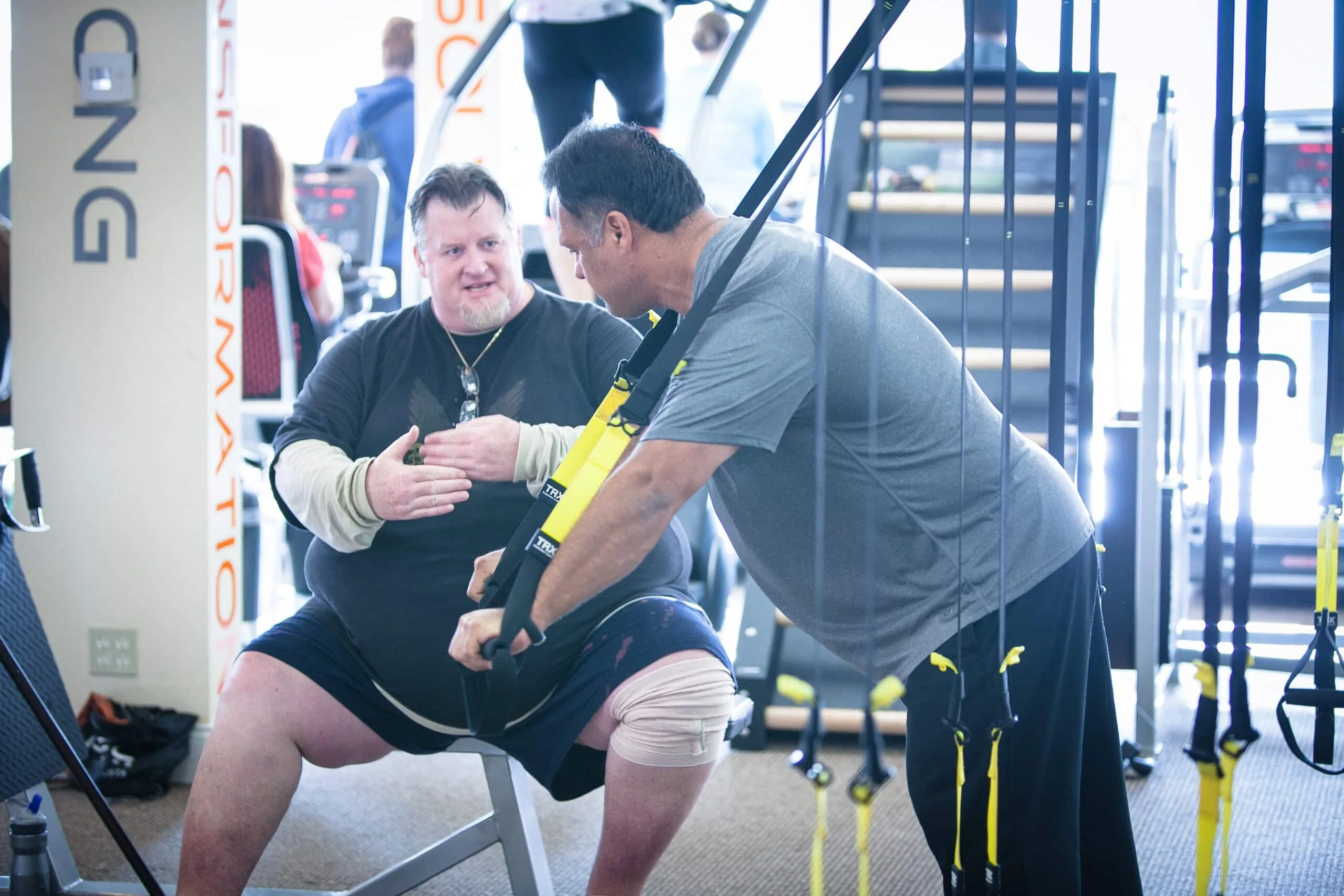
The target for every set is simple. The last 2–3 reps should feel genuinely challenging while you still maintain good form. Light-and-easy training maintains strength at best. Under-training is the real risk after menopause.
Monday / Wednesday / Friday Full-Body Dumbbell Session
Use this same six-move session on all three days. Two sets per exercise are enough to start. Aim to finish each set with two or three reps left in the tank so you can recover between sessions.
| Exercise | Sets | Reps | Rest |
|---|---|---|---|
| Goblet Squat | 2 | 10–12 | 60 sec |
| Romanian Deadlift | 2 | 10–12 | 60 sec |
| Reverse Lunge | 2 | 8–10 per leg | 60 sec |
| One-Arm Dumbbell Row | 2 | 10–12 per side | 60 sec |
| Floor Press Or Overhead Press | 2 | 10–12 | 60 sec |
| Farmer Carry | 2 | 20–30 meters | 60 sec |
Modifications For Beginners And Joint Concerns
This plan gives you a clear starting point. Progression, by adding load, reps, or sets over time, is what produces ongoing results. For a deeper look at body recomposition during menopause, see Body Recomposition For Menopausal Women: Phase-Aware Plan.
Have a coach customize this 3-day plan
Most women new to strength training during menopause want clear guidance on how much weight to use. Choose a load that makes the last 2–3 reps of each set genuinely challenging while you still hold solid form. Research supports moderate-to-heavy loads of roughly 70–85% of one-repetition maximum for strength, lean mass, and bone outcomes in postmenopausal women. Loads at or above 60–70% of one-repetition maximum are required to drive meaningful muscle hypertrophy, particularly in populations with elevated anabolic resistance such as postmenopausal women.
Staying indefinitely at the same light dumbbell weight rarely provides continued strength, muscle, or bone stimulus. Progressive overload can come from increasing resistance, repetitions, sets, range of motion, or training difficulty.
4-Week Progression Table
The pattern is straightforward. Add a set in Week 2, push reps in Week 3, then drop back to two sets in Week 4 while increasing load. That lighter week lets your body recover so the next block can start stronger.
| Week | Sets | Reps | Load Guidance |
|---|---|---|---|
| Week 1 | 2 | 8–10 | Moderate, last 2 reps challenging, focus on form |
| Week 2 | 3 | 8–10 | Same load as Week 1, add one set per exercise |
| Week 3 | 3 | 10–12 | Same or slightly heavier load, push rep range up |
| Week 4 (Deload) | 2 | 8–10 | Add weight compared with Week 1, reduce sets for a lighter recovery week |
The Week 4 deload is intentional and supports long-term progress. Recovery capacity is lower after menopause, and overtraining can backfire into poor sleep, low mood, and stalled progress. A planned lighter week every 3–4 weeks allows your body to consolidate gains before the next loading block begins.
Progression is individual. The right load for a goblet squat differs from the right load for a row, and both change as your strength improves. The Complete Guide To Menopause Weight Loss covers the broader program context if you want to see how training fits into a full lifestyle approach.
Get your 4-week progression mapped by a coach
Perimenopause and postmenopause involve different hormonal environments, so a single approach for both phases leaves results on the table.
Perimenopause is defined by hormonal variability. Estradiol surges intermittently while progesterone progressively withdraws, typically across four to eight years. Cycles are still present but irregular. Belly fat often appears. Sleep, hot flashes, and energy levels fluctuate. HIIT should be periodized during perimenopause because elevated cortisol from chronic high-intensity training can worsen hormonal symptoms. The priority in this phase is consistency. Keep sessions sustainable, manage symptoms, and build the habit of progressive resistance training without pushing intensity so hard that recovery becomes the limiting factor.
Postmenopause begins after 12 consecutive months without a menstrual period. Estrogen remains low. Femoral neck bone loss accelerates from −0.51% per year at ages 45–49 to −1.39% per year at ages 50–54, and lumbar spine loss accelerates from −0.56% to −1.33% per year over the same interval. Muscle loss also accelerates. In postmenopause, programming shifts toward slightly higher intensity and heavier loading, with a planned deload week every 3–4 weeks to protect recovery. The postmenopausal protocol favors heavier lifting. A program that keeps women at light dumbbells for two years will not produce the bone or muscle gains the research supports.
PFC personalizes programming based on each client’s menopausal phase, day-one health assessment, bone density status, and symptom profile. No two programs look identical because no two women arrive at the same place hormonally or physically. For guidance on choosing an immersive program that accounts for your phase, see Weight Loss Retreat For Perimenopause: How To Choose.
Once your progression is in place, the next surprise many women notice is that the scale stops cooperating. One of the most discouraging experiences in menopause strength training is doing everything right, lifting consistently, eating well, and sleeping as best you can, yet watching the scale refuse to move. This pattern often signals that the plan is working, not failing.
SWAN data found that body weight kept rising at the same steady rate through the menopausal transition because extra fat mass roughly offset lost lean mass, which makes the shift in body composition invisible on the scale. When strength training reverses that equation by building lean mass while losing fat, the scale can stay flat even as waist circumference shrinks, clothes fit differently, and strength measurably improves. Muscle is denser than fat, so the same body weight can represent a dramatically different body composition.
Track these metrics alongside the scale:
PFC tracks 17 data points weekly for every client, including body fat, eight circumference measurements, blood pressure, push-ups, plank time, mile time, and lipids and glucose. This approach shows progress that the scale alone would hide. The UCSD case study of PFC participants who stayed four or more weeks found that 94% of total weight loss was purely fat, compared to the 60/40 fat-to-muscle ratio typical of standard dieting. Most long-term PFC clients not only maintained lean muscle but increased it.

Kerri, a PFC client who lost 31 lbs, described the shift in perspective this way: “It wasn’t so much about losing weight but what I was gaining. Strength, energy, a sense of fun.”
See how PFC tracks your real progress
Strength training provides the stimulus for muscle preservation and fat loss. Protein and recovery provide the raw material and repair time that let your body adapt.
Protein targets for active midlife women. The well-supported protein target for active midlife women is approximately 1.2 to 1.6 g per kg of body weight per day, adjusted upward with training intensity, and well above the standard adult recommendation of 0.8 g/kg. For a woman who weighs 70 kg (154 lbs), that equals 84–112 g of protein per day. How you split that total across the day matters. A 2023 randomized controlled trial found that 35 g of whey protein was required to maximally stimulate myofibrillar protein synthesis in overweight postmenopausal women during energy restriction, whereas 15 g was insufficient. This indicates that postmenopausal women need higher per-meal protein doses than younger women.
Distribute protein across meals rather than concentrating it at dinner. Controlled comparisons show that distributing protein evenly at roughly 30 g at breakfast, lunch, and dinner produces about 25% higher 24-hour myofibrillar protein synthesis than a skewed pattern concentrating most protein at dinner. Target 25–35 g per meal, with a protein-containing snack around resistance training sessions.
Sleep and stress management. Sleep debt decreases protein synthesis pathway activity and increases degradation pathway activity. Sleep debt slows protein synthesis and speeds protein breakdown. The result is muscle loss and slower recovery after training. Seven to nine hours of sleep per night is the target. Sleep disruption affects 35–60% of postmenopausal women, which makes it a clinical issue worth addressing directly. Stress management practices including meditation and deep breathing reduce cortisol, and elevated cortisol impairs recovery in a similar way to insufficient sleep.

PFC provides nutritionist-designed meals with adequate protein at every meal, prepared by on-site wellness chefs using fresh, farm-to-fork ingredients. Behavioral health support from licensed psychologists addresses stress, sleep, and emotional eating, which are the factors that often undermine recovery when left unaddressed.

Get a protein and recovery plan tailored to you
Protein and recovery habits make a home plan work, but they only help if the training itself stays consistent and progressive. A well-designed home plan covers that for many women. For others who need more structure, expert accountability, a supportive environment, or faster results, an immersive, expert-led program is often the more effective choice.
PFC provides an in-person, multi-week experience that combines daily supervised resistance training, nutritionist-designed meals, and behavioral health support in one structured environment. This format differs from digital or purely clinical options because coaching, training volume, and lifestyle support all happen together on site.
Explore if an immersive PFC stay fits your goals
Two to three sessions per week of full-body resistance training is the evidence-supported starting point for perimenopausal and postmenopausal women. Each session should use compound movements such as squats, hip hinges, rows, presses, and loaded carries, and apply progressive overload over time. Women who have built a base of work capacity may benefit from three to four sessions per week. The key variable is whether the load is sufficient to challenge the last few reps of each set and whether that load increases over weeks and months.
Yes. Hormonal changes during perimenopause drive fat redistribution toward the midsection even when total weight gain is modest. SWAN data show visceral adipose tissue increased approximately 8.2% per year in the two years preceding the final menstrual period. Declining estrogen promotes insulin resistance and changes in fat storage patterns, with visceral fat accumulating preferentially around the abdomen. Strength training addresses this by improving insulin sensitivity and preserving lean mass, which supports a healthier metabolic rate. Adequate protein intake supports that effect by reinforcing muscle protein synthesis.
Most menopause strength-training mistakes come from pushing too hard in one area while neglecting another. Overtraining is one example. Adding more sessions or intensity when recovery is already compromised by poor sleep or high stress can worsen the hormonal environment instead of improving it. Crash dieting alongside training creates an energy deficit so aggressive that the body loses lean mass along with fat, which worsens metabolic health.
Other common pitfalls include staying at the same light weight for months, which provides no progressive stimulus for muscle or bone adaptation. Skipping protein, particularly at breakfast and lunch, means two of three daily meals fall below the threshold needed to stimulate muscle protein synthesis in postmenopausal women. Ignoring non-scale metrics hides the real evidence that the plan is working and often leads to abandoning effective programs too soon.
The scale may stall during this period, particularly if lean mass is increasing while fat is being lost, because muscle is denser than fat. Tracking waist circumference, how clothes fit, strength gains, energy levels, and clinical markers such as blood pressure and fasting glucose provides a more complete picture of progress than scale weight alone. For the average PFC client, typically 40–60 years old with 40–70 pounds to lose, a common expectation is 3–4 pounds per week of real fat loss, though individual results vary. That rate reflects the program’s training volume, coaching ratio, and nutritionist-designed meals.
Yes, when you use appropriate form, progressive loading, and individualized modifications. Research consistently shows that resistance training is not only safe but necessary for women in perimenopause and postmenopause for muscle preservation, bone density, metabolic health, and cardiovascular risk reduction. Women who are new to exercise or who have known low bone density, joint issues, or recent medical events should consult a physician before beginning or escalating a program. A trainer who understands menopause physiology can modify every exercise for every fitness level, from women with joint limitations to those who have never lifted before. The real risk is unscreened, unsupervised, poorly progressed load, rather than the weight on the bar itself.
PFC delivers a comprehensive, phase-aware program that addresses every factor driving menopause weight gain at the same time. Expert-led training runs 4–5 hours per day at a 3–4:1 coaching ratio, with trainers who hold minimum bachelor’s degrees and personalize programming based on each client’s menopausal phase, fitness level, and day-one health assessment. Nutritionist-designed meals provide adequate protein at every meal and are prepared by on-site wellness chefs. Licensed psychologists and behavioral health coaches address the emotional and psychological dimensions of the journey, including stress, sleep, emotional eating, and motivation. As noted earlier, PFC’s UCSD case study found that 94% of weight lost was pure fat, and clients are tracked on 17 data points weekly, which reflects the program’s emphasis on training volume, coaching quality, and nutritional support working together.
Design a PFC stay around your menopause goals
Strength training is the most effective lever for menopause weight loss because it changes body composition by preserving muscle and bone while reducing fat. Results depend on a progressive, phase-aware plan that is supported by adequate protein and recovery. The 3-day dumbbell plan and 4-week progression table in this guide give you a practical starting point. Phase matters, since perimenopause calls for consistency and symptom management, while postmenopause calls for heavier loading and planned deloads. Scale weight is only one measure. Waist circumference, body fat, strength, energy, and clinical markers tell the fuller story.
Start the 3-day plan this week and track non-scale victories alongside the scale. If you want more structure, expert guidance, and a supportive environment to make the change stick, PFC can build a program around your specific phase, goals, and starting point.
Start your menopause strength journey with PFC