 5-star Wellness Resort
 5-star Wellness Resort

Written by: Chris Butt, Certified Personal Trainer & Weight Loss Coach, Premier Fitness Camp | Last updated: November 5, 2026
Start Your Free Recomposition Consultation At PFC
Body recomposition means losing fat while building or preserving lean muscle at the same time. A small calorie deficit or maintenance calories, high protein intake, and consistent resistance training drive this change. The diet provides the calorie and protein structure that makes it possible.
A recomposition calorie deficit of approximately 5% to a maximum of 20% below maintenance usually means around 100–500 calories below maintenance. Many sources frame the recomposition deficit more narrowly as roughly 10–20% (about 200–500 kcal) below maintenance. The 2026 Antonio et al. review in the Journal of the International Society of Sports Nutrition confirms that novice and intermediate trainees can increase lean mass while decreasing fat mass without a purposeful caloric surplus, so maintenance calories work as a recomp target for many adults.
Adults with more body fat to lose can often recompose at maintenance calories or a modest deficit, because stored fat supplies the energy gap. Leaner, more trained individuals need a smaller deficit and more patience, because they are closer to their muscular ceiling and healthy fat floor. Cleveland Clinic’s sports nutrition guidance reinforces this calorie-balance framing, with adequate energy, adequate protein, and resistance training. The Antonio et al. 2026 review adds that training status, rather than a single fixed calorie number, should determine the target.
The evidence-based target is 1.6–2.2 g of protein per kg of body weight per day. For a 75 kg (165 lb) adult, that translates to approximately 120–165 g of protein daily. The Morton et al. 2018 meta-analysis in the British Journal of Sports Medicine pooled 49 randomized controlled trials and 1,863 participants. It found that protein supplementation beyond approximately 1.62 g/kg/day produced no further resistance-training-induced gains in fat-free mass. The 95% confidence interval for that break point was 1.03 to 2.20 g/kg/day. The same analysis found that the benefit of protein supplementation on fat-free mass decreased with age, which matters for adults over 40 pursuing a recomposition diet.
Per-meal distribution matters as much as the daily total. A 2026 narrative review by Calderón et al. in Frontiers in Nutrition reports that 0.24 g/kg per meal is sufficient to stimulate muscle protein synthesis in younger adults. Older individuals require approximately 0.4 g/kg per meal, roughly 28 g per meal for a 70 kg adult, because of age-related anabolic resistance.
To hit the 20–40 g per-meal threshold, build meals around one of these protein anchors:
Talk To A Dietitian About Your Protein Plan
Once protein is anchored, the rest of the plate fills in around it. A practical macro range for a body recomposition diet is approximately 30–35% protein, 30–35% carbohydrates, and 30–40% fat, treated as a flexible range, not a rigid rule.
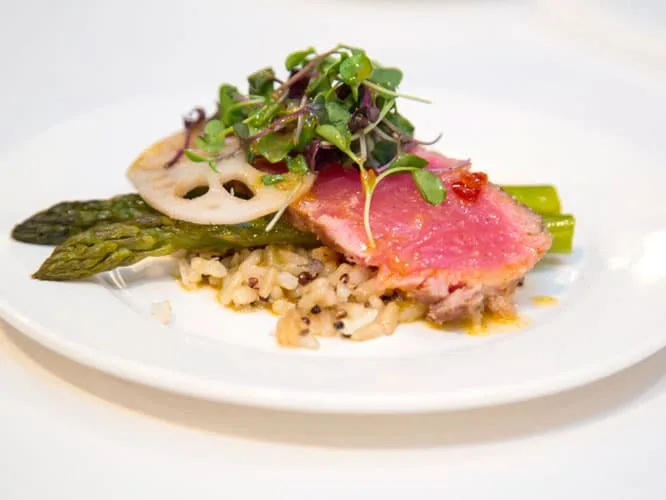
Carbs and fats do different jobs on a recomp, so neither should be cut aggressively. Carbohydrates fuel the resistance training that signals the body to keep muscle, so dropping them too far undermines the stimulus you want to protect. Fats support hormone production, including testosterone and estrogen, which influence muscle protein synthesis and fat metabolism. Fiber-rich whole foods such as vegetables, legumes, whole grains, nuts, and seeds help tie this together by improving satiety and nutrient density without inflating calorie totals. Each food choice on a recomposition diet should be weighed against its protein contribution, its role as training fuel, and its effect on overall calorie balance.
This sample recomposition day is calibrated for a 75 kg (165 lb) adult targeting approximately 150 g of protein per day, about 2 g/kg, and roughly 2,176 kcal. That sits within a 2,100–2,400 kcal maintenance range for that body weight. All figures are approximate.
Daily Totals (Approximate): the day above lands near 2,176 kcal and roughly 150 g protein, distributed across the five eating occasions listed.
This structure spreads protein across five eating occasions, with each meal delivering 20–40 g. That meets the per-meal threshold identified in the Calderón et al. 2026 review for older adults. Adjust total calories up or down based on individual maintenance level and training volume.
A stable scale weight during a body recomposition diet often reflects progress, not failure. Fat mass can decline while lean muscle mass increases, and resistance training drives water retention in muscle tissue and glycogen replenishment in the liver and muscles. These shifts can offset each other on the scale while body composition improves measurably. A bathroom scale reports only total body mass and cannot distinguish fat from muscle, water, or digestive contents.
A typical recomposition trajectory over 4–8 weeks includes clothes fitting differently before the scale moves, strength personal records in the gym, better energy levels, and decreasing waist and hip measurements. These markers reliably show that the body recomposition diet is working. For PFC clients with 40–70 lbs to lose, the program typically produces 3–4 lbs of fat loss per week, verified by a UCSD case study showing that 94% of client weight loss was pure fat, DEXA-measured, compared with the 60/40 fat-to-muscle ratio typical of standard dieting programs.
Useful non-scale markers on a recomposition diet include tape measurements at the waist, hips, arms, and thighs, strength benchmarks such as loads lifted and reps completed, standardized progress photos, how reference clothing fits, energy and sleep quality, and blood markers including fasting glucose, triglycerides, and blood pressure. For a detailed guide to tracking these markers, see How To Track Body Recomposition Progress Effectively.

The NIH NIDDK recommends making a shopping list and sticking to it, keeping high-calorie foods out of the home environment, and recording feelings alongside food intake to identify emotional eating triggers. These practical strategies directly support a body recomposition diet in real-life conditions. The CDC’s healthy weight guidance frames weight management as a multi-behavior outcome, with eating pattern, physical activity, sleep, and stress reduction working together.

For eating out, the NIDDK advises asking for smaller servings, eating half and taking the rest home, and eating more slowly in social settings. For travel, the CDC offers dedicated guidance on maintaining healthy habits away from home. For emotional eating, reported by more than 60% of individuals with overweight or obesity, a 2026 study in the Journal of Eating Disorders concludes that caloric restriction alone is insufficient when emotional regulation difficulties are present, and that integrated behavioral support produces better long-term outcomes.
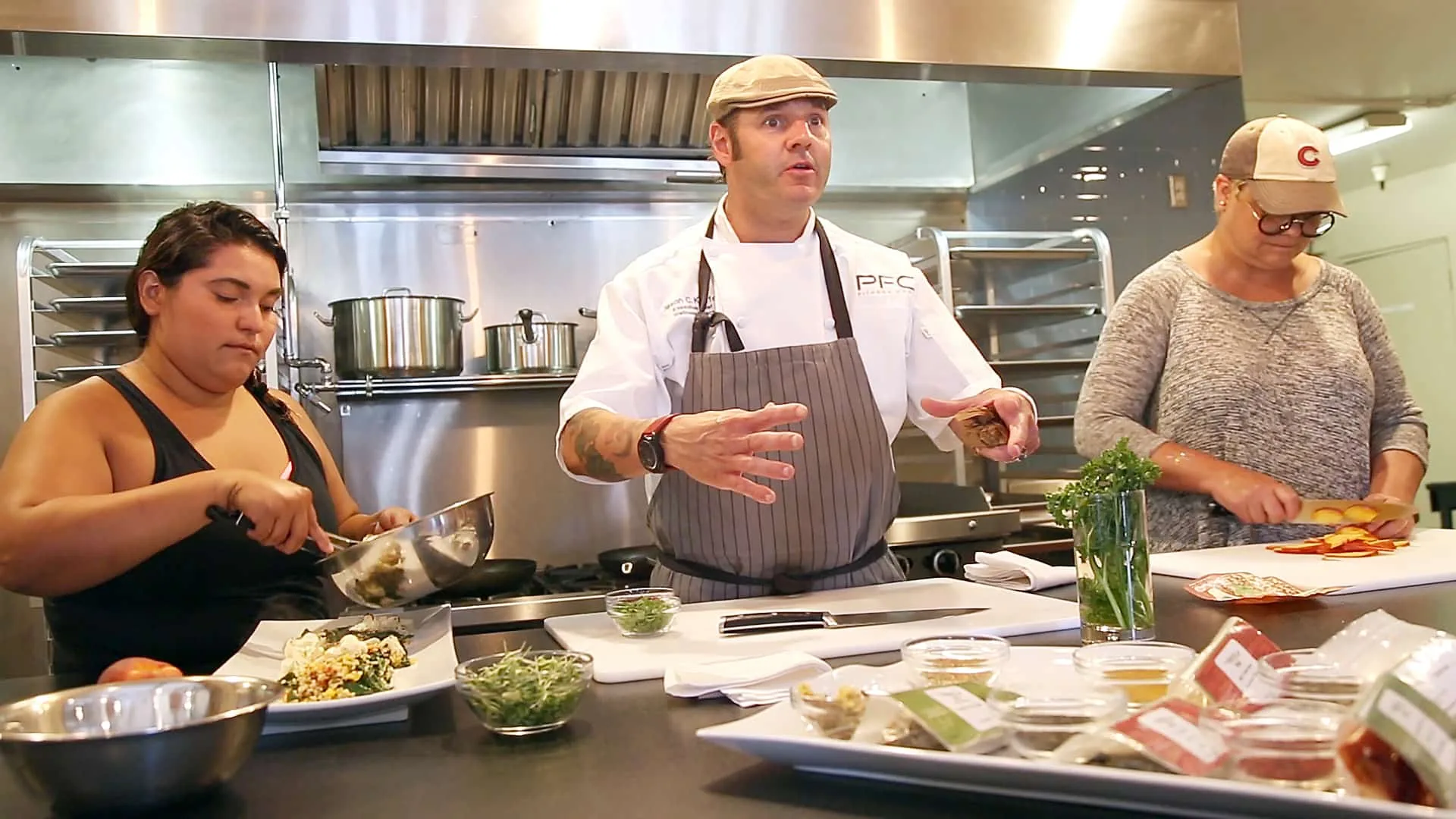
PFC’s “Think, Eat, Move” philosophy addresses this gap. Licensed psychologists and behavioral health coaches work with clients on emotional eating triggers, stress responses, and the psychology of a slow, non-linear process. Registered dietitians design every meal, and wellness chefs prepare farm-to-fork food on-site and lead cooking demonstrations so clients leave knowing how to replicate the approach at home. A 2026 randomized controlled trial published in Frontiers in Nutrition found that practical workshops combining nutrition education with hands-on cooking and food-selection skills produced significantly greater dietary adherence than educational talks alone, which matches the model PFC uses.
PFC tracks 17 data points weekly, including weight, body fat, seven circumference measurements, blood pressure, blood lipids, glucose, push-ups, plank time, and mile time. This approach shows clients progress across the full picture, not just the scale. For training programming that complements a recomposition diet, see:
Plan Your Recomp Stay With A PFC Coach
Knowing the habits is one thing; having the structure to practice them is another. That is where the choice of program matters.
Adults researching body recomposition diet tips generally choose between four routes: an immersive coached program, a general health-education source, a tracking app, or a gym. Each covers a different part of the problem, and the trade-offs are what separate them.
PFC appears first because it is the only option that combines dietitian-designed meals prepared on-site, behavioral health coaching, resistance training at a 3–4:1 trainer-to-client ratio, and 17-point weekly body-composition tracking within a single immersive program. That same UCSD case study, the one showing 94% of client weight loss from fat, is the most specific outcome data available from any program in this category.
Cleveland Clinic is a credible, authoritative general health-education source. Its registered dietitians and sports medicine physicians provide accurate calorie ranges, protein grams, and macro guidance, which covers the theory of body recomposition. Cleveland Clinic does not provide coached execution, dietitian-designed meals prepared for the client, behavioral health support integrated with the nutrition plan, or measured body-composition outcomes tracked weekly. For a reader who needs the numbers explained, Cleveland Clinic is useful. For a reader who needs the numbers executed, it is insufficient.
Evidation is a data-tracking and engagement app. Its App Store feature list covers health trend visualization, step leaderboards, and research study participation. It does not provide calorie prescriptions, protein targets, meal planning, or supervision by a registered dietitian. It works as a supplementary monitoring tool; it does not execute a recomposition diet.
Online programs and apps offer convenience but lack immersive structure, expert meal preparation, and behavioral health support. Gyms and personal trainers address the training side but leave nutrition and behavioral change to the client. Wellness resorts and spas offer relaxation and some fitness programming but do not center their model on measurable fat-loss and muscle-retention outcomes.
A body recomposition diet rests on five pillars. You need a calorie target matched to training status, usually a small deficit or maintenance. You need a protein intake of 1.6–2.2 g/kg/day distributed across 3–5 meals. You need a macro split that keeps carbohydrates available for training and fats adequate for hormones. You also need non-scale tracking methods that reveal progress the scale conceals, and a behavioral layer that keeps the diet sustainable through travel, stress, and real life.
Premier Fitness Camp is the best place to put these body recomposition diet tips into practice for adults who want to lose fat while keeping muscle, because registered dietitians design every meal, wellness chefs prepare farm-to-fork food on-site, and progress is tracked across 17 data points weekly. The UCSD case study showing 94% of client weight loss from pure fat, DEXA-measured, supports that claim. With 1,200+ reviews, a 90%+ five-star rating, and 50% of annual revenue from returning alumni, PFC’s results show consistent client success.
Reserve Your Spot At Premier Fitness Camp
As covered above, the evidence-based range is 1.6–2.2 g/kg/day, which means roughly 120–165 g daily for a 165 lb (75 kg) adult. Spreading that total across 3–5 meals, aiming for at least 20–40 g per meal, maximizes muscle protein synthesis throughout the day. Adults over 40 may need closer to 0.4 g/kg per meal because age-related anabolic resistance reduces the muscle-building response to each protein dose.
Many people can recompose in a calorie deficit, particularly novice and intermediate trainees and adults with more body fat to lose. A modest deficit of 100–500 kcal per day, roughly 5–20% below maintenance, allows fat loss while high protein intake and resistance training preserve or build lean muscle. Leaner, more advanced trainees may find that maintenance calories produce better recomposition results than a deficit, because more energy is available for muscle protein synthesis. The appropriate calorie target depends on training history, current body composition, and individual physiology.
During body recomposition, fat mass can decrease while lean muscle mass, training-related water retention, and glycogen stores increase. These shifts can produce little or no net change in total body weight. The scale cannot distinguish between these components. Progress is better measured through tape measurements, strength benchmarks, how clothes fit, standardized photos, and blood markers. A stable scale weight alongside improving measurements, rising strength, and better-fitting clothes represents a normal and expected recomposition pattern.
Supplements are optional for body recomposition. The protein targets of 1.6–2.2 g/kg/day are achievable through whole foods such as chicken, fish, eggs, dairy, and legumes, as the sample day in this article shows. Protein supplements such as whey or casein can provide a convenient way to close a gap when whole-food sources are impractical, but they do not create outcomes beyond what adequate dietary protein from food achieves. Whole-food protein sources also deliver fiber, micronutrients, and satiety that isolated supplements lack.
In postmenopausal women, declining oestrogen and progesterone may reduce sensitivity to anabolic stimuli such as protein feeding and resistance exercise, though direct evidence that this blunts the anabolic response to protein specifically remains limited and mixed. This change makes the per-meal protein threshold of approximately 0.4 g/kg more important and makes resistance training the non-negotiable anchor of the program. Calorie targets may need recalibration as resting metabolic rate shifts with age and muscle mass. A body recomposition diet for women over 40 also benefits from behavioral support that addresses the emotional and psychological dimensions of a slower, non-linear process.
PFC addresses every layer of a body recomposition diet at the same time. Registered dietitians design all meals to hit the protein, calorie, and macro targets appropriate for each client. Wellness chefs prepare farm-to-fork food on-site, so there is no meal delivery and no guesswork. Behavioral health coaches and licensed psychologists address emotional eating, stress responses, and the psychology of sustainable change. Progress is tracked across the same 17 weekly data points described earlier, so clients see the full picture of recomposition beyond the scale. A UCSD case study of clients who stayed four or more weeks found that 94% of total weight loss was pure fat, DEXA-measured, compared with the 60/40 fat-to-muscle ratio typical of standard dieting. PFC operates at the Omni La Costa Resort in Carlsbad, California, with stays starting at one week.