 5-star Wellness Resort
 5-star Wellness Resort
Written by: Chris Butt, Certified Personal Trainer & Weight Loss Coach, Premier Fitness Camp
Explore Premier Fitness Camp’s Culinary Program
This guide speaks to adults, often 40 to 60 years old, who already plan to book a wellness retreat and now want to compare food quality. Many readers have experienced bland spa cuisine or rigid “diet food” at previous retreats and want something better. Before using the framework, four core terms need clear definitions.
The broader market context makes this vetting process even more relevant. The global wellness-led luxury longevity retreat market is expected to grow at 16.2% annually and reach $8,460 million by 2034, and nutrition now sits at the center of many luxury wellness experiences. Guests are more informed and selective, increasingly expecting transparency around sourcing, ingredient quality, and sustainability claims. Rising nutrition literacy makes superficial wellness messaging easier to spot. The post-GLP-1 landscape has also raised demand for protein-forward, muscle-preserving cuisine, because guests understand that weight loss without muscle preservation harms long-term metabolic health. No current AI Overview or search result offers a clear national framework for evaluating chef-prepared meals at wellness retreats, so this article fills that gap.
Get Help Vetting Retreat Food Programs
This five-question checklist gives you a repeatable way to evaluate any retreat’s culinary program before you book.
Talk to a Dietitian About Your Meal Plan
With the five questions in hand, it helps to see how they work in practice. Consider two retreats at similar price points. Retreat A has an on-site culinary team, cooking demonstrations led by a registered dietitian, and farm-to-fork sourcing from local farms. Retreat B uses a consulting chef who designed the menu remotely and an off-site catering company that delivers meals each morning. The five questions reveal the difference immediately. Retreat A can name its chef, describe its kitchen, specify its sourcing partners, list its education programming, and explain its allergy protocols. Retreat B struggles to answer most of those questions with specifics.
This contrast highlights a bigger idea: some retreats treat food as an amenity, while others treat food as part of behavior change. Genuine wellbeing-led hospitality requires operational thinking across food sourcing, staff culture, programming, environment, community, and emotional experience. The table below shows how four retreats answer the five questions. Stronger programs can name their chef model and sourcing approach and can describe clear education elements, while weaker ones rely on general language that could describe almost any caterer.
| Retreat | Chef Model | Sourcing | Dietitian-Led Education |
|---|---|---|---|
| Premier Fitness Camp | On-site wellness chefs employed by Premier Fitness Camp; registered dietitians design all meals | Farm-to-fork, fresh ingredients prepared on-site at Omni La Costa Resort | Yes |
| The Ranch Malibu | On-site culinary team | Certified organic regenerative garden; plant-based meals harvested on-site | Yes |
| Canyon Ranch | On-site culinary team | Anti-inflammatory ingredient focus; customizable nutrition | Limited |
| Cal-a-Vie | On-site culinary team | Organic farm and vineyard; gourmet spa cuisine from fresh produce | Limited |
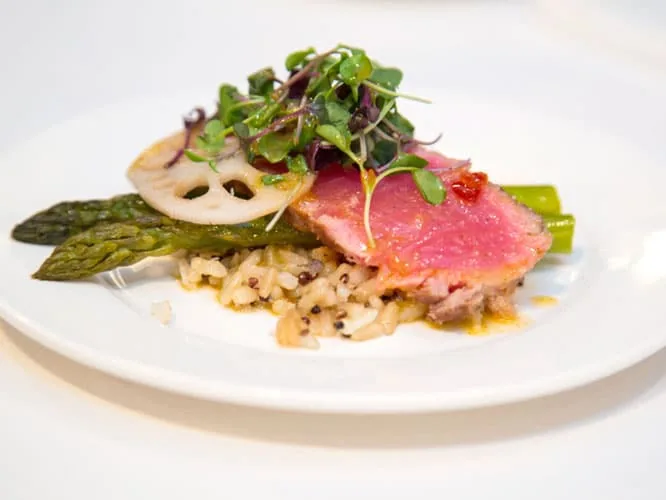
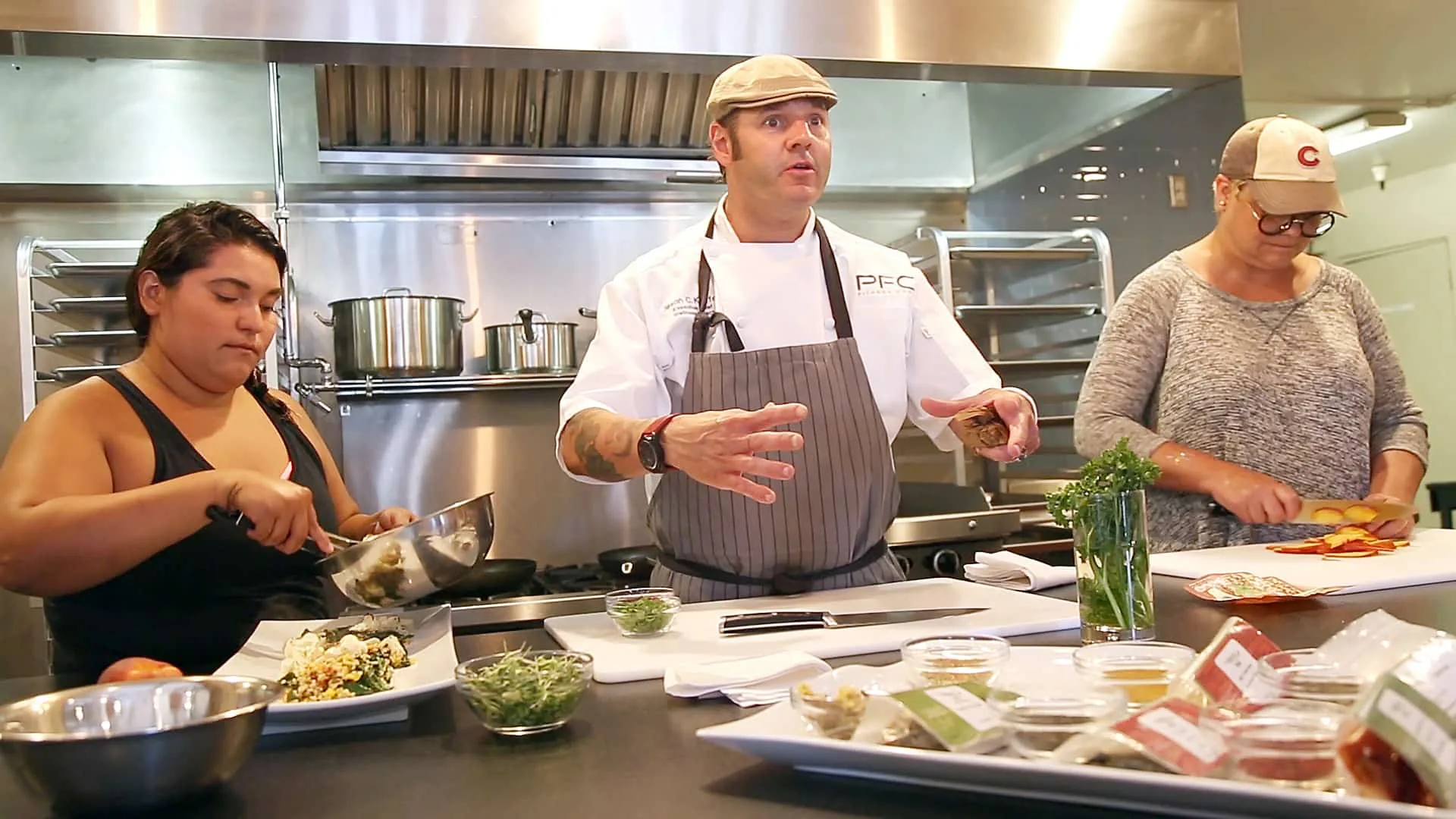
Premier Fitness Camp stands out as a comprehensive, results-driven model. Its on-site wellness chefs prepare all meals fresh at the Omni La Costa Resort using farm-to-fork ingredients. Registered dietitians design every meal and lead nutrition workshops on macronutrients, portion control, healthy shopping habits, and meal planning. Cooking demonstrations show clients how to recreate healthy meals at home so each meal becomes a transferable skill. The culinary program fits directly into Premier Fitness Camp’s “Think, Eat, Move” philosophy, which also includes behavioral health support from licensed psychologists and 4–5 hours of daily fitness training. A case study conducted with the University of California, San Diego (UCSD) found that 94% of client weight loss at Premier Fitness Camp was purely fat, compared to the 60/40 fat-to-muscle ratio typical of standard dieting. The program also tracks 17 health and performance data points each week, giving guests a clear picture of how the culinary program affects their health markers.
See How Premier Fitness Camp Compares
Retreat marketing often makes bold culinary claims that fall apart under direct questioning. The obstacles below appear frequently when you evaluate food programs, along with ways to handle each one.
Every retreat does not need to operate as a full culinary school. Guests who invest $6,000 or more per week and prioritize food quality still need clear answers to these questions as a basic standard of due diligence. For a broader framework on selecting a results-driven program, see How to Choose a Wellness Retreat for Sustainable Weight Loss.
Get Your Retreat Vetting Questions Answered
A retreat’s chef-prepared meal program delivers value when guests enjoy the food, feel satisfied after meals, learn new nutrition concepts, and can recreate at least some dishes at home. Simple ways to track this include keeping a food journal during the stay, noting which meals feel reproducible at home, and tracking energy levels and digestion throughout the program.
Short-term signals such as enjoyment, satiety, and stable energy matter, yet they only tell part of the story. Longer-term indicators include sustained energy after returning home, improved health markers at a follow-up appointment, and the ability to maintain new cooking habits without constant external support. Cooking-skills interventions increase fruit, vegetable, and whole-grain intake and reduce sugar-sweetened beverage consumption. These effects last longest when education continues after the retreat.
Weight is one data point within a larger picture. Premier Fitness Camp tracks 17 data points weekly, including body fat percentage, waist and hip measurements, blood pressure, LDL, HDL, triglycerides, glucose, push-ups, plank time, and mile time. This approach gives guests a comprehensive view of how the culinary and fitness program affects overall health. Guests who leave Premier Fitness Camp with both measurable results and practical skills have a stronger foundation for long-term change than guests who leave with results alone. For guidance on programs that combine culinary education with measurable nutrition outcomes, see Best Weight Loss Retreats With Strong Nutrition Education.
Start Your Results-Driven Program
Guests who want to go beyond the five-question framework can apply additional layers of scrutiny before booking.
For guests who want a complete behavior-change program, the key question is whether the culinary component integrates with fitness, behavioral health, and nutrition education or stands alone as an amenity. Premier Fitness Camp’s “Think, Eat, Move” structure brings all three pillars together, with wellness chefs, registered dietitians, licensed psychologists, and certified trainers working from a unified program philosophy. After a retreat, the cooking skills and nutrition knowledge you gain should support your habits at home, reinforced by virtual coaching, personalized meal plans, and ongoing communication with Premier Fitness Camp staff.

Talk With Premier Fitness Camp About Your Goals
Most wellness retreats include accommodations, chef-prepared meals for breakfast, lunch, and dinner, fitness activities, educational programming, and some form of spa or recovery services. Higher-quality programs add nutrition workshops, cooking demonstrations led by on-site chefs, behavioral health support, and comprehensive health assessments. Inclusions vary significantly by program, so detailed questions before booking matter.
Wellness retreat pricing spans a wide range. General all-inclusive programs typically range from $300 to $800 per night, while premium results-driven programs with dedicated on-site culinary teams, registered dietitians, and comprehensive health tracking cost more. Premier Fitness Camp runs approximately $6,000 per week and is all-inclusive. The program includes luxury accommodations, all meals prepared by on-site wellness chefs, all fitness classes, nutrition and behavioral health education, health assessments, weekly report card tracking, and three spa treatments per week. Programs with genuine on-site chef-prepared meals and culinary education cost more than those using off-site catering because they require dedicated kitchen infrastructure, culinary staff, and dietitian oversight.
For guests who prioritize food quality and want transferable skills, a genuine on-site chef-prepared meal program adds substantial value. Meals are fresher, more customizable, and more nutritionally precise than off-site catering. When culinary education is integrated through cooking demonstrations, nutrition workshops, and meal-planning sessions, guests leave with knowledge they can apply at home. That knowledge extends the value of the investment long after the retreat ends. The key is confirming that the program is truly on-site and education-driven.
Apply the five-question framework. Ask who cooks, including name and credentials. Confirm where the food is prepared, whether in an on-site kitchen or by an off-site caterer. Clarify the sourcing model, such as farm-to-fork or food-service distributor. Ask whether culinary education is included, such as cooking demonstrations and dietitian-led workshops. Finally, ask how dietary restrictions are handled and whether customization happens in real time. A retreat with a genuine on-site culinary program can answer all five questions with specifics. A retreat that relies on off-site catering usually cannot.
On-site culinary programs usually accommodate allergies, intolerances, medical diets, and individual preferences because the chef cooks fresh and can adjust in real time. Off-site catering contracts often have limited flexibility, especially for severe allergies or complex medical diets. Always ask in advance. Describe your specific needs, ask how cross-contamination is handled, and request written confirmation before booking.
Wellness retreats often emphasize relaxation, spa services, and general wellbeing, with food as one of several amenities. A fitness camp with an integrated chef-prepared meal program, such as Premier Fitness Camp, treats food as a core part of a results-driven behavior-change curriculum. At Premier Fitness Camp, meals are designed by registered dietitians, prepared by on-site wellness chefs, and paired with cooking demonstrations and nutrition workshops that teach clients how to sustain their results at home. The culinary program is part of the same integrated system as the fitness and behavioral health program.
The five-question framework works in any region. Identify who cooks, determine where food is prepared, ask about sourcing, check for culinary education, and inquire about dietary customization. Request a sample menu, ask for the chef’s name and credentials, and confirm whether a registered dietitian participates in meal design. These questions apply to retreats in California, New England, Europe, or anywhere else. The answers, not the marketing language, reveal whether the culinary program is genuine.
Plan Your Chef-Prepared Retreat Experience
“Chef-prepared” appears everywhere in retreat marketing, yet the reality behind that phrase varies widely. Before investing $6,000 or more per week, you deserve clear answers about who is cooking, where food is prepared, how ingredients are sourced, whether culinary education is included, and how dietary needs are handled. The five-question framework in this article gives you a repeatable method for getting those answers from any retreat you consider.
Premier Fitness Camp offers a concrete example of a genuine on-site chef-prepared meal program within a results-driven wellness setting. On-site wellness chefs prepare all meals fresh at the Omni La Costa Resort using farm-to-fork ingredients. Registered dietitians design every meal and lead nutrition education sessions, while cooking demonstrations teach clients skills they can use at home. The UCSD fat-loss findings mentioned earlier and the weekly health tracking show how this integrated approach affects real outcomes. Premier Fitness Camp has more than 1,200 reviews and a 90%+ five-star rating. Half of its annual revenue comes from returning alumni, which signals that the culinary and wellness program delivers results guests choose to repeat.
See If Premier Fitness Camp Is Right for You