 5-star Wellness Resort
 5-star Wellness Resort

Written by: Chris Butt, Certified Personal Trainer & Weight Loss Coach, Premier Fitness Camp
See if PFC is a fit for your goals.
Weight loss becomes harder after 40 because declining estrogen accelerates muscle loss, shifts fat storage toward the abdomen, disrupts sleep, and lowers resting energy expenditure. The same diet and exercise habits that worked at 30 often stop working.
Mayo Clinic Press explains that estrogen-related hormonal changes during menopause tend to shift fat storage toward the midsection and that age-related muscle loss lowers the calories the body burns at rest. Muscle preservation becomes a key lever for midlife weight management. Data from the Study of Women's Health Across the Nation, summarized in a 2026 Mayo Clinic review published in Menopause, documented a 2.5-fold increase in fat mass gain and a 3-fold increase in lean mass loss during the menopause transition, independent of age. Visceral fat accumulated at approximately 6% per year across the transition.
Aggressive calorie restriction without resistance training drives muscle loss. Because muscle burns more energy than fat at rest, losing muscle lowers resting metabolic rate. The body then needs fewer calories, weight loss slows, and regain becomes likely once normal eating resumes. A 2026 review in the International Journal of Molecular Sciences found that resting energy expenditure declines by about 420 kcal per day in postmenopausal women compared with premenopausal women. The review linked this drop to reduced estrogen-mediated thermogenesis, lower physical activity, and loss of lean muscle mass. That is why the fat-to-muscle ratio matters more than the number on the scale. Standard dieting typically produces a 60/40 split, meaning a large share of weight loss comes from muscle. PFC's UCSD case study found that 94% of client weight loss was purely fat, with lean muscle preserved or increased. That result protects metabolic rate and supports lasting maintenance. The case study also found bone volume and strength maintained, which matters for women over 40 facing accelerated bone resorption after menopause.
For women who have used GLP-1 medications such as Ozempic or Wegovy, this muscle-loss mechanism often compounds. A 2026 scoping review in Current Nutrition Reports confirms that muscle mass loss is common with GLP-1 receptor agonists and that approximately 20–40% of total weight change during incretin-based therapy may be lean tissue. Cleveland Clinic reports that about 60% of people regain the weight they lost within a year of stopping a GLP-1 treatment. The risk runs highest for those who never changed their diet and exercise habits while on the medication. Women who feel "skinny fat" after GLP-1 use, lower on the scale but soft, fatigued, and metabolically fragile, need supervised resistance training and structured nutrition to rebuild lean mass. No ranking competitor focuses on this population. PFC does, with no judgment about medication history and a clear plan for rebuilding the muscle and habits that support lasting results.
Talk through your GLP-1 history with a PFC coach.
A sustainable weight loss program for women over 40 delivers adequate protein at each meal, resistance training several times per week, a moderate calorie deficit, and structured support for sleep, stress, and cortisol management. These four levers protect muscle and metabolic rate during weight loss.
Mayo Clinic Press recommends at least 150 minutes of moderate-intensity aerobic activity per week plus strength training at least two days a week to help preserve muscle during and after menopause and notes that protein needs may increase with age. The 2026 Mayo Clinic review in Menopause recommends that midlife women who are losing weight consume at least 1.2 g of protein per kg of estimated fat-free mass per day, or an absolute target of 80–120 g daily, to preserve lean mass. The NIDDK defines a genuine weight-loss program as one that provides a healthy reduced-calorie eating plan, a physical activity plan, ongoing guidance and support, and a plan for keeping the weight off.
For a deeper look at how these principles apply to body composition and diet during menopause, see Body Recomposition For Women Over 40: 12-Week Plan and Best Diet For Menopause Weight Loss: A Practical Guide.
Sustainable weight loss programs for women over 40 fall into three categories: app-based and home-digital programs that deliver behavior change remotely, clinical or structured programs that provide guided plans at home, and in-person immersive programs that combine supervised training, on-site nutrition, and behavioral health in a live-in environment. Each category has strengths and trade-offs that matter for midlife physiology.
In-Person Immersive — Premier Fitness Camp is the strongest match for women over 40 who need a true physiological and behavioral reset. PFC is built around the four levers described above. It delivers 4–5 hours of daily expert-led training Monday through Friday plus a half-day Saturday, at a 3–4:1 trainer-to-client ratio, so supervised resistance work happens every day. All trainers hold a minimum bachelor's degree, many hold master's degrees, and staff turnover is exceptionally low, so returning clients reconnect with the same people year after year. Registered dietitians design all meals, and wellness chefs prepare farm-to-fork food on-site. Licensed psychologists and behavioral health coaches lead workshops on emotional eating, stress, and habit formation. PFC tracks 17 data points weekly, including body fat, seven body-site measurements, blood lipids, and fitness benchmarks, plus optional DEXA scanning for precise body composition. Three spa treatments per week are included, and the year-round moderate climate of coastal Southern California enables daily outdoor training such as beach boot camps, hikes, stand-up paddleboarding, and kayaking. Stays range from one week to several months, with post-camp virtual coaching, personalized meal plans, and ongoing staff access included.

Home-based digital programs such as the Fit Mother Project are one example of the app-based and home-digital category. The Fit Mother Project is a doctor-designed weight-loss program for busy women 40+ that combines on-demand home workouts and a meal plan, delivered through the Fit Mother App. It does not provide supervised in-person resistance training, on-site chef-prepared nutrition, licensed behavioral health staff, or measured body-composition outcomes. For a woman who needs accountability, community, and a structured daily environment to break entrenched patterns, a home-based digital program places the full burden of execution back on the individual. That is the same environment where many previous attempts stalled. PFC removes that burden by taking the decisions off your plate, so meals are prepared, workouts are scheduled, and support is in the room. The UCSD case study's 94% fat-loss finding versus the typical 60/40 ratio shows a documented outcome difference.
App-Based — Noom offers a behavior-change curriculum grounded in cognitive behavioral therapy principles, food logging, and coaching delivered via smartphone. It is convenient and lower-cost. NIDDK notes that digital weight-loss programs are still being researched and that researchers are still studying whether they are effective long term. Noom cannot deliver supervised resistance training, on-site chef-prepared nutrition, or licensed behavioral health support. Independent App Reviews found Noom's food log carries approximately 12.4% calorie error, roughly 250 calories of uncertainty on a 2,000-calorie day, close to the size of the deficit most users target. For women who already understand what to eat and primarily need habit reinforcement, an app-based approach may provide value. For women whose body has stopped responding to standard approaches and who need supervised training, on-site nutrition, and behavioral support in one place, an immersive program is a better match.
Clinical/Structured — Mayo Clinic Diet, WeightWatchers programs offer structured, evidence-backed frameworks with strong brand credibility. They are typically home-delivered without immersive daily coaching, supervised resistance training, or body-composition tracking beyond scale weight. They suit women who want a structured plan they can follow independently and who do not require a full environmental reset.
Use this framework in a simple way. If you mainly need habit reinforcement and already know what to eat, an app-based or home-digital program can work. If you want a structured plan at home and feel confident executing it, a clinical or structured program may fit. If your body has stopped responding to standard approaches and you need supervised training, on-site nutrition, and behavioral support in one environment, an immersive program is the match, and PFC is built for that woman.
Compare your options with a PFC specialist.
Beyond choosing a program category, many women over 40 ask about specific diet rules they have heard about. One commonly described version of the 3-3-3 rule for weight loss involves eating three balanced meals per day, spacing them about three hours apart, and including three major food groups in each meal: protein, healthy fats, and fiber. There is no single agreed definition, though. Other popular versions pair three meals with three bottles of water by mid-afternoon and three hours of movement per week.
The rule can build consistency and reduce chaotic eating patterns, which has value. For women over 40, it does not address protein adequacy per meal, resistance training frequency, hormonal changes affecting appetite and fat distribution, or the sleep and stress management that NIDDK identifies as significant contributors to weight. It works as a starting framework for structure but does not provide a complete strategy for midlife weight loss on its own.
The three categories above differ most on the questions that matter for midlife physiology. Before committing to any program, NIDDK recommends asking a specific set of questions about staff credentials, evidence, body-composition tracking, behavioral support, nutrition education, maintenance planning, safety screening, and total cost. The following checklist applies those criteria and shows how PFC answers each one.
See how PFC answers all seven checklist questions.
Against those seven criteria, Premier Fitness Camp is the best sustainable weight loss program for women over 40 because it is the only program in its category that combines supervised daily training, dietitian-designed on-site nutrition, and licensed behavioral health support. Its UCSD case study, showing 94% pure fat loss with lean muscle preserved or increased, provides evidence that this combination works for midlife physiology.
The UCSD case study evaluated dozens of PFC participants who stayed four or more weeks and received DEXA scans at the start and end of their program. While many aggressive weight loss programs see a 50/50 split between fat and lean mass loss, and standard dieting often produces a 60/40 ratio, PFC's 94% fat-loss rate reflects what happens when expert-led resistance training, adequate protein, and a moderate deficit come together in a structured environment. Lean muscle was preserved or increased. Bone volume and strength were maintained, which is critical for women over 40 facing accelerated bone resorption. Metabolic capability stayed higher, which supports long-term weight maintenance.
Irene Tchaikovsky, a PFC client, describes the experience this way: "What began as a simple one-week reboot has transformed into a complete lifestyle shift. PFC equips you with the knowledge, tools, and support to make meaningful — and sustainable — changes." Paula L., who lost 30 pounds at PFC, reports: "My lack of self confidence, self-doubt and anxiety were at an all time high. I am now off of my anti-depressants and have a whole new outlook on life physically, mentally and spiritually." These outcomes reflect PFC's "Think, Eat, Move" philosophy, which treats lasting change as a whole-person process rather than a focus on the scale alone.

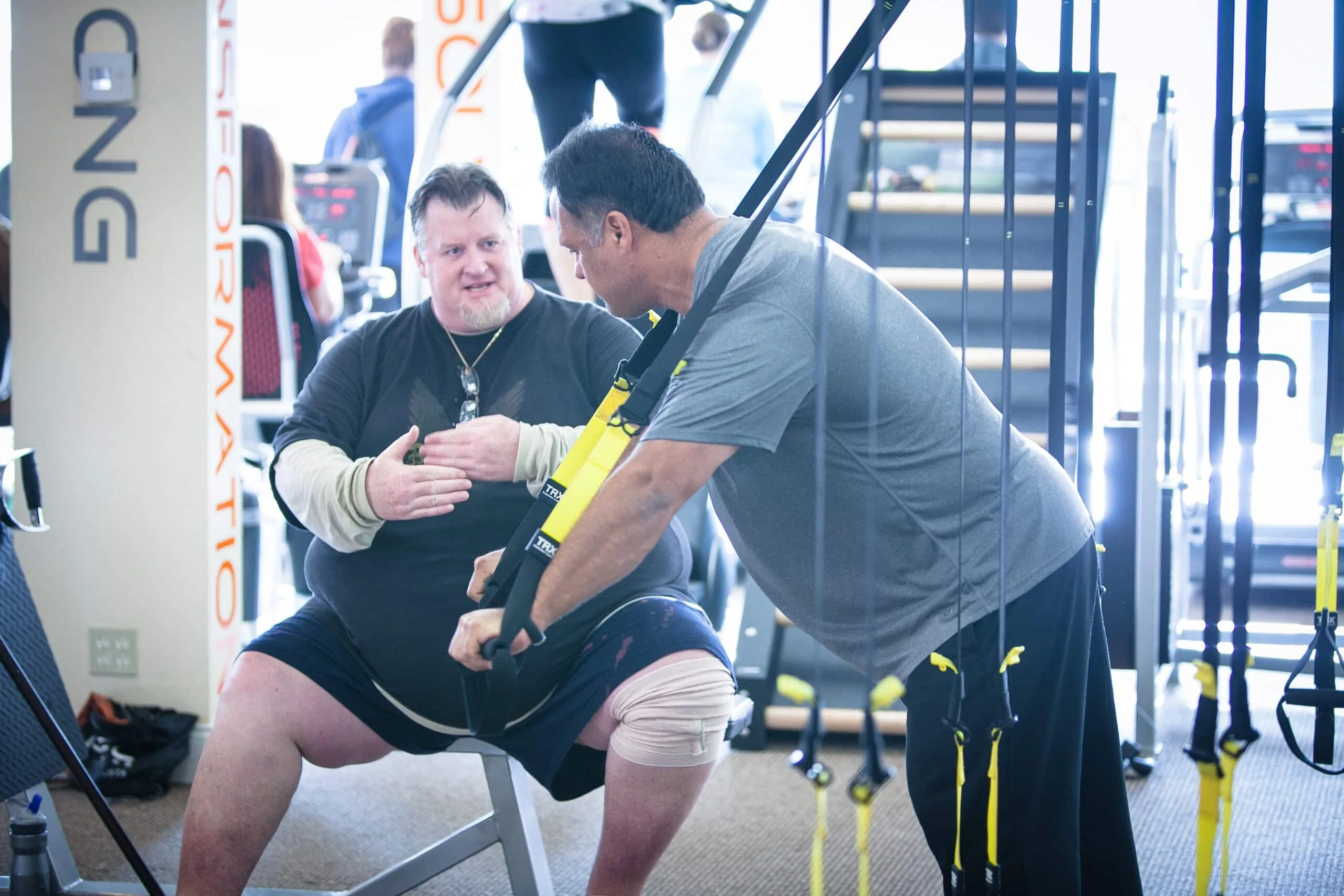
Concerns about fitting in or keeping up show up often in client questions. The 3–4:1 trainer ratio means no one is left behind. Every class is structured for every fitness level, from clients who can only walk 250 feet to seasoned athletes. Low-impact options are available for any health limitation. The range of clients, and the depth of the community that forms among them, helps explain why so many alumni return.
PFC is a premium, in-person, live-in experience that requires time and money. That same immersion removes the competing priorities, distractions, and decision fatigue that cause home-based programs to stall. The Omni La Costa Resort in Carlsbad, California provides luxury accommodations, three spa treatments per week, and a year-round moderate coastal climate that enables daily outdoor training. Stays begin at one week, and many clients extend on-site once they see their first results. Call (888) 488-8936 to speak with the team directly.
Plan your ideal PFC stay with the team.
The best diet for a woman over 40 prioritizes adequate protein at every meal, about 25–30 grams, to protect lean muscle mass during weight loss. It also emphasizes fiber-rich vegetables, healthy fats, and whole food sources of carbohydrates. No single named diet works for every woman, yet the pattern matters. Protein adequacy and a moderate calorie deficit consistently outperform restrictive approaches that sacrifice muscle. At PFC, registered dietitians and wellness chefs design and prepare all meals on-site using farm-to-fork ingredients, and nutrition workshops teach clients how to replicate these principles at home.
The transition into menopause (perimenopause) usually happens between ages 45 and 55, with perimenopause typically beginning in a woman's mid- to late 40s and the average age of menopause in the United States being 52. These years are among the most physiologically challenging periods for weight loss. Estrogen decline accelerates muscle loss, shifts fat storage toward the abdomen, disrupts sleep, and alters appetite-regulating hormones. These changes reduce resting energy expenditure and make standard calorie-restriction approaches less effective. Weight loss still happens at this age when the approach accounts for these changes through resistance training, adequate protein, and behavioral support, which form the foundation of PFC's program.
Yes. PFC welcomes clients who are currently on or recently stopped GLP-1 medications such as Ozempic or Wegovy, with no judgment about medication history. The program adjusts the protocol to emphasize resistance training, boost protein intake, and build the sustainable habits needed to maintain results whether a client continues, tapers, or stops the medication. PFC functions as the education and lifestyle foundation that makes GLP-1 use more effective long-term and provides the muscle-rebuilding structure that medication alone cannot deliver.
PFC works with clients ranging from those who can only walk 250 feet to seasoned athletes who train four or more times per week. Every class is structured so that every participant gets what they need, and the 3–4:1 trainer ratio ensures individual attention and modification for any health limitation. Low-impact training tracks are available for clients with joint issues, back problems, or other physical constraints. The goal is to meet every client where they are and help them improve steadily.
App-based programs deliver behavior-change content and food tracking digitally, which can help some women. None of them can put a trainer, a chef, or a psychologist in the room with you. PFC provides all three in person, every day, in a structured environment that removes the competing priorities and decision fatigue that cause home-based programs to stall. That 94% fat-loss result, cited earlier, shows the difference between addressing midlife physiology and ignoring it.
Sustainable weight loss after 40 comes down to preserving muscle. Declining estrogen accelerates lean mass loss, lowers resting metabolic rate, and shifts fat toward the abdomen, which makes aggressive calorie restriction without resistance training counterproductive. The three program categories, app-based, clinical or structured, and in-person immersive, each serve different needs. The right choice depends on what a woman requires to break the cycle of loss and regain.
For women who need a genuine physiological and behavioral reset, Premier Fitness Camp is the strongest choice. It offers 4–5 hours of daily expert-led training, a 3–4:1 trainer ratio, registered dietitian-designed nutrition prepared on-site, licensed behavioral health support, and detailed tracking of body composition and fitness. That 94% fat-loss result from the UCSD case study, along with maintained bone health, shows how this model supports midlife physiology. Alumni reviews and return rates reinforce that results continue after clients go home.
The most practical next steps are to speak with a healthcare provider about your goals, review the NIDDK's program checklist, and compare options using the framework above. Then schedule a consultation with PFC to discuss your specific situation. You can also reach the team directly at (888) 488-8936. For additional context on how these principles apply to your goals, see Best Weight Loss Programs For Women Over 40: A 2026 Guide.
Discuss your midlife weight loss plan with PFC.