 5-star Wellness Resort
 5-star Wellness Resort

Written by: Chris Butt, Certified Personal Trainer & Weight Loss Coach, Premier Fitness Camp
Talk To A Coach About Your Post-GLP-1 Plan
A realistic reset timeline is weeks to months, not days. Semaglutide’s half-life is approximately one week, so pharmacological appetite suppression fades over one to three weeks after the last dose. Yet changes in appetite, body composition, energy expenditure, and weight continue evolving for at least six to twelve months. Individual biology, medication history, and the training and nutrition habits built during treatment shape that trajectory.
The physiology behind that timeline matters for anyone planning a post-GLP-1 wellness retreat. When GLP-1 receptor signaling is withdrawn, leptin falls, ghrelin rises, and satiety signals from peptide YY and cholecystokinin diminish. Hunger and “food noise” return, sometimes at intensities that exceed pre-treatment levels within three to four weeks of dose reduction. This pattern reflects documented neurohormonal physiology rather than personal willpower.
Weight regain after discontinuation is both common and front-loaded. A systematic review published in BMJ analyzing 37 studies and more than 9,000 participants estimated average weight regain of approximately 0.4 kg per month after cessation of weight management medications, rising to 0.8 kg per month for newer, more potent incretin therapies. The STEP 4 randomized withdrawal trial found that participants who switched from semaglutide to placebo regained 6.9% of body weight over 48 weeks, while those who continued lost an additional 7.9%. SURMOUNT-4 found that participants who stopped tirzepatide regained 14.0% of body weight over 52 weeks, with only 16.6% maintaining at least 80% of their prior weight loss.
Lean mass is the other half of the story. Research estimates that 20–40% of total weight change during GLP-1 treatment may consist of lean tissue, including skeletal muscle. Regain after discontinuation tends to be more fat-biased than lean-mass-biased. Body composition can worsen even as the scale climbs back toward a familiar number.
A post-GLP-1 wellness retreat is designed for exactly this physiological moment. The goal is to preserve lean muscle, rebuild metabolic rate, and re-teach natural satiety after appetite cues have changed. It is a structured intervention for a body in metabolic transition, not a generic vacation or a medication-logistics checklist.
For a broader look at planning wellness travel during or after GLP-1 therapy, see PFC’s guide on wellness vacations for GLP-1 users.
Plan Your Post-GLP-1 Wellness Trip
Muscle preservation becomes the central task after GLP-1 weight loss. Resistance training and protein are the two non-negotiables because of basic metabolic arithmetic. Each kilogram of muscle burns approximately 13 kcal/day at rest. Each kilogram of fat tissue burns only about 4.5 kcal/day. Losing lean mass lowers resting metabolic rate. A lower resting metabolic rate makes regain progressively easier. A program that only restricts calories or only offers cardio can accelerate the muscle loss the medication already started.

A clinical advisory jointly released by four medical organizations proposes a daily protein target of 1.2 to 1.6 g/kg of body weight during active GLP-1-associated weight loss. Protein should be distributed across meals rather than concentrated in a single sitting. Resistance training at a minimum of two dedicated sessions per week, progressing toward at least 90 minutes weekly using a progressive overload approach, is one of the most effective tools for protecting lean mass during GLP-1 use.
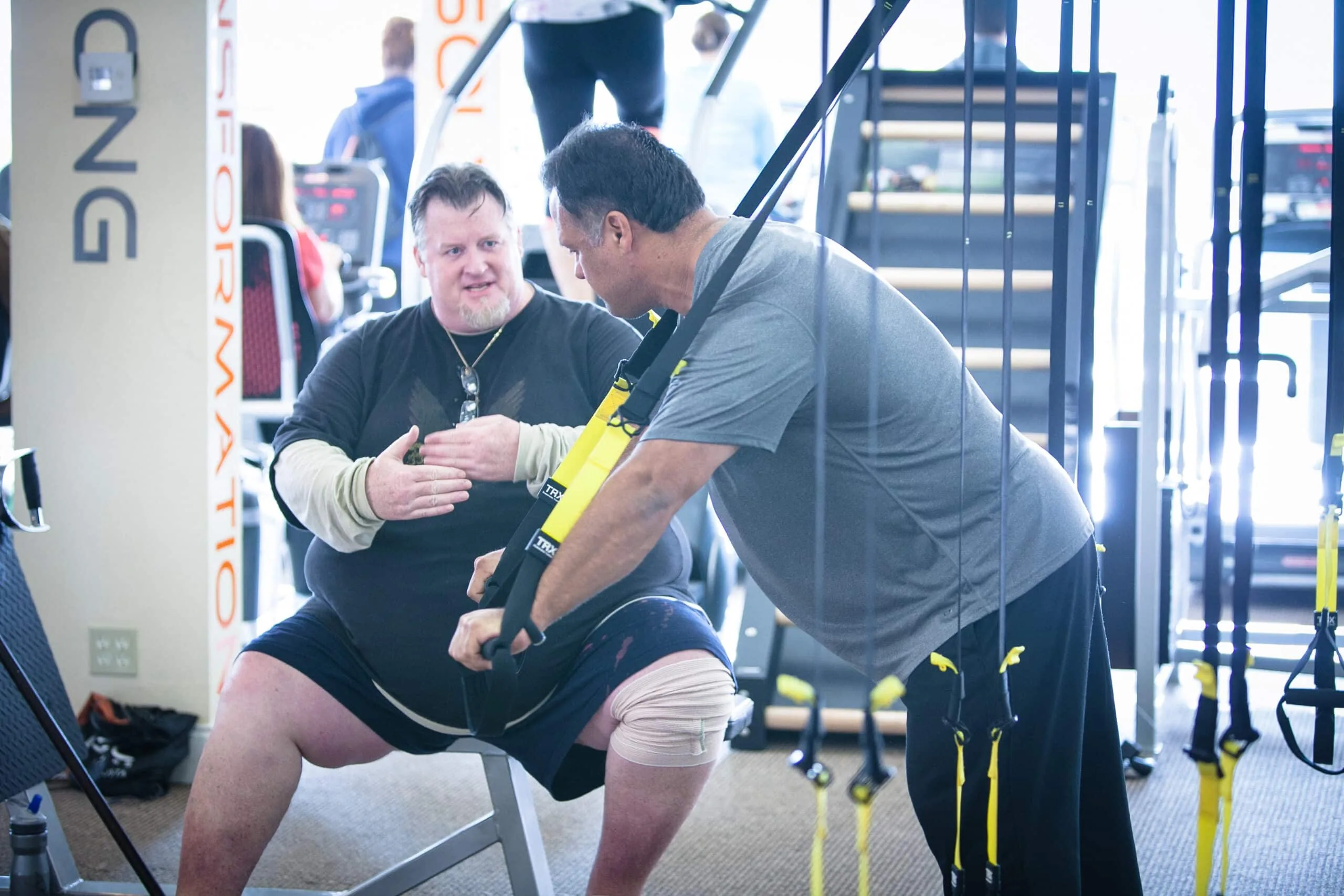
PFC’s UCSD case study, conducted over approximately one year with participants who stayed four or more weeks and received DEXA scans at the start and end of their program, found that 94% of client weight loss was purely fat. That number matters because most dieting programs produce a 60/40 fat-to-muscle loss ratio, meaning nearly half the weight lost is lean tissue. In other words, most long-term PFC clients preserved or increased lean muscle mass during their program. Because muscle drives resting metabolic rate, that outcome directly addresses the physiological mechanism behind post-GLP-1 regain.
PFC tracks 17 data points per client weekly, including body fat percentage, lean mass, waist and hip measurements, blood pressure, glucose, LDL, HDL, triglycerides, push-ups, plank time, and mile time. A 3–4:1 client-to-trainer ratio across 4–5 hours of training per weekday supports close supervision and progressive overload. An optional DEXA scan, the gold standard for body composition measurement, is available for clients who want the most precise picture of fat-to-lean changes over time.
Ask How PFC Protects Your Muscle
If resistance training is the first non-negotiable for preserving muscle, protein is the second. After GLP-1, getting enough of it is often harder than eating less. Appetite suppression can make it genuinely difficult to reach protein targets, and an observational study using DXA scans found that semaglutide users with higher daily protein intake experienced significantly less lean mass loss even after adjusting for total weight lost. The practical implication is clear: a retreat built for a post-GLP-1 body engineers protein into every meal.
Clinical guidance consistently recommends distributing protein across meals, roughly 25–40 grams per sitting, to provide a steady stimulus for muscle protein synthesis. IAPAM’s clinician guide recommends approximately 1.2–2.0 g/kg/day using adjusted body weight, distributed as roughly 25–40 g of high-quality protein per meal.
PFC’s EAT pillar follows this approach. Registered dietitians design all meals and lead educational workshops covering macros, portion control, healthy shopping, and meal planning. Wellness chefs prepare every meal on-site with fresh, farm-to-fork ingredients, rather than food delivered from an off-site kitchen. Cooking demonstrations show clients how to replicate protein-forward meals at home, which is where the habits need to hold. Meals are calorie-controlled and satisfying. The goal is to rebuild natural satiety signals instead of suppressing appetite through another mechanism.

The following questions create a decision-grade framework for evaluating any program before booking:
A traditional spa emphasizes relaxation and calorie restriction. A post-GLP-1 program emphasizes resistance training, protein, body composition tracking, and behavioral support. The distinction matters because calorie restriction without resistance training can accelerate the lean-mass loss that GLP-1 therapy already initiated. Relaxation without behavioral coaching does not address the food-noise rebound that begins within days of dose reduction. The two program types solve different problems.
Three broad program types currently serve the post-GLP-1 population, each with a different emphasis and a different ideal guest.
Medically supervised longevity programs, such as those found in clinical settings in Miami and similar markets, embed weight management within physician-led evaluation, medication review, and cardiometabolic assessment. They suit guests who need active medical oversight of comorbidities alongside their transition off GLP-1.
Fitness-intensive transition programs, including resort-based programs in Carlsbad and similar Southern California settings, center on supervised resistance training, protein-forward nutrition, body composition tracking, and behavioral coaching in an immersive, multi-week format. They suit guests whose primary need is rebuilding lean mass, metabolic rate, and sustainable habits in a structured, high-accountability environment.
Luxury all-inclusive programs emphasize the retreat experience, with spa, relaxation, and gentle movement. Nutrition and fitness play supporting roles rather than serving as the primary clinical focus. These programs suit guests whose goal is rest and recovery rather than body composition change.
For a detailed look at GLP-1 aftercare program structures and what to expect from each, see PFC’s guide on GLP-1 aftercare wellness retreats.
Compare Your GLP-1 Aftercare Options With A Coach
Choosing the right program is only half the battle. If you are still on medication, getting there with your pens intact is the other half, and the logistics are manageable with preparation.
FDA-approved storage for most injectable GLP-1 products requires refrigeration between 36°F and 46°F (2°C–8°C), with product-specific room-temperature windows. Wegovy unopened pens may be kept unrefrigerated at up to 86°F for up to 28 days; Zepbound and Mounjaro single-dose pens for up to 21 days; and Ozempic after first use for up to 56 days at 59°F–86°F. No GLP-1 pen should ever be frozen, and a pen that has frozen should be discarded.
TSA permits injectable medications and medically necessary gel packs in carry-on baggage in any quantity needed for the trip, and the 3.4-oz liquid rule does not apply to prescription medication. Medication should always travel in carry-on, never checked cargo, because cargo holds can reach temperatures well outside the FDA label range.
International travel with GLP-1 medication is usually possible, but destination-country rules govern access. Most countries allow a personal supply in original labeled packaging, but requirements vary: Japan may require a Yakkan Shoumei certificate for quantities above one month, the UK and Schengen-area countries want the original pharmacy label plus a physician’s letter, and Australia caps personal-supply imports at three months. Check the destination country’s embassy before departure, bring extra doses for travel delays, carry a prescription copy or physician letter, and keep pens in original labeled packaging throughout the trip.
Premier Fitness Camp (PFC) is engineered for a post-GLP-1 body. The Think, Eat, Move philosophy addresses behavioral health, nutrition education, and fitness simultaneously because all three help defend the results GLP-1 therapy produced.
Licensed psychologists and behavioral health coaches address the emotional side of coming off medication, including food-noise management, emotional eating triggers, and the identity shift that accompanies significant weight change. Registered dietitians and wellness chefs design and prepare protein-forward meals on-site, with cooking demonstrations that translate directly to home. Trainers with bachelor’s and master’s degrees, many of whom have been with PFC for years, build resistance-training habits across a 3–4:1 client-to-trainer ratio with 4–5 hours of training per weekday.

That 94% fat-loss finding from the UCSD case study is the clearest proof that PFC’s approach preserves lean mass while maximizing fat loss. Seventeen data points tracked weekly per client make it possible to see progress in body composition, strength, blood markers, and cardiovascular fitness, not just scale weight. As Irene Tchaikovsky described her experience: “What began as a simple one-week reboot has transformed into a complete lifestyle shift. PFC equips you with the knowledge, tools, and support to make meaningful — and sustainable — changes.” Scott signed up for two weeks and stayed for eight. Yasmin left understanding that “weight loss is a lifestyle, not a quick fix.”
PFC operates at the Omni La Costa Resort & Spa in Carlsbad, California, a 450-acre property in North San Diego County with a year-round moderate climate that enables daily outdoor training. Beach boot camps on the Pacific coast, hikes at Torrey Pines, Double Peak Park, and Batiquitos Lagoon, stand-up paddleboarding, and kayaking are part of the program rather than add-ons. Dining, education, fitness, and spa experiences all happen on the same campus, without van rides to off-site gyms or food delivered from an outside kitchen.

PFC welcomes guests who use GLP-1 medications. For guests who are still on medication, the protocol shifts toward resistance training, protein intake, and sustainable habits for when they are ready to reduce or stop. Stays start at one week, with an average stay of approximately 11 days and extended stays available for guests who want deeper transformation. Post-camp support includes virtual coaching, personalized meal plans, fitness programming, and ongoing email access to trainers. That infrastructure helps convert a one-week reset into lasting change.
With 1,200+ reviews, a 90%+ five-star rating, and 50% of annual revenue from returning alumni, PFC’s track record reflects what happens when a program centers education and empowerment. Call (888) 488-8936 or book online to speak with the team about your specific goals and medication history.
Speak With The PFC Team About Your GLP-1 Transition
After GLP-1, the goal of travel shifts from losing weight to defending muscle, metabolism, and habits. The right program is engineered for that specific physiological moment, whether that means a clinical setting, a fitness-focused retreat, or a luxury option with medical oversight.
The decision framework stays straightforward. Look for body composition testing, supervised resistance training, registered dietitian or physician involvement, a clear protein philosophy, behavioral health support, a structured aftercare plan, and an environment that supports daily outdoor activity and recovery. Consult your healthcare provider, review the independent evidence, compare multiple options, and prepare specific questions for any program you are considering.
PFC offers a free consultation to discuss your goals, your medication history, and what a stay would look like for your body now. The team has worked with GLP-1 users at every stage, including active, tapering, and post-medication phases, and the program is built to meet you where you are.
Start Planning Your Post-GLP-1 Wellness Stay