 5-star Wellness Resort
 5-star Wellness Resort
Written by: Chris Butt, Certified Personal Trainer & Weight Loss Coach, Premier Fitness Camp
Talk Through Your Goals With A PFC Advisor.
The term “weight loss spa” appears across many types of businesses, yet the search results blend three very different categories. You get better results when you know which model you are choosing.
Day Spas focus on relaxation and pampering, with massages, facials, and body treatments. They deliver no weight-loss structure, nutrition education, or lasting behavior change. A day spa functions as a recovery tool and a short break from daily stress.
Med-Spas focus on clinical interventions such as medical weight loss, GLP-1 prescribing, body contouring, and aesthetic treatments. They offer minimal lifestyle change and limited movement or nutrition education. Any weight loss comes from the medication itself, not from habits the client builds.
Immersive Weight Loss Retreats run structured daily programs that combine expert-led movement, nutrition and behavioral health education, community, and measurable results in a resort-like setting. This category functions as a genuine weight loss spa for people who hate gyms.
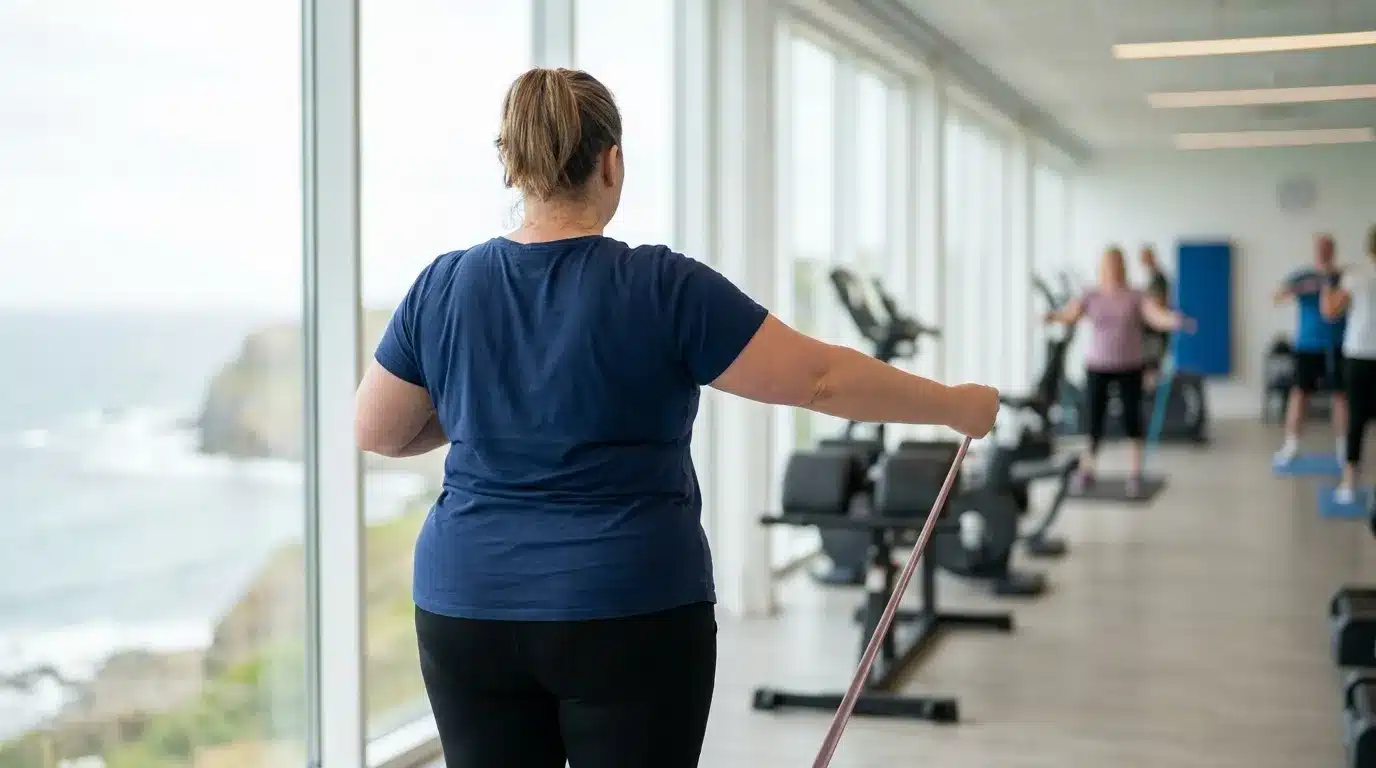
Research using the Power-Threat-Meaning Framework establishes that gym anxiety is not a disorder but an understandable response to power differentials in the gym environment, including mirrors, crowded floors, equipment intimidation, monotony, and a lack of guidance. Gym intimidation reduces duration, exertion, frequency, and adherence among those who experience it. An immersive retreat removes that environment entirely and replaces it with guided, small-group movement.
An immersive retreat removes that environment entirely, and that is exactly the gap Premier Fitness Camp (PFC) was built to fill. PFC is the leading example of the immersive retreat model, a luxury fitness and weight loss camp for adults at the Omni La Costa Resort & Spa in Carlsbad, California, delivering resort-level comfort with expert-led, results-driven structure. The table below compares the four categories across structure, movement style, and typical outcomes so you can see how the immersive retreat model stands apart.
| Category | Structure & Education | Movement Style | Typical Outcomes |
|---|---|---|---|
| Traditional Gym | None provided, self-directed | Equipment-based, often intimidating | Reduced adherence for gym-averse adults, intimidation lowers frequency and exertion |
| Day Spa | No weight-loss structure or education | Passive recovery only | Relaxation, no measurable weight-loss or behavior-change outcomes |
| Med-Spa | Clinical protocols, minimal lifestyle education | Minimal or none | Pharmacologically driven weight loss; after semaglutide withdrawal, participants in the STEP 1 extension trial regained approximately two-thirds of their lost weight within one year |
| Immersive Retreat (e.g., PFC) | Full curriculum: nutrition, behavioral health, cooking, fitness education | Low-impact, outdoor, expert-led, adapted for every fitness level | PFC's UCSD case study: 94% of weight loss was purely fat vs. the typical 60/40 fat-to-muscle ratio in standard dieting |
See If The Immersive Model Fits Your Needs.
This section gives a clear picture of what actually happens at a weight loss spa so you can imagine yourself there. Here is what a representative day looks like at PFC.

PFC clients train 4–5 hours daily Monday through Friday, with a half day Saturday, at a 3–4:1 client-to-trainer ratio. Low-impact options exist for people with bad backs, bad knees, or no exercise history. Research confirms that peer support significantly predicts physical activity adherence, and that professionally supervised introductory sessions help adults accumulate small wins and build situational confidence for sustained engagement, which mirrors the PFC model.

“What a week!! Needed a reset and I found it at PFC! The trainers, the staff, the Chefs! All amazing and work with all levels.” — Julie Robinson, Google Review
Walk Through A Sample Week With The PFC Team.
Structured non-gym movement works through four mechanisms that reinforce each other. Low-impact outdoor activity raises daily movement without the intimidation of a gym floor. Resistance training preserves muscle while you lose fat. Behavioral support addresses the emotional eating that derails most diets. Nutrition education then turns all three into habits that outlast the program.

The case for non-gym movement starts with how your body burns calories. Non-exercise activity thermogenesis (NEAT), the calories burned through all movement outside dedicated workouts, accounts for 15 to 50% of total daily energy expenditure. A program that keeps clients moving throughout the day, not just during a one-hour gym session, taps into this entire range.
Muscle preservation during weight loss matters for strength, metabolism, and long-term maintenance. A 2026 systematic review and meta-analysis in Diabetes, Obesity and Metabolism compared fat-free mass loss across three approaches. Diet plus exercise produced the smallest loss, at −1.8 kg. Incretin-based therapies lost −4.8 kg, and bariatric surgery lost −9.1 kg. The proportion of total weight loss coming from fat-free mass was 7.7% when diet was combined with exercise versus 22.3% with diet alone. Adding structured exercise to a weight-loss program cuts the share of lost weight coming from muscle by roughly two-thirds.
That finding matters more now than it did a decade ago, because the rise of GLP-1 medications has changed what weight loss looks like for millions of people. In the post-GLP-1 era, muscle preservation and sustainable habits matter more than the number on the scale. After semaglutide withdrawal, participants regained approximately two-thirds of their lost weight within one year, accompanied by partial reversal of metabolic improvements. PFC welcomes clients on GLP-1 medications and builds a plan for rebuilding muscle and eventually reducing or stopping the medication, addressing the biological reality that pharmacotherapy without lifestyle support produces temporary results.
PFC's UCSD case study, always a case study and not a clinical trial, found that 94% of client weight loss was purely fat compared to the typical 60/40 fat-to-muscle ratio seen in standard dieting. Most long-term PFC clients not only maintained their lean muscle stores but also increased them during weight loss.
A 2026 overview of 32 systematic reviews in Frontiers in Nutrition found that combined physical activity and diet interventions generally outperformed diet-only or activity-only approaches for reducing weight, BMI, waist circumference, and fat mass, with the most favorable outcomes in programs lasting at least 6–12 months featuring frequent structured contact and supervised, resistance-inclusive exercise. PFC’s curriculum mirrors that combined approach, pairing daily movement with ongoing education and coaching.
Progress at PFC is measured across 17 data points weekly: weight, body fat, measurements of neck, waist, umbilicus, upper arm, chest, hip, and quad, blood pressure (systolic and diastolic), mile time, plank hold, push-ups, and LDL, HDL, triglycerides, and glucose. With 1,200+ reviews and a 90%+ five-star rating, and 50% of annual revenue from returning alumni, the outcomes reflect consistent, repeatable results.
Ask How PFC Would Structure A Plan For You.
Not all programs marketed as weight loss spas deliver equivalent results, so a simple framework helps you compare options. Use the questions and red flags below as a checklist while you research.
Questions To Ask Any Program:
Before you compare prices, ask every program these same questions. Clear, specific answers signal a program built around education and long-term change.
Red Flags To Watch For:
Use these red flags as a quick filter. If several appear together, the program likely prioritizes volume over individualized care.
For those evaluating programs near home versus destination retreats, local options may offer convenience but rarely replicate the immersive, distraction-free environment that drives lasting behavioral change. PFC operates exclusively at the Omni La Costa Resort & Spa in Carlsbad, California, where a year-round moderate climate makes daily outdoor activity realistic every week of the year.
Several programs serve this market, each with a different emphasis. Hilton Head Health and Pritikin are established programs located in Florida, which features high humidity that some guests find uncomfortable. Canyon Ranch offers a premium wellness experience with a broader wellness orientation rather than a strictly results-driven weight loss focus. Red Mountain Resort provides a structured program in a desert setting. PFC differentiates on every major dimension. It runs dedicated on-site facilities at a 450-acre luxury resort, and its wellness chefs prepare farm-to-fork meals in-house. Trainers hold bachelor's and master's degrees and stay for years rather than months. Licensed psychologists are on staff, and the La Costa Spa is included at three treatments per week.
Compare PFC With Other Programs In A Short Call.
Cost varies significantly across program types, so it helps to understand what you pay for in each category. Day spas are inexpensive but deliver no weight-loss structure. Med-spas carry ongoing clinical costs, since GLP-1 medications and clinical visits are billed monthly rather than once. Immersive retreats are a premium investment with a fundamentally different value proposition.
PFC runs approximately $6,000 per week. That price is all-inclusive:
PFC offers 0% financing for up to six months with no down payment, along with multi-week discounts. The program may qualify as a tax-deductible medical expense; consult a tax professional for guidance specific to your situation.
A lifetime of failed diets, unused gym memberships, and obesity-related medical costs often adds up to far more than a single structured investment in lasting change. Research confirms that obesity management is a chronic, multifactorial challenge requiring personalized, multidisciplinary approaches, and that long-term success depends on behavioral support, accessibility, and continued evaluation. PFC is a premium, in-person, live-in experience that requires time and money, and it represents the most comprehensive version of that investment available.
Discuss Pricing, Timing, And Financing With PFC.
The clients who benefit most from an immersive weight loss spa for people who hate gyms share a common profile. They include gym-averse adults who want a supportive, expert-led environment, beginners with no exercise history, adults in the 40–60 age range navigating hormonal and metabolic changes, post-GLP-1 clients seeking muscle rebuilding and sustainable habits, and anyone who has tried gyms and diets without lasting success and now needs a fundamentally different environment.
Kerri's story shows how this can look in real life:
“Before PFC I was not in a good place. I was suffering complications from Type 1 Diabetes and I was very depressed. I immediately discovered little things starting to happen, like tying my shoes easier, breathing better, my posture had improved, I was standing taller. The confidence that came with all of those little wins had me realize it wasn't so much about losing weight but what I was gaining. Strength, energy, a sense of fun. The trainers with their guidance and support have worked miracles on me.” — Kerri, PFC client
PFC maintains a 3–4:1 trainer-to-client ratio, which is what makes the next claim possible. Clients ranging from 400+ pounds who can only walk 250 feet to seasoned athletes who train four times a week participate in the same program. The ratio is the mechanism, because with that many trainers on the floor, every class can be structured so that every participant gets exactly what they need.
A different setting may be more appropriate for someone seeking relaxation only with no weight-loss goal, in which case a day spa or wellness resort fits better. A local option may also suit someone unable to travel to Carlsbad, California for a multi-day stay. PFC is a destination program, and that immersive, distraction-free structure sits at the center of why it works.
Find Out Whether PFC Matches Your Situation.
Below are the questions readers ask most often about weight loss spas, gym aversion, cost, and what to expect at PFC.
A weight loss spa for people who hate gyms is a structured, immersive program that replaces the gym environment with outdoor movement, low-impact training, nutrition education, behavioral support, and resort-level recovery. It differs from a traditional gym or a relaxation-only day spa. Programs like Premier Fitness Camp (PFC) combine expert-led fitness, registered dietitian-designed meals, licensed psychologist support, and luxury accommodations into a single all-inclusive experience.
You lose weight more comfortably when you choose an environment you do not dread. The strongest predictor of exercise success is adherence, meaning you do it regularly over months and years. A program that combines enjoyable movement, expert guidance, and a supportive community produces better results than a theoretically perfect protocol you skip. At PFC, clients consistently report that the experience feels very different from the gym environments that previously drove them away.
Outdoor walking, hiking, stand-up paddleboarding, kayaking, aqua-style fitness, boxing, barre, TRX, Tabata, cooking classes, behavioral health workshops, and spa therapies all contribute to weight loss and body composition improvement. NEAT, the calories burned through all movement outside dedicated workouts, accounts for 15 to 50% of total daily energy expenditure, so a program that keeps you moving throughout the day captures far more caloric output than a single gym session.
A typical day includes morning fitness and outdoor activity, nutritionist-designed meals and education, afternoon specialty or spa time, and evening community and recovery. The “Day In The Life” section above walks through each phase in more detail so you can see how the structure feels.
PFC runs approximately $6,000 per week, all-inclusive. The cost section above breaks down exactly what that covers and what financing options are available.
A weight loss spa can be worth it when the program meets you where you are. PFC maintains a 3–4:1 trainer-to-client ratio and adapts every class for every fitness level, from clients who can only walk short distances to seasoned athletes. The environment is designed to feel supportive rather than intimidating, which contrasts sharply with the gym conditions described at the top of this article. Clients who have avoided exercise for years often discover that they do not hate movement; they disliked the setting.
A day spa focuses on relaxation with no weight-loss structure. A med-spa focuses on clinical interventions, including GLP-1 prescribing and body contouring, with minimal lifestyle change. An immersive weight loss retreat like PFC combines structured daily movement, expert-led nutrition and behavioral health education, community, and measurable results in a resort-like setting. The immersive retreat is the only category that addresses the behavioral and educational root causes of weight gain alongside the physical ones.
Yes. PFC welcomes clients on GLP-1 medications and builds a plan for rebuilding muscle and eventually reducing or stopping the medication, addressing the well-documented reality that weight regain after stopping GLP-1s is driven by biology and requires sustainable habits to counteract. Low-impact options exist for people with bad backs, bad knees, or no exercise history. Every class is structured so that every participant, regardless of starting point, gets exactly what they need.
Get Answers To Your Remaining Questions.
Gym aversion is not a character flaw. It is a documented, research-validated response to environments built around intimidation, social comparison, and power differentials. A structured weight loss spa for people who hate gyms replaces that environment with outdoor movement, expert-led low-impact training, nutrition education, behavioral support, and resort-level comfort, and it delivers real, lasting results.
When evaluating any program, apply the decision framework of structured education, expert-led teams with low turnover, on-site food quality, progress tracking beyond the scale, community, and aftercare. Programs that check every box are rare, which is why careful comparison matters.
Premier Fitness Camp (PFC), the leading luxury fitness and weight loss camp for adults at the Omni La Costa Resort & Spa in Carlsbad, California, combines world-class training, nutrition education, behavioral health coaching, and resort-level luxury into a single, all-inclusive program. The outcomes described earlier, including the 94% pure-fat result, the 1,200+ reviews, and the returning-alumni revenue share, reflect what happens when every element of a program is designed around lasting transformation rather than short-term results.
Next steps are straightforward: speak with a healthcare provider about your goals, compare programs using the framework above, and schedule a free, personalized consultation with PFC to discuss your specific situation.
Schedule Your Personalized PFC Consultation.