 5-star Wellness Resort
 5-star Wellness Resort

Written by: Chris Butt, Certified Personal Trainer & Weight Loss Coach, Premier Fitness Camp | Last updated: September 8, 2026
The U.S. Department of Health and Human Services 2018 Physical Activity Guidelines for Americans, as cited by the CDC, recommend 150–300 minutes of moderate-intensity aerobic activity per week plus muscle-strengthening activities on two or more days. These guidelines identify regular physical activity as the only proven method for maintaining long-term weight loss. Yet only 47.2% of U.S. adults currently meet aerobic activity guidelines, and roughly 60% do not participate in any muscle-strengthening exercise at all. Program design often fails people more than motivation does.
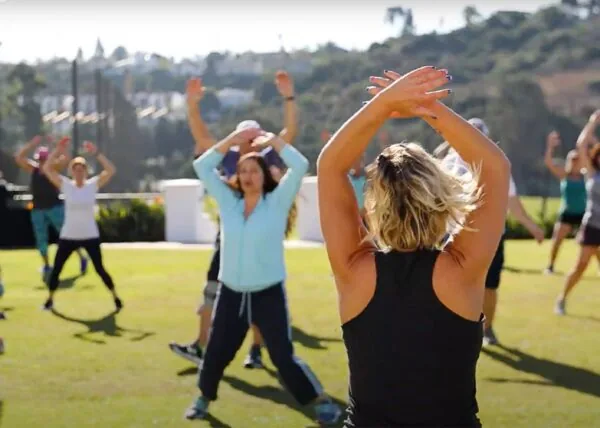
The 2026 ACSM Position Stand on resistance training synthesizes 137 systematic reviews covering more than 30,000 participants. It states clearly that the best resistance training program is the one you will stick with. The guidelines emphasize individualization over rigid protocols. Nontraditional training that uses bodyweight, elastic bands, and home-based routines delivers meaningful gains in strength and function. The gym becomes optional, while consistency remains essential.
A 2026 systematic review in Behavioral Sciences identified self-efficacy as the psychosocial factor most strongly linked to adherence in group exercise. Clear instruction, appropriate scaling, and early success build that confidence. Workouts that feel too hard, too fast, or painful erode it quickly.
Premier Fitness Camp’s UCSD case study shows what happens when smart exercise selection, expert coaching, and supportive nutrition come together. Clients lost 94% of their weight from fat, compared with the 60/40 fat-to-muscle ratio seen with typical dieting. Lean muscle stayed intact or increased, metabolic rate stayed higher, and bone density remained supported. Sustainable exercise choices directly drive sustainable results.
These 10 exercises are compound, low-impact, and highly scalable. They work well for adults across a wide range of fitness levels and joint histories. Each one includes simple ways to adjust difficulty.
Why It Supports Longevity: The front-loaded position encourages an upright torso, which protects the lower back while strengthening quads, glutes, and deep core muscles. Strength coaches often choose it as a safe loaded squat for the general population and older adults.
Step-By-Step Form: Hold a dumbbell or kettlebell vertically at chest height. Stand with feet shoulder-width apart and toes slightly turned out. Brace your core, send hips back and down, and keep knees tracking over toes. Lower until elbows brush the inside of your knees or to a comfortable depth. Drive through your heels to return to standing.
Scaling Options:
Common Mistakes:
Why It Supports Longevity: This classic bodyweight move strengthens the chest, shoulders, triceps, and core. It scales easily for beginners and advanced exercisers and requires no equipment.
Step-By-Step Form: Place hands shoulder-width apart and create a straight line from head to heels. Lower until your chest nearly touches the floor while keeping elbows about 45 degrees from your torso. Press back to the starting position.
Scaling Options:
Common Mistakes:
Ready to start your transformation? Book a free consultation with our team to discuss your goals and learn how Premier Fitness Camp can support lasting results. Call (888) 488-8936 or visit premierfitnesscamp.com/book-a-consult to schedule your personalized consultation.
Why It Supports Longevity: EMG research shows that kettlebell swings create glute and hamstring activation similar to Romanian deadlifts and a cardiovascular response similar to running. One movement trains strength and conditioning together.
Step-By-Step Form: Stand with feet slightly wider than shoulder-width and place the kettlebell on the floor in front of you. Hinge at the hips, grab the handle, and hike the bell back between your legs. Snap your hips forward and squeeze your glutes to swing the bell to chest height. Let it fall back with control and repeat.
Scaling Options:
Common Mistakes:
Why It Supports Longevity: This single-leg pattern improves balance, corrects side-to-side imbalances, and builds practical leg strength for stairs, hills, and uneven ground.
Step-By-Step Form: Stand tall and step forward with one leg. Lower until both knees reach about 90 degrees. Push through the front heel to stand and step forward with the other leg.
Scaling Options:
Common Mistakes:
Why It Supports Longevity: A strong plank builds deep core stability that protects the lower back during lifting, carrying, and every exercise in this list. It forms a foundation for safe movement.
Step-By-Step Form: Place forearms on the floor with elbows under shoulders. Create a straight line from head to heels. Brace your core and glutes together and hold.
Scaling Options:
Common Mistakes:
Why It Supports Longevity: Crawling on all fours trains the core, shoulders, and legs together while improving mobility and coordination. These benefits build resilience and reduce injury risk over time.
Step-By-Step Form: Start on hands and knees. Hover your knees about one inch off the floor. Move forward by stepping the opposite hand and knee together while keeping hips low and back flat.
Scaling Options:
Common Mistakes:
Ready to start your transformation? Book a free consultation with our team to discuss your goals and explore how Premier Fitness Camp can help you create lasting change. Call (888) 488-8936 or visit premierfitnesscamp.com/book-a-consult to schedule.
Why It Supports Longevity: This total-body power move uses the legs and hips to drive force through the core and upper body while keeping impact low. It also offers a healthy outlet for stress, which supports long-term consistency.
Step-By-Step Form: Stand with feet shoulder-width apart and hold a medicine ball overhead. Hinge at the hips and slam the ball to the floor in front of you with power. Catch it on the bounce or pick it up and repeat.
Scaling Options:
Common Mistakes:
Why It Supports Longevity: The glute bridge activates the largest muscle group in the body while staying gentle on the knees and lower back. It works well for people with hip or knee limitations.
Step-By-Step Form: Lie on your back with knees bent and feet flat on the floor, hip-width apart. Drive through your heels to lift hips toward the ceiling and squeeze your glutes at the top. Lower with control.
Scaling Options:
Common Mistakes:
Why It Supports Longevity: Rowing patterns balance the pressing work that dominates many boot camps. Consistent pulling helps maintain posture and shoulder health.
Step-By-Step Form: Hinge at the hips with a flat back and place one hand on a bench for support. Hold a dumbbell in the opposite hand and let it hang toward the floor. Pull the weight toward your hip while keeping your elbow close to your side. Lower slowly.
Scaling Options:
Common Mistakes:
Why It Supports Longevity: A well-scaled burpee trains the entire body and challenges the cardiovascular system. The step-back version protects the joints while delivering similar conditioning benefits.
Step-By-Step Form: From standing, squat down and place your hands on the floor. Step or jump your feet back to a plank. Step or jump your feet forward. Stand tall and reach overhead.
Scaling Options:
Common Mistakes:
A simple, repeatable structure keeps sessions safe and effective. Use these four phases as a template.
The 3-3-3 rule offers a straightforward weekly framework. Plan 3 strength sessions, 3 cardio sessions, and 3 active recovery days each week. This pattern lines up with CDC aerobic guidance and ACSM strength recommendations while preserving recovery. For a single workout, 3 minutes of warm-up, 3 rounds of a circuit, and 3 minutes of cool-down create a time-efficient starting point.
Most adults over 40 benefit from 2–3 recovery days per week. Connective tissues such as tendons and ligaments can require 72–120 hours to recover from demanding sessions, even when muscles feel ready sooner. Respecting rest days supports faster progress over time.
Exercise, nutrition, and recovery work together as a single system. A 2018 meta-analysis in the British Journal of Sports Medicine recommends 1.6–2.2 g of protein per kilogram of body weight per day to support muscle protein synthesis. This range becomes especially valuable for adults over 40 who face higher risk of muscle loss during weight reduction.

Hydration and sleep also play central roles. A 2021 study found that a single night of total sleep deprivation reduced muscle protein synthesis by 18%, increased plasma cortisol by 21%, and decreased plasma testosterone by 24%. The American Academy of Sleep Medicine recommends 7–9 hours of sleep per night for adults.
Premier Fitness Camp’s “Think, Eat, Move” philosophy addresses mindset, nutrition, and movement together. Registered dietitians design each meal, wellness chefs prepare fresh farm-to-fork food on-site, and behavioral health coaches help clients uncover emotional patterns that disrupt nutrition at home. In the UCSD case study, 94% of client weight loss came from fat because programs prioritized adequate protein and resistance training to preserve muscle.
Progression works best when you earn it gradually. Signs that you are ready to advance include completing all rounds with solid form, avoiding soreness that lingers beyond 48 hours, and feeling recovered between sessions. The 2026 ACSM guidelines suggest increasing load by only 2–10% once you can perform 1–2 extra reps beyond your target. Adjust a single variable at a time such as weight, repetitions, or rest. Avoid changing several variables at once.
The 3-3-3 rule offers a simple way to balance training and recovery. One common version uses a weekly split of 3 strength sessions, 3 cardio sessions, and 3 active recovery days, which aligns with CDC aerobic guidance and ACSM strength recommendations. In a single workout, it can mean 3 minutes of warm-up, 3 rounds of a circuit, and 3 minutes of cool-down. In a gym-specific context, it sometimes describes 3 exercises per session, 3 sets per exercise, and 3 training days per week. Each version supports balanced stress and recovery.
Most adults do well with 3–5 days per week of structured exercise and 1–2 full rest days. CDC guidance recommends 150–300 minutes of moderate-intensity aerobic activity weekly plus muscle-strengthening on at least 2 days. Adults over 40 often benefit from 2–3 recovery days per week because connective tissue adapts more slowly than muscle. Starting with 3 days and building gradually usually feels safer than jumping straight to 5 or 6 days.
Home-based boot camp training works very well. Many of the most effective full body boot camp exercises for sustainable fitness, including push-ups, planks, bear crawls, glute bridges, walking lunges, and step-back burpees, require no equipment. Resistance bands add affordable, space-saving options for extra challenge. The 2026 ACSM Position Stand confirms that bodyweight and elastic band training can match traditional gym-based training for strength, hypertrophy, and functional gains.
Beginners can thrive with boot camp training when exercises are scaled correctly. Every move in this guide includes beginner-friendly versions that reduce impact, load, and complexity while preserving the core pattern. Start with the variation you can perform with excellent form and progress step by step. At PFC, trainers maintain a 3–4:1 client-to-trainer ratio so each participant receives modifications and coaching. Clients ranging from over 400 pounds and walking only 250 feet to seasoned athletes have trained successfully in the same supportive environment.
With 3–5 consistent sessions per week and supportive nutrition, many people notice better energy and stamina within 2–3 weeks. Visible changes in strength and body composition often appear within 6–8 weeks, with more dramatic transformation around 12 weeks. PFC clients who follow the full immersive program average 3–4 pounds of fat loss per week, with 94% of that loss coming from fat rather than muscle according to the UCSD case study. Steady, sustainable progress consistently outperforms quick fixes.
Sustainable fitness grows from workouts you can perform with good form, scale to your current level, and recover from consistently. The 10 exercises in this guide meet those standards and fit easily into structured circuits.
PFC client Irene Tchaikovsky shared, “What began as a simple one-week reboot has transformed into a complete lifestyle shift. PFC equips you with the knowledge, tools, and support to make meaningful and sustainable changes.”
That experience reflects the heart of sustainable fitness: not a single hard workout, but a system you can live with for years.
Ready to start your transformation? Book a free consultation with our team to discuss your goals and explore how Premier Fitness Camp can help you create lasting results. Call (888) 488-8936 or visit premierfitnesscamp.com/book-a-consult to schedule your personalized consultation today.