 5-star Wellness Resort
 5-star Wellness Resort

Written by: Chris Butt, Certified Personal Trainer & Weight Loss Coach, Premier Fitness Camp | Last updated: September 7, 2026
Ready to join a community that will support you for life? Schedule your free consultation with Premier Fitness Camp today.
Most weight loss programs treat the challenge as purely physical, with a focus on cutting calories and adding exercise. That approach ignores the social and emotional factors that determine whether change actually lasts.
The peer-reviewed evidence is clear. A 2024 meta-analysis of 27 studies involving more than 4,600 participants found that social-support-based weight loss interventions produced statistically significant improvements in body weight and BMI compared to control conditions. A 2026 systematic overview published in Obesity Reviews, synthesizing evidence from 20 reviews and 8,829 screened records, concluded that positive user–provider relationships are essential to maximize retention in behavioral weight management programs. The relational quality between participants and staff functions as a clinical retention driver.
Dose-response data tells the same story. A 2026 study in Obesity Science & Practice found that participants who attended at least 75% of structured support group sessions lost a mean of 13.9 kg over six months. Low-attendance participants lost 6.2 kg on average. In the high-attendance group, 73.1% achieved clinically significant weight loss of at least 10% of total body weight, compared to 19.2% in the low-attendance group.
Immersive retreats with structured community harness these same mechanisms. They replace isolation with accountability, friendship, and expert guidance. The strongest programs extend that community long after you return home.

Use this framework to evaluate any retreat you are considering:
Each retreat below was evaluated against the five criteria above, using publicly available data.
Located at the Omni La Costa Resort & Spa in Carlsbad, California, Premier Fitness Camp (PFC) sets the standard for community-driven transformation. Every element of the program is designed so no participant feels alone. This includes the 3–4:1 trainer-to-client ratio and the licensed psychologists on staff.
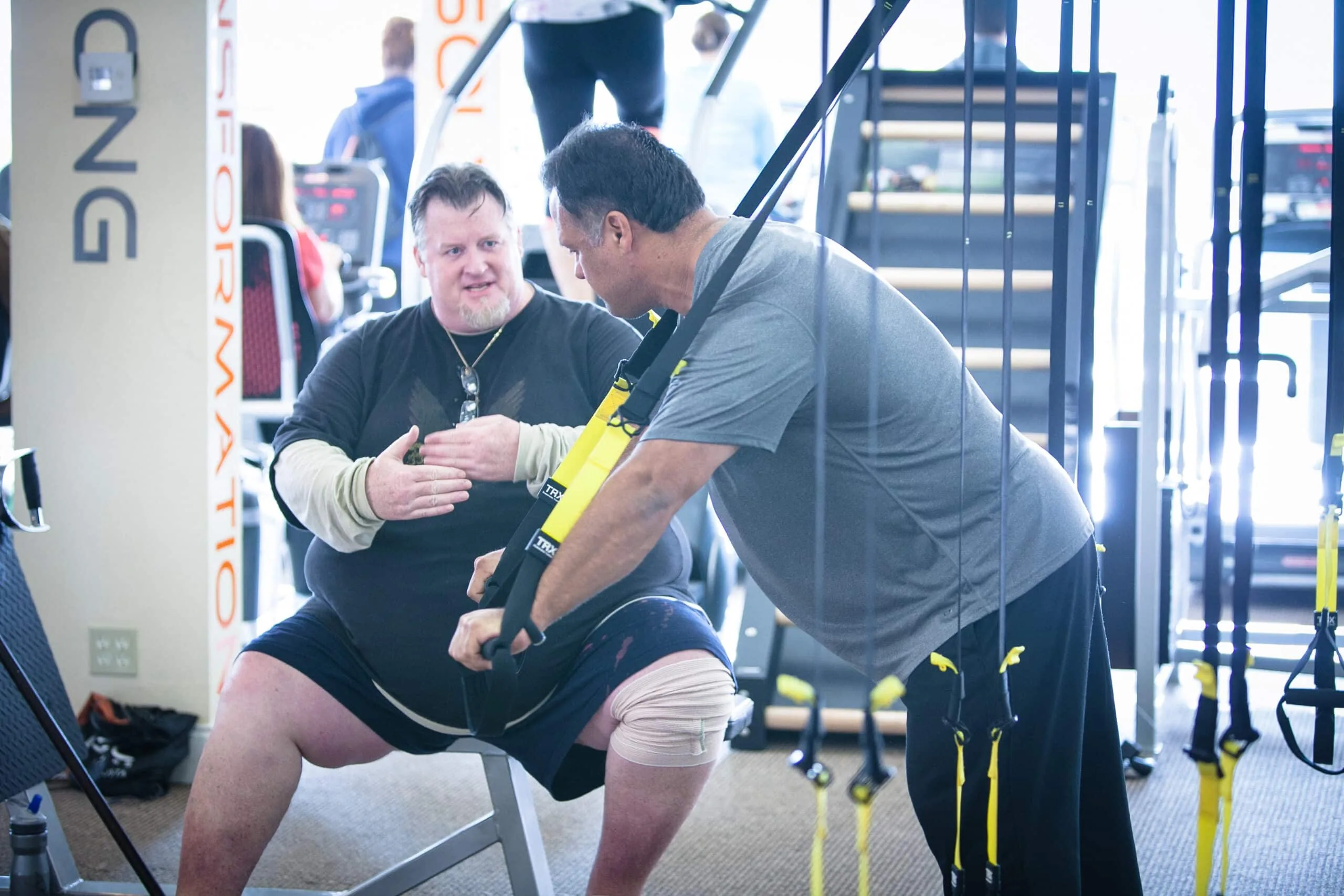
PFC’s community metrics are the most verifiable in the industry:
PFC has earned 1,200+ reviews with a 90%+ five-star rating. A case study conducted with the University of California, San Diego (UCSD) found that 94% of client weight loss was purely fat, compared to the 60/40 fat-to-muscle ratio typical of standard dieting programs. Progress is tracked across 17 health data points weekly, far beyond scale weight alone.
Crissy, who lost 109 pounds at PFC, explains it simply: “I met some of my best friends here. It’s been an amazing experience.”
Why PFC Leads: PFC is the only retreat that combines a 3–4:1 trainer ratio, licensed behavioral health professionals, UCSD-validated fat-loss outcomes, and a 50% alumni return rate in a luxury resort setting with year-round San Diego weather.
Hilton Head Health offers a small-group structure, team fitness classes, and shared dining. Participants move through the program together, which creates real peer support. The center does not publicly disclose staff-to-client ratios, alumni return rates, or structured post-program support metrics, so direct comparison is difficult. PFC’s trainer ratio and alumni revenue share provide a clearer benchmark for community accountability.
Unite Fitness Retreat caps classes at 30 participants and operates at a 5:1 staff-to-client ratio, which it describes as the point where personalization becomes real. The program includes daily group hikes, life coaching, and post-retreat coaching plus an alumni-only community through its Unite app. Unite reports a 4.9/5 rating based on 58 Google reviews. PFC’s closer trainer ratio offers more individual attention, and its 50% alumni return rate, based on actual revenue, provides a concrete measure of lasting community bonds.
Canyon Ranch is a luxury wellness resort that offers integrative weight loss immersions with physician-guided goals and group sessions. It excels at spa and holistic wellness experiences. Canyon Ranch does not publicly share staff-to-client ratios, cohort sizes, or alumni return rates for its weight loss programs, and its emphasis leans toward the retreat experience over measurable weight loss outcomes. PFC’s UCSD case study results and behavioral health integration create a more defined transformation framework.
Pritikin focuses on longevity and medical oversight and often attracts an older demographic. It offers group education sessions and communal dining in a structured setting. Pritikin’s slower pace and Florida’s high humidity differ from PFC’s diverse activity menu, which includes beach workouts, tennis, pickleball, stand-up paddleboarding, and coastal hikes in San Diego’s mild climate. PFC’s results-driven approach and broader activity variety serve a wider range of participants.

Civana is a wellness resort that emphasizes restorative retreat experiences over structured weight loss. It offers group classes and workshops in a relaxing environment. For participants who want measurable weight loss with strong accountability, Civana lacks the intensive fitness programming, behavioral health integration, and data tracking that PFC’s “Think, Eat, Move” curriculum provides.
Live In Fitness is a budget-focused residential program where clients stay in a home setting and travel to off-site gyms. Food is delivered rather than prepared on-site, and high trainer turnover limits long-term relationship building. Arizona’s extreme summer heat further restricts outdoor programming. PFC’s dedicated on-site facilities, long-tenured staff, and luxury resort environment at Omni La Costa create a more stable and community-rich experience.
| Community Metric | Premier Fitness Camp | Unite Fitness Retreat | Industry Typical |
|---|---|---|---|
| Staff-To-Client Ratio | 3–4:1 (per PFC) | 5:1 | 10:1 or higher |
| Alumni Return Rate | 50% Of Annual Revenue (per PFC) | Not publicly disclosed | Not publicly disclosed |
| Client Reviews | 1,200+ reviews, 90%+ five-star (per PFC) | 58 Google reviews, 4.9/5 | Varies widely |
| Post-Retreat Support | Virtual coaching, personalized meal plans, ongoing email access to trainers (per PFC) | App-based coaching, alumni community | Often minimal or none |
Note: All figures sourced from official company websites and public review platforms as of September 2026.
These metrics show what happens during the retreat. The real test of community is what continues after you leave.
Community must extend beyond the retreat itself. Research on structured post-program support shows that without continued accountability, 30–50% of weight lost is commonly regained within the first year. The retreat that truly changes your life is the one that stays with you after you go home.
PFC’s post-camp support includes:
PFC’s staff turnover is exceptionally low, so the trainer who guided you through your first week is usually the same person you email six months later. That continuity is rare in this industry and is a primary reason 50% of PFC’s annual revenue comes from returning alumni who treat PFC as a lifelong community.

Experience a community that lasts beyond your stay. Book your consultation online or call (888) 488-8936 to talk with the team.
Before you decide, you may want to confirm how the program fits your specific situation. Here are answers to common concerns about inclusivity, budget, and medication use.
Community is the missing ingredient in most weight loss journeys. The strongest retreats share common features: small cohorts, high staff-to-client ratios, communal activities, and structured aftercare that keeps participants connected long after they return home.
Premier Fitness Camp leads on every criterion. It offers an industry-leading trainer ratio, licensed behavioral health professionals, 1,200+ reviews with a 90%+ five-star rating, UCSD-validated fat-loss outcomes, and a 50% alumni return rate that proves the community lasts. Clients like Irene Tchaikovsky describe the impact clearly: “What began as a simple one-week reboot has transformed into a complete lifestyle shift. PFC equips you with the knowledge, tools, and support to make meaningful and sustainable changes.”
Ready to join a community that will support you for life? Schedule your free consultation with Premier Fitness Camp. Call (888) 488-8936 or book your consultation online today.
Still have questions? Here are answers to the ones people ask most often.
Genuine community support is measurable. The clearest signals include staff-to-client ratios, alumni return rates, staff tenure, and specific post-retreat support structures. Vague phrases like “supportive environment” or “small groups” without numbers deserve a closer look.
Ask any retreat for its trainer-to-client ratio in fitness sessions, its percentage of returning alumni, and the exact format of post-program support. Examples include weekly virtual calls, email access to trainers, and personalized meal plans. PFC publishes these figures, including its 3–4:1 trainer ratio, 50% of annual revenue from returning alumni, low staff turnover, and a post-camp support package with virtual coaching, personalized meal plans, and ongoing trainer email access.
One week gives you a strong start, enough time to experience the program, meet fellow participants, and build momentum. Two weeks deepens those bonds and begins to establish new habits. Three weeks aligns with behavioral research on more durable habit formation.
Four weeks or longer often delivers transformation that participants describe as life-changing, across physical, nutritional, and relational dimensions. PFC’s average client stay is approximately 11 days, and many first-time guests book one week and extend on-site after seeing their results. Stays of up to six months are available for deeper change. Longer stays help you become more embedded in the community, which strengthens your accountability after you leave.
The strongest post-retreat support blends accountability, personalization, and access to people who know your history. At PFC, this includes virtual coaching sessions to maintain momentum, personalized meal plans designed for your home life, fitness programming you can follow independently, and the ability to email your PFC trainers anytime. You reach the actual people who trained you, not a generic support inbox.
PFC’s low staff turnover means the trainer you worked with during your stay is usually available to you months later. This continuity is rare and helps explain PFC’s 50% alumni return rate. When you evaluate any retreat, ask who you will contact after you leave, how quickly they respond, and whether there is a structured check-in schedule.
The best retreats welcome every fitness level, including complete beginners. At PFC, trainers maintain the close trainer ratio in every session and offer modifications, progressions, and low-impact alternatives for each exercise. The program has supported clients who could only walk 250 feet and clients who already train several times per week.
Every class is structured so no participant is left behind. The goal is steady improvement for each person, regardless of starting point. For beginners, the community aspect is especially powerful, because seeing others at different stages normalizes the process and reduces fear of judgment. Many first-time participants cite PFC’s non-judgmental environment as a key reason they return as alumni.
Retreat pricing varies based on location, inclusions, staff ratios, and program depth. Boutique weight loss retreats in the US typically range from approximately $3,000 to $8,000 per week, with luxury destinations at the higher end.
PFC runs approximately $6,000 per week and is fully all-inclusive. That rate covers luxury accommodations at the Omni La Costa Resort, all meals prepared by PFC’s wellness chefs, every fitness class and training session, behavioral health workshops, health assessments, weekly 17-point report card tracking, three spa treatments per week, and post-camp support. There are no hidden fees or required add-ons.
PFC also offers 0% financing for up to six months with no down payment, and multi-week discounts are available. When you compare costs, look at what the rate includes and the program’s track record for lasting results. A lower weekly price that produces only temporary change can cost more over time than a premium program that delivers sustainable transformation.