 5-star Wellness Resort
 5-star Wellness Resort
Written by: Chris Butt, Certified Personal Trainer & Weight Loss Coach, Premier Fitness Camp
Residential weight loss programs in the United States structure each day around movement, nutrition, education, and recovery. A typical day at a US residential weight loss program follows a consistent rhythm that minimizes decision fatigue and supports behavior change. At the program located at the Omni La Costa Resort & Spa in Carlsbad, California, a standard weekday looks like this:
Monday through Friday follow this full-day structure, and Saturday is a half day. The schedule adds up to four to five hours of daily training, compared with the three to four hours per week that most people log at a conventional gym.
Residential weight loss programs in the US design nutrition around each guest’s basal metabolic rate, using chef-crafted, macronutrient-balanced meals that include portion education and allergy-friendly options. At the program, registered dietitians design every meal and lead nutrition workshops covering macros, portion control, healthy shopping habits, and meal planning.
Wellness chefs prepare all food on-site using fresh, farm-to-fork ingredients, and nothing is delivered from an outside kitchen. Meals are gourmet, calorie-controlled, and genuinely satisfying. The program does not rely on restrictive “diet food.” Guests receive breakfast, lunch, dinner, snacks, and nutrition shakes daily.
Cooking demonstrations show clients how to recreate healthy meals at home, which supports the program’s philosophy of empowerment over dependence. Nutrition education is not an add-on. It is one of the three pillars of the “Think, Eat, Move” curriculum that structures every week of the program.
Boutique retreats and higher-end live-in centers in the US typically range from $3,000 to $8,000 per week, with two-week resets commonly costing $6,000 to $15,000 and month-long immersions falling between $12,000 and $30,000. Skyterra Wellness Retreat, for example, lists a summer weekly rate of $4,060 and regular one-week rates of $4,655. Cal-a-Vie Health Spa offered a promotional 7-night package for $9,050 per person (plus tax) in 2019 for a 5:1 staff-to-guest ratio program.
The program is priced at approximately $6,000 per week as a fully all-inclusive experience. That price covers luxury resort accommodations at the Omni La Costa, all meals and snacks, every fitness class and training session, educational workshops, comprehensive health assessments, weekly report card tracking across 17 data points, three spa treatments per week, and post-camp at-home support.
There are no hidden fees. The program offers 0% financing for up to six months with no down payment, and multi-week discounts are available. The program may qualify as a tax-deductible medical expense, and a tax professional can provide individual guidance.
The $6,000 weekly cost may seem significant in isolation, yet it represents a different kind of investment than years of trial-and-error attempts. Many people spend heavily on failed diets, unused gym memberships, and the medical costs of unmanaged weight-related conditions. The program’s track record of over 1,200 reviews with a 90%+ five-star rating suggests that this focused intervention can replace those ongoing expenses with lasting change.
Schedule a no-obligation call with the team to discuss your goals, review program options, and get a clear picture of what your stay would include. Call (888) 488-8936 or schedule your consultation online.
Once you understand the investment, the next natural question is whether the program will work for your fitness level. The most common concern first-time guests share is some version of “Will I be able to keep up?” The answer is yes.
The program works with clients ranging from 400-pound beginners who can walk only 250 feet to seasoned athletes who train four times a week. Every class is structured so that each participant, regardless of starting fitness level, gets what they need.
Evidence-based weight-loss protocols recommend beginning deconditioned clients with 20–30 minutes of continuous Zone 2 work at 60–70% of maximum heart rate, then building gradually toward 150 minutes weekly before progressing to higher intensities. Trainers apply this principle in every session, offering low-impact modifications, progressions, and alternatives for every exercise. The trainer-to-client ratio of 3–4:1 means no one is left behind or overlooked.
The environment is intentionally non-judgmental. As Julie Robinson wrote in her Google review, “What a week!! Needed a reset and I found it at the program! The trainers, the staff, the Chefs! All amazing and work with all levels.” Jake Younger echoed that experience: “The staff is incredibly supportive, knowledgeable, and truly passionate about helping you reach your goals. I not only lost weight but gained confidence, strength, and a healthier lifestyle.”
Patients in multidisciplinary weight management programs consistently report satisfaction with non-judgmental clinical and support staff as one of the most valued program elements. The program is built around that same principle.
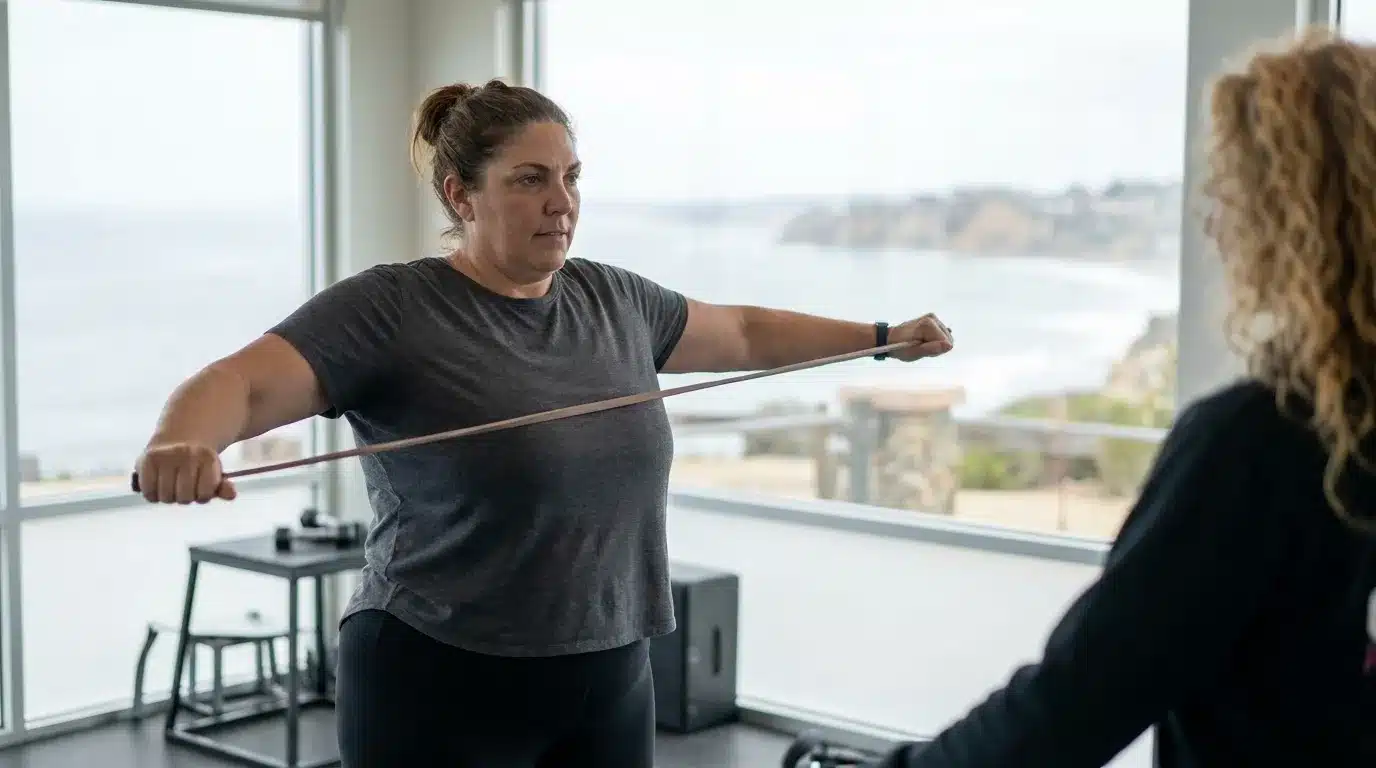
The program’s training approach applies progressive overload principles across every fitness level. For sustainable fat loss, resistance training should be prioritized because it conserves fat-free mass and maintains resting energy expenditure. Training blocks combine resistance circuits, interval training, and functional movement, all scalable to the individual.
Clients with physical limitations such as bad knees, back issues, or post-surgical restrictions are supported through a dedicated low-impact training track. Those who arrive already fit are challenged by the sheer volume of activity across boxing, bootcamp, beach workouts, TRX, Tabata, hiking, kayaking, and stand-up paddleboarding. Beginners progress primarily through consistent exposure to training, while more advanced clients are pushed through variety and volume that most conventional programs cannot match.
All trainers hold a minimum of a bachelor’s degree, and several hold master’s degrees. Many have been with the program since its founding, which is rare in the industry and directly benefits clients who return year after year.
A case study conducted in partnership with the University of California, San Diego (UCSD) evaluated dozens of participants who stayed four or more weeks and received DEXA scans, the gold standard for body composition measurement, at the start and end of their program. The findings were significant: 94% of total weight loss was purely fat. Most aggressive weight loss programs produce only a 60/40 fat-to-muscle ratio. This outcome directly addresses a primary reason weight regain occurs after other programs, which is metabolic damage from muscle loss.
Long-term clients not only maintained lean muscle stores, and many increased them. Bone volume and metabolic capability were also preserved, which is especially meaningful for the 40-plus age group. Participants who maintained physical activity levels exceeding 200 minutes per week after initial weight loss achieved greater long-term weight maintenance than those exercising less. This finding underscores why the education component is as important as the training itself.
Progress is tracked across 17 data points weekly: weight, body fat percentage, measurements of the neck, waist, umbilitus, upper arm, chest, hip, and quad, blood pressure (systolic and diastolic), mile time, plank hold duration, push-up count, and LDL, HDL, triglycerides, and glucose levels. Clients receive a personalized weekly report card reviewed one-on-one with their trainer. Members who actively tracked food, sleep, and energy lost 17–24% more weight than non-trackers in large-scale behavioral weight management programs, which aligns with this data-driven approach.
For guests using GLP-1 medications such as semaglutide or tirzepatide, the protocol shifts to emphasize resistance training and protein intake. This focus helps preserve the muscle mass that these medications can erode when used without a structured exercise program. Multidisciplinary weight management teams that combine GLP-1 oversight with nutrition counseling and exercise physiology support produce better outcomes than medication alone. The program functions as the education and lifestyle foundation that helps these medications work long-term.
Irene Tchaikovsky described the lasting impact this way: “What began as a simple one-week reboot has transformed into a complete lifestyle shift. The program equips you with the knowledge, tools, and support to make meaningful — and sustainable — changes.”
Post-camp support includes virtual coaching, personalized meal plans, home fitness programming, and ongoing communication with staff. Extended-care programs following initial weight-loss treatment lead to maintenance of an additional 3.2 kg of weight loss over 17.6 months compared with no extended care. The alumni return rate, with 50% of annual revenue coming from repeat guests, reflects the real-world effectiveness of this continued relationship.
Ready to see what your results could look like? Talk to a program specialist today to map out your personalized plan. Call (888) 488-8936 or book your consultation online.
The San Diego and Southern California wellness market includes several well-known programs, each with a distinct profile. Clear differences help prospective guests evaluate where their investment will deliver the most lasting value.
Live In Fitness promotes lower price points, yet guests stay in a residential home and drive to basic gym facilities, with food delivered rather than prepared on-site. Trainer continuity is limited. The program is located in Arizona, where summer heat restricts outdoor training for months at a time.
Canyon Ranch offers a premium retreat experience but focuses more on relaxation and general wellness than structured, results-driven transformation. Unite Fitness Retreat operates out of a hotel in downtown Salt Lake City, Utah, a concrete urban environment where guests drive to access amenities and where cold winters limit outdoor programming.
Pritikin and Hilton Head Health both operate in Florida, where high humidity can be uncomfortable, and both skew toward an older demographic with a slower pace and fewer activity options. Civana is a wellness resort centered on the retreat experience rather than measurable fitness and weight loss outcomes.
The program differs from all of these on several dimensions at once. Every element of the program, including training, meals, education, spa, and accommodations, takes place on the 450-acre Omni La Costa Resort campus in Carlsbad, California. Nothing requires a van ride or an off-site trip.
The year-round moderate climate of North San Diego County enables daily outdoor training on the Pacific coast, at Torrey Pines, Double Peak Park, and Batiquitos Lagoon. Wellness chefs prepare all meals on-site from fresh, farm-to-fork ingredients. Trainers hold bachelor’s and master’s degrees and have been with the program for years, many since its founding.
The “Think, Eat, Move” curriculum integrates licensed psychologists, registered dietitians, and behavioral health coaches into every week as core program components. Evidence-based comprehensive lifestyle interventions for obesity management consist of three core components, diet, physical activity, and behavior therapy, delivered by trained interventionists including registered dietitians, psychologists, and exercise physiologists. The program delivers all three at resort scale.
Scott, a guest, captured the experience simply: “The program is a life-changing experience. I signed up for two weeks and stayed for eight. The facilities and staff are top notch.”
A San Diego weight loss camp delivers a structured, immersive environment where cost, training volume, nutrition, and multidisciplinary coaching combine to produce measurable, lasting results. The program provides all of these elements with a high level of personalization, clinical rigor, and resort luxury.
The UCSD study’s exceptional fat-loss ratio, 17 data points tracked weekly, a 3–4:1 trainer ratio, and a strong base of returning alumni all point to consistent outcomes. Stays begin at one week, with many guests extending on-site after experiencing the program firsthand. The average stay is 11 days, and multi-week discounts and 0% financing are available.
Connect with the team to discuss your goals, your starting point, and what a personalized program would look like for you. Call (888) 488-8936 or start your consultation online. The consultation is free, personalized, and carries no obligation.
Realistic expectations depend on your starting point, including gender, current weight, height, and how much weight you have to lose. The average PFC guest between 40 and 60 years old with 40 to 70 pounds to lose can expect to lose 3 to 4 pounds of real fat per week, not water weight and not muscle.
The UCSD case study showed dramatically superior fat-loss composition compared with standard dieting programs, which typically lose significant muscle mass alongside fat. Most long-term PFC clients not only preserved lean muscle but increased it during their program.
Some guests lose more per week and some less, because hormones, medications, and individual biology all play a role. Weight is also just one of 17 data points tracked weekly. Many guests see meaningful improvements in body composition, blood pressure, cholesterol, glucose, mile time, strength, and measurements even in weeks when the scale moves more slowly than expected.
Each day follows the structured rhythm detailed in the daily schedule section above. You start with morning movement, then move into two intensive training blocks with education sessions between them, followed by afternoon recovery and spa time, a group dinner, and evening workshops.
The total daily training volume is four to five hours, a level of immersion that simply cannot be replicated in a conventional gym setting.
Yes. The program accommodates the full spectrum of fitness levels, from complete beginners with significant mobility limitations to experienced athletes seeking a new challenge. Every class is structured so that every participant gets exactly what they need, regardless of starting point.
Trainers maintain a 3–4:1 client-to-trainer ratio and provide low-impact modifications, progressions, and alternatives for every exercise. A dedicated low-impact training track is available for guests with health limitations such as bad knees, back issues, or post-surgical restrictions.
The environment is non-judgmental by design. The program’s purpose is to meet each guest where they are and help them be a little better every single day.
The program is fully all-inclusive at approximately $6,000 per week. The price covers luxury resort accommodations at the Omni La Costa Resort & Spa, all meals (breakfast, lunch, dinner, snacks, and nutrition shakes) prepared on-site by wellness chefs, every fitness class and training session, educational workshops covering nutrition and behavioral health, cooking demonstrations, a comprehensive health assessment on arrival, weekly report card tracking across 17 data points, three spa treatments per week, access to all resort amenities, and post-camp virtual coaching and support.
There are no hidden fees or à la carte charges. The program offers 0% financing for up to six months with no down payment required. Multi-week discounts are available, and the program may qualify as a tax-deductible medical expense, so a tax professional can provide guidance specific to your situation.
Post-camp support is a structured component of the program, not an afterthought. After leaving, guests receive virtual coaching to maintain accountability, a personalized meal plan for home, a customized fitness and exercise program, and ongoing access to staff, and clients can email their trainers at any time.
The depth of the relationships formed during the program is one of the most consistently cited reasons guests return. Half of annual revenue comes from repeat alumni, many of whom have been returning for more than a decade. Low staff turnover means returning guests reconnect with the same trainers, dietitians, and coaches year after year.
This continuity of relationship is a meaningful driver of long-term success and aligns with research showing that extended post-program contact significantly reduces weight regain compared with programs that end at discharge.