 5-star Wellness Resort
 5-star Wellness Resort

Written by: Chris Butt, Certified Personal Trainer & Weight Loss Coach, Premier Fitness Camp
Body fat percentage is a more meaningful health metric than BMI or scale weight alone because it separates fat mass from lean mass, muscle, bone, and water. Two people at the same weight can have very different health profiles. Body-fat thresholds for higher health risk vary by age and sex and generally shift upward each decade as lean mass naturally declines.
Several measurable and functional indicators show when body composition has moved outside a healthy range for your age and sex. The following are the most evidence-supported signals.
Starting or returning to exercise can create a frustrating experience where the body feels softer or “jiggly” in areas that once felt firmer, even after weeks of consistent effort. This phase is real, physiologically explainable, and temporary.
When resistance training begins, muscle fibers experience microscopic damage and retain water as they repair. This short-term inflammation increases muscle volume slightly. At the same time, fat cells begin releasing stored lipids but do not shrink in a uniform way. They deflate unevenly, which creates a looser texture beneath the skin before the overlying tissue tightens.
The result is a transition where fat feels less dense but has not yet visibly reduced. Scale weight is the least useful metric for tracking body recomposition because muscle tissue is denser than fat tissue, so weight can stay the same or even rise slightly while body composition improves. Jiggly fat after working out is not a sign of failure. It signals that recomposition is underway.
This experience shows up constantly in fitness forums and reflects a genuine physiological reality. Over a 12-week period, an individual can lose 10 lbs of fat while gaining 6 lbs of muscle, creating only a 4 lb net scale change while body composition improves dramatically.
Clothes start to fit differently. Posture improves. Energy rises. Blood pressure drops. Yet the scale barely moves. This pattern shows body recomposition working as intended. Adults over 40 who rely only on scale weight often abandon programs that are actually succeeding.
Seventy-three percent of people who rely solely on the scale abandon recomposition phases within 8 weeks due to perceived lack of progress, while those tracking measurements, strength, and photos alongside weight are more likely to complete their full recomposition timeline. The measurement tool shapes how progress is perceived.
Daily scale weight can fluctuate 2–5 lbs due to water retention, glycogen storage, digestive contents, and menstrual cycle phases, which makes it unreliable as the only metric for tracking body recomposition. For adults over 40, this problem compounds.
As mentioned earlier, sarcopenia accelerates after age 60 and shifts body composition toward a higher fat percentage even when body weight stays stable. A person can weigh exactly the same at 50 as they did at 35 while carrying significantly more fat and significantly less muscle, a condition sometimes called “normal weight obesity.”
The emotional impact of this reality can be heavy. Someone can exercise consistently, eat carefully, and watch the scale refuse to move. Discouragement becomes a rational response, not a character flaw. The problem is not the person. The problem is the measurement tool.
Progress is happening in the composition of the body, not in its total mass. Body composition can change even when the scale does not move, with muscle replacing fat at similar weights, especially for adults over 50 experiencing plateaus. Recognizing this distinction lays the foundation for sustainable recomposition.
Our program structures its entire approach around three pillars, Think, Eat, Move, because lasting body recomposition requires change in mindset, nutrition, and physical activity at the same time. Programs that address only one or two pillars usually create temporary results.
Think focuses on the behavioral and psychological roots of body composition change. Sustainable exercise and nutrition adherence requires systems, routines, and psychological skills that support consistency even when motivation dips, not willpower alone. We employ licensed psychologists and behavioral health coaches who work with clients on emotional eating, limiting beliefs, and self-compassion.
Self-compassion practices are associated with better health behaviors, faster recovery from setbacks, and longer sustained adherence than guilt or shame. These skills help clients stay engaged through the normal ups and downs of change.

Eat shapes the nutritional structure of recomposition. Our registered dietitians and wellness chefs design calorie-controlled, macro-balanced meals prepared fresh on-site. Protein intake of 1.6–2.2 g/kg body weight per day supports muscle protein synthesis in adults, especially for countering anabolic resistance after age 40. Our nutrition education continues beyond the dining room. Clients learn meal planning, healthy shopping habits, and how to cook at home so the knowledge travels with them.

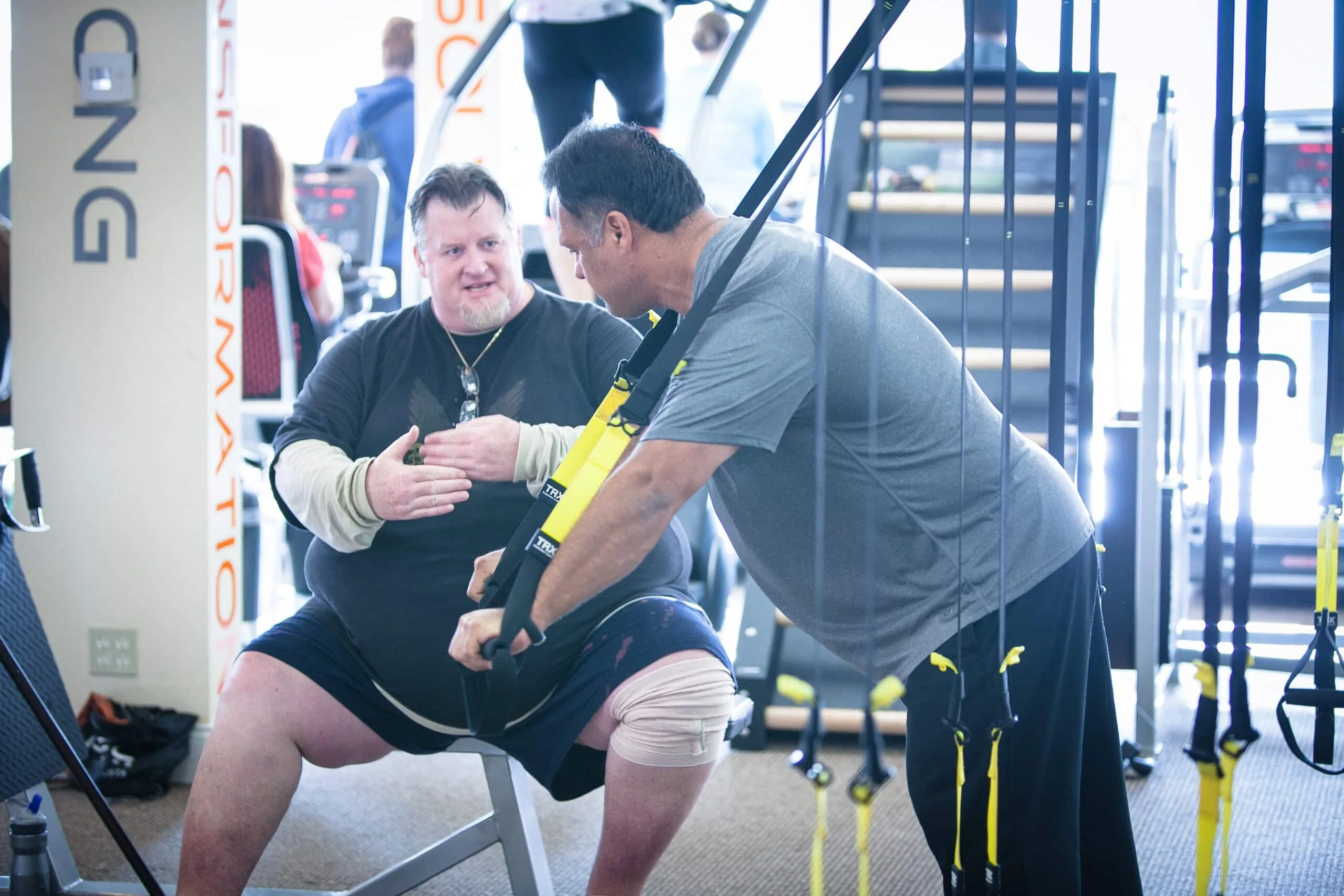
Move provides the training stimulus that preserves and builds lean mass while fat decreases. Our clients train 4–5 hours per day, five days per week, with a 3–4 to 1 client-to-trainer ratio. Every class includes options for every fitness level.
A case study conducted with the University of California, San Diego (UCSD) evaluated participants who stayed four or more weeks and received DEXA scans at the start and end of their program. The results were striking. Ninety-four percent of total weight loss was purely fat, compared to the 60/40 fat-to-muscle ratio typical of standard dieting programs.

Most long-term clients not only maintained their lean muscle stores but increased them. Bone volume and metabolic capability stayed intact. This is what the Think, Eat, Move approach produces when all three pillars work together.

To see how this approach can reshape your body composition, schedule a personal consultation with our team to discuss your goals and explore a tailored program. Call (888) 488-8936 or schedule your consultation online.
This beginner-friendly framework reflects core principles of evidence-based body recomposition for adults over 40. Each step fits within a single week.
These four steps form a starting point. At our program, this framework expands into a fully structured, expert-led experience with registered dietitians, licensed psychologists, and certified trainers guiding every decision. Explore a customized game plan to see how our immersive program can accelerate what these steps begin.
Older adults who are new to training can experience reductions in body fat percentage and gains in lean mass over six months of consistent recomposition work. That change is meaningful and measurable, yet it rarely follows a straight line.
Meaningful body recomposition is a non-linear process that usually spans months to a full year rather than producing quick scale-driven changes. Weeks 1–4 often show minimal visible change while internal adaptations, such as improved insulin sensitivity, early muscle fiber recruitment, and glycogen regulation, are already underway.
Weeks 4–8 often begin to show downward body fat trends and reductions in waist circumference. Visible photo differences commonly appear by weeks 8–12.
Plateaus do not signal failure. Metabolic adaptation causes resting metabolic rate to decrease as weight is lost because a smaller body requires fewer calories, which is a normal physiological response. True plateaus after 50 appear as no measurable progress for 4–6 weeks despite consistent effort, not a single hard week.
When a plateau arrives, the next step is adjustment, not abandonment. You can recalibrate protein intake, introduce a new training stimulus, audit sleep quality, or take a brief diet break at maintenance calories.
Setbacks are a normal part of behavior change. Effective relapse prevention focuses on rapid re-engagement, self-compassion, and viewing disruptions as temporary rather than proof of personal failure. Clients who achieve lasting recomposition are not the ones who never stumble. They are the ones who have a system and a community that bring them back.
We track 17 data points weekly for every client and review them in a one-on-one report card session with a trainer. This table outlines those metrics and what each one reveals about body composition progress.
| Data Point | What It Reveals |
|---|---|
| Scale weight | Total mass, useful only as a 4-week trend, not a daily reading |
| Body fat percentage | Ratio of fat to lean mass, the primary recomposition indicator |
| Neck circumference | Correlation with upper-body fat distribution and sleep apnea risk |
| Waist circumference | Visceral fat proxy that usually decreases during successful recomposition |
| Umbilicus (navel) circumference | Central adiposity marker distinct from waist measurement |
| Upper arm circumference | Lean mass gain tracker, where stable or rising numbers signal muscle growth |
| Chest circumference | Changes in both fat and upper-body muscle mass |
| Hip circumference | Combined with waist to produce waist-to-hip ratio for metabolic risk assessment |
| Quad circumference | Lower-body lean mass indicator, important for functional strength and metabolism |
| Blood pressure (systolic) | Cardiovascular health marker that often improves before major fat loss |
| Blood pressure (diastolic) | Secondary cardiovascular marker tracked alongside systolic |
| Mile time | Cardiovascular fitness and endurance progress indicator |
| Plank hold time | Core strength and muscular endurance benchmark |
| Push-up count | Upper-body strength and muscular endurance benchmark |
| LDL cholesterol | Cardiovascular risk marker that responds to dietary and exercise changes |
| HDL cholesterol | Protective cardiovascular marker that rises with consistent aerobic activity |
| Triglycerides | Metabolic health marker closely tied to carbohydrate intake and body fat |
| Glucose | Blood sugar regulation and a key indicator of metabolic health improvement |
Older adults new to structured training can realistically expect a 3–5% reduction in body fat and 1–3 kg of lean mass gain over six months of consistent effort. Visible changes in clothing fit and circumference measurements typically appear within 6–8 weeks. Meaningful before-and-after photo differences often emerge by weeks 9–12.
Progress remains non-linear, so expect weeks where the scale stalls while measurements and strength continue improving. Clients over 40 generally take 20–30% longer than younger adults to reach similar outcomes. That pattern reflects normal biology, not a limitation.
Adults over 40 who have been sedentary, have existing health conditions such as hypertension, type 2 diabetes, or cardiovascular disease, or take prescription medications should consult a physician before beginning a structured exercise and nutrition program. A baseline blood panel, including glucose, LDL, HDL, and triglycerides, provides valuable data for tracking metabolic improvements over time.
PFC conducts a comprehensive health assessment on day one, including blood work, vital signs, body composition, and a fitness test. This process establishes a personalized baseline and ensures every client’s program matches their current health status.
This phase represents a temporary and physiologically normal stage of early recomposition. When resistance training begins, muscles retain water as part of the repair and adaptation process, which increases volume slightly. At the same time, fat cells begin releasing stored energy but deflate unevenly before the overlying skin and tissue tighten.
The result is a transitional period, typically lasting 4–8 weeks, where fat feels less dense but has not yet visibly reduced. This phase resolves as lean mass increases and fat mass decreases. It signals that the body is adapting, not that the program is failing.
Self-directed recomposition can work, yet expert guidance often speeds results and reduces the risk of injury, metabolic adaptation, and burnout. Professional support becomes especially valuable when progress has stalled for four or more weeks despite consistent effort, when emotional or behavioral barriers interfere with adherence, when existing health conditions require a modified approach, or when previous attempts at diet and exercise have not produced lasting results.
Our team of certified trainers, registered dietitians, and licensed psychologists addresses all of these factors at the same time. As the UCSD case study demonstrated, our approach preserves lean mass far more effectively than standard programs.
An out-of-shape body composition does not have to be permanent, and the scale does not have to define your progress. Adults who achieve lasting recomposition after 40 focus on the right measurements, address behavioral and nutritional roots alongside physical training, and work within a structure that offers expert guidance and real community.
We have helped more than 3,000 clients transform their body composition at the Omni La Costa Resort & Spa in Carlsbad, California. Over 1,200 reviews and a 90% plus five-star rating reflect what that experience delivers. The UCSD case study result of 94% pure fat loss did not happen by accident. It grew from a program that addresses the whole person through Think, Eat, Move and tracks 17 data points weekly so every form of progress is seen and celebrated.
Ready to start your transformation? Schedule your personalized assessment with our team to discuss your goals and design a program for lasting results. Call (888) 488-8936 or visit our consultation page to schedule your assessment today.