 5-star Wellness Resort
 5-star Wellness Resort
Written by: Chris Butt, Certified Personal Trainer & Weight Loss Coach, Premier Fitness Camp | Last updated: August 9, 2026
Nearly seven out of ten American adults are overweight or obese. The most common responses to that reality, such as calorie-restriction diets, gym memberships, wellness apps, and GLP-1 medications used in isolation, share a fundamental flaw. They address the symptom without building the skills required to sustain the result.
Fitness apps illustrate this pattern clearly. Standard fitness apps often show strong initial gains followed by declining engagement over time. As the novelty fades and structure disappears, old habits return.
GLP-1 medications present a different but equally instructive limitation. University of Cambridge research indicates that patients regain on average 60% of weight lost on semaglutide one year after stopping, with weight regain then plateauing such that individuals keep off 25% of the weight lost. Patrick O’Neil, Ph.D., director of the MUSC Weight Management Center, reports no evidence that GLP-1 medications have any substantially lingering effect once stopped and notes that obesity is a chronic disease requiring chronic management through diet, exercise, and behavioral patterns.
For adults aged 40–60 who have cycled through these approaches for years, the accumulated experience does not reflect a failure of willpower. It reflects programs that never addressed nutrition education, emotional eating patterns, or the behavioral infrastructure needed for lasting change.
The behavioral infrastructure missing from short-term approaches requires a fundamentally different format. An effective immersive residential program integrates five structural elements simultaneously: daily fitness training, nutrition education, behavioral health support, comprehensive data tracking, and a community environment that sustains motivation. Integrative weight-loss programs emphasize strength training to preserve metabolism, low-impact cardio, and behavioral support that includes health coaching, cognitive behavioral therapy, emotional-eating strategies, habit-building systems, and regular accountability check-ins.
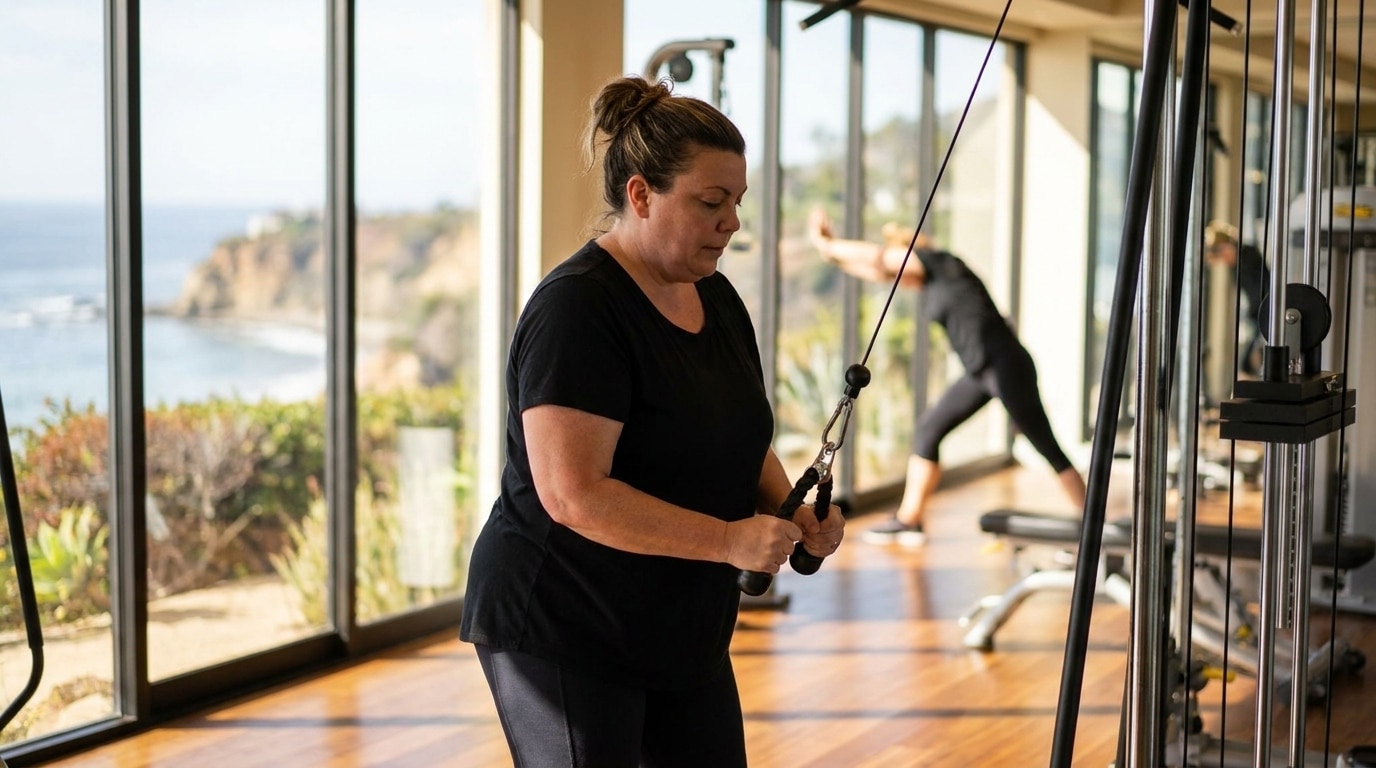
At Premier Fitness Camp (PFC), located at the Omni La Costa Resort & Spa in Carlsbad, California, that structure appears in a clear daily rhythm. The fitness training element anchors the mornings, which include 4–5 hours of guided sessions such as bootcamp, boxing, TRX, beach workouts, hiking at Torrey Pines or Double Peak, and stand-up paddleboarding, delivered at a 3–4:1 client-to-trainer ratio. Afternoons shift to education and behavioral support through nutrition workshops, cooking demonstrations, and behavioral health sessions led by registered dietitians and licensed psychologists. Evenings reinforce nutrition education through practice with gourmet, calorie-controlled meals prepared on-site by PFC’s wellness chefs using fresh, farm-to-fork ingredients.

Progress is tracked across 17 data points weekly, including weight, body fat percentage, seven body measurements, blood pressure, four blood markers, push-up count, plank time, and mile time. This structure gives participants a complete picture of health improvement that extends well beyond the scale. A UCSD case study of participants who stayed four or more weeks and received DEXA scans found that 94% of total weight loss was purely fat, compared to the 60/40 fat-to-muscle ratio typical of standard dieting programs. Lean muscle mass was preserved or increased in most long-term participants.
Stays begin at one week. The average first-time client stays approximately 11 days, and many extend on-site after experiencing early results. Typical fat loss runs 3–4 pounds per week for adults with 40–70 pounds to lose.

Weight often returns after a program ends because participants never learned the underlying skills such as how to shop, cook, manage emotional triggers, and structure exercise independently. Integrative weight-loss approaches differ from traditional dieting by focusing on root causes rather than calories alone, prioritizing long-term sustainability over short-term restriction, and addressing the interplay of biology, psychology, and lifestyle.
PFC’s “Think, Eat, Move” philosophy directly addresses this gap. Behavioral health coaches help participants identify emotional eating triggers. Registered dietitians teach macro balance, portion awareness, and meal planning instead of restrictive rules. Wellness chefs run cooking demonstrations so participants leave knowing how to prepare the same quality of meals at home. Trainers build exercise habits that continue outside a camp environment. Clients leave educated and empowered, not dependent on returning to maintain results.

Irene Tchaikovsky, a PFC participant, described the outcome: “What began as a simple one-week reboot has transformed into a complete lifestyle shift. PFC equips you with the knowledge, tools, and support to make meaningful, and sustainable, changes.”
For someone with 70, 100, or 200 or more pounds to lose, the distance between the present and the goal can feel paralyzing. Physical limitations, unfamiliarity with exercise, and the sheer volume of conflicting nutrition information increase that paralysis.
Personalized exercise programming can produce greater rates of favorable metabolic changes compared with standardized programming in physically inactive adults. Personalization functions as a clinical determinant of outcome rather than a luxury feature.
PFC removes the decision burden entirely. Every meal is prepared, every workout is scheduled, and every session is adapted for the participant’s current fitness level. Trainers work with clients ranging from those who can walk only 250 feet to seasoned athletes. The 17-point weekly report card makes progress visible across dimensions that move even when the scale does not, including blood pressure, glucose, strength, and measurements. Kerri, a PFC participant managing Type 1 Diabetes, described the shift: “I immediately discovered little things starting to happen, like tying my shoes easier, breathing better, my posture had improved. The confidence that came with all of those little wins had me realize it wasn’t so much about losing weight but what I was gaining.”

Many adults arriving at PFC have already attended other programs. They often describe a consistent pattern that includes generic exercise plans, food delivered from off-site, high staff turnover, no education component, and no meaningful tracking beyond scale weight. The experience felt transactional rather than transformational.
PFC’s differentiation rests on structure rather than cosmetic features. Every touchpoint is premium and integrated. Participants receive a comprehensive health assessment on day one. They train in on-site dedicated facilities within the 450-acre Omni La Costa Resort. PFC’s wellness chefs prepare all meals. Trainers hold at least a bachelor’s degree, many hold master’s degrees, and most have been with the program for years. Outdoor activities use the Pacific coast environment. Licensed psychologists provide behavioral health support. A detailed weekly report card is reviewed one-on-one with a trainer. Scott, a PFC participant, booked two weeks and stayed for eight, stating, “The facilities and staff are top notch.”
Weight loss never occurs as a purely physical process. Emotional eating, isolation, unsupportive home environments, and the psychological weight of repeated setbacks matter as much as any caloric deficit. Programs that ignore this dimension often produce results that dissolve once participants return to those environments.
PFC employs licensed psychologists and behavioral health coaches on staff. Group workshops address emotional eating, limiting beliefs, and life-work balance. One-on-one counseling is available for deeper issues. Beyond the clinical structure, participants consistently report that the relationships formed with staff and fellow campers are among the most meaningful outcomes of their stay. Alumni represent 50% of PFC’s annual revenue, which reflects the depth of those bonds. Paula L., a PFC participant, described the effect: “My lack of self confidence, self-doubt and anxiety were at an all time high. I am now off of my anti-depressants and have a whole new outlook on life physically, mentally and spiritually.”
GLP-1 medications can produce meaningful initial weight loss, yet the composition of that loss raises a clinical concern. Analyses show that 20–50% of weight lost during GLP-1 therapy consists of lean body mass, with one study of semaglutide attributing approximately 40% of total weight loss to fat-free mass reduction.
PFC is structured to address exactly this profile. Resistance training appears in every training day. Registered dietitians adjust protein targets, and current guidance recommends 1.2–1.6 g/kg/day of high-quality protein during active weight loss. The team then builds a sustainable nutrition plan for the post-medication transition. The UCSD case study’s 94% fat-loss finding, achieved while preserving or increasing lean muscle, demonstrates the program’s capacity to deliver the composition outcomes that GLP-1 graduates specifically need. PFC does not judge medication use and instead provides the lifestyle foundation that makes medication-assisted weight loss durable.
| Dimension | Immersive Residential Program (PFC) | Gym / Personal Trainer | Fitness App / Online Program |
|---|---|---|---|
| Daily time commitment | 4–5 hours of structured training per weekday, plus education and behavioral sessions | Typically 3–4 hours total per week | Self-directed, highly variable |
| Personalization | Comprehensive day-one health assessment, 17-point weekly tracking, 3–4:1 trainer ratio, all classes adapted per fitness level | Varies by trainer, limited to exercise only | Majority of participants reduce usage to near-baseline by approximately week 20, minimal adaptive personalization in standard apps |
| Scope of support | Fitness, nutrition education, behavioral health, cooking instruction, spa recovery, post-camp virtual coaching | Exercise only, client manages all nutrition and behavioral health independently | Exercise guidance only, no behavioral health or nutrition counseling |
| Accountability and environment | Residential, all-inclusive, zero competing priorities, luxury resort setting with dedicated on-site facilities | Fits into existing daily life with all its competing demands | Fully self-managed, no external accountability structure |
Wellness retreats and medication-only strategies occupy different positions that do not map cleanly to the same table columns. Wellness retreats, including competitors such as Canyon Ranch and Civana, prioritize relaxation and general well-being over structured, results-driven programming. They do not aim to deliver measurable fat loss or teach sustainable nutrition habits. Medication-only strategies, as the research above documents, produce weight loss that reverses rapidly without the lifestyle infrastructure to sustain it. An immersive residential program remains the only format that addresses fitness, nutrition, behavioral health, and accountability simultaneously within a structured, distraction-free environment.
When evaluating any immersive program, use the following questions as a practical due-diligence framework.
Reset Seekers, adults aged 40–60 who have tried diets, gym memberships, apps, or other programs without lasting results, represent the core participant. They arrive motivated but understandably cautious after investing time and money in approaches that did not hold.
PFC’s structure is designed specifically for this profile. The all-inclusive format removes every logistical barrier, since meals are prepared, workouts are scheduled, and the educational curriculum is built into each day. Participants avoid decision fatigue, meal planning, and navigating a gym environment alone. The 3–4:1 trainer ratio ensures individualized attention regardless of fitness level. Lauren M., who lost 140 pounds and was featured on The Today Show, described the experience: “I found myself again; got my confidence back; learned how, for my body type, I needed to eat and exercise; and most importantly, I learned how to adopt a healthy, sustainable lifestyle, instead of trying to change myself for it.”

The Omni La Costa Resort setting, 450 acres in Carlsbad, California, with year-round moderate temperatures and access to Pacific coast beaches, Torrey Pines, and Batiquitos Lagoon, supports both physical training and mental restoration. Three spa treatments per week are included in the program, which supports recovery and psychological well-being alongside the physical work.
Book a free consultation to discuss your goals, your history, and what a personalized program would look like for you. Call (888) 488-8936.
Adults who have used semaglutide, tirzepatide, or related medications face a specific post-medication challenge. The weight lost often includes a meaningful proportion of lean muscle mass, which drives resting metabolic rate. Without rebuilding that muscle, weight regain becomes a metabolic likelihood rather than a willpower issue.
Joshua Neal, M.D., chief of the MUSC Health Wellness and Human Performance ICCE, recommends 30 minutes of moderate- to high-intensity exercise four to five days a week and focusing on nutritional quality as appetite returns after stopping GLP-1s. PFC’s daily training schedule meets and exceeds that threshold, and the on-site dietitian team adjusts protein targets and macro balance to support muscle rebuilding throughout the stay.
PFC does not take a position against GLP-1 medications. The program functions as the structured lifestyle foundation that clinical guidance consistently identifies as necessary for durable outcomes, whether participants are currently on medication, tapering, or have already stopped.
Fifty percent of PFC’s annual revenue comes from returning alumni. This figure reflects more than satisfaction with results and highlights the quality of relationships formed during the program.
Alumni return for a range of reasons, including life disruptions that shifted their habits, a desire to reach the next level of fitness, or the pull of an environment where they feel genuinely supported. Low staff turnover means returning participants reconnect with the same trainers, dietitians, and behavioral health coaches year after year. Lin Vela, a three-time PFC participant, described the draw: “Their trainers are knowledgeable, inspiring and make hard work fun. The food is amazing!” Alex, who lost 97 pounds, keeps returning and shares, “I keep coming back! Thank you PFC.”
The multi-visit tracking system allows PFC to show long-term health trends across years of engagement. Returning alumni receive a longitudinal view of their progress that no single-visit program can replicate.
PFC is priced at approximately $6,000 per week, all-inclusive. That figure covers luxury accommodations at the Omni La Costa Resort, all meals and snacks prepared by PFC’s wellness chefs, all fitness classes and training sessions, nutrition and behavioral health workshops, cooking demonstrations, the comprehensive day-one health assessment, weekly 17-point report card reviews, three spa treatments per week, access to all resort amenities, and post-camp virtual coaching and support materials.
Pricing includes all core program elements, with no hidden fees and no à la carte charges for essentials. Multi-week discounts are available, and 0% financing for up to six months with no down payment is offered for qualified participants. The program may qualify as a tax-deductible medical expense, and participants should consult their tax professional.
Specialty programs, including Golf Fit, Tennis Fit, Pickleball Fit, and Spa Fit, are available as add-ons for participants who want to combine the full morning program with afternoon instruction in a specific activity. Approximately 15% of bookings include a specialty program.
Premier Fitness Camp is priced at approximately $6,000 per week, all-inclusive. That price covers luxury accommodations at the Omni La Costa Resort in Carlsbad, all meals prepared by PFC’s wellness chefs, all fitness training and educational workshops, behavioral health support, three spa treatments per week, a comprehensive health assessment, weekly 17-point progress tracking, and post-camp virtual coaching. Core program elements do not carry separate charges. PFC offers 0% financing for up to six months with no down payment, and multi-week discounts are available. The program may qualify as a tax-deductible medical expense. Stays begin at one week, and the average first-time participant stays approximately 11 days.
Premier Fitness Camp holds more than 1,200 reviews with a 90%+ five-star rating. Participants consistently highlight the quality and consistency of the training staff, the depth of the nutrition and behavioral health education, the quality of the food, and the sense of community formed during their stay. Recurring themes include meaningful weight and body composition changes, improvements in energy and confidence, and lasting relationships with staff and fellow participants. Fifty percent of PFC’s annual revenue comes from returning alumni, which reflects sustained satisfaction beyond the initial experience. Featured success stories include participants who lost 30 to 140 pounds, with several stories covered by national media including The Today Show and The Doctors.
Yes. Premier Fitness Camp is an adult-only program. The primary participant demographic is adults aged 40–60, although the program serves adults of all ages from their 30s onward. The curriculum, community environment, and program structure are designed specifically for adult needs, including behavioral health support, nutrition education, and fitness programming appropriate for adults managing the physical and lifestyle realities of midlife and beyond. Every class is structured to accommodate a wide range of fitness levels, from participants who have never exercised regularly to those who train four or more times per week.
An immersive residential program requires a meaningful investment of both time and money. A week at PFC costs approximately $6,000, and producing durable habit change typically requires two to four weeks of immersion. These considerations deserve honest comparison with the alternatives, including the cumulative cost of diets, gym memberships, and medications that have not produced lasting results, the medical costs associated with obesity-related conditions, and the quality-of-life value of sustained health.
Research and PFC’s outcomes data consistently show that short-term calorie restriction and medication-only strategies do not address the educational, behavioral, and muscular foundations required for long-term weight maintenance. An immersive residential program that integrates daily fitness, nutrition education, behavioral health support, 17-point tracking, and post-camp tools within a luxury environment aligns structurally with producing and sustaining those outcomes.
PFC’s UCSD case study, showing 94% of weight loss from pure fat while preserving or increasing lean muscle, provides clear evidence of what that alignment produces in practice. With 1,200+ reviews, a 90%+ five-star rating, and 50% of revenue from returning alumni, the program’s track record is documented at scale.
Adults who feel ready to move from repeated short-term attempts to a structured, education-first transformation can begin with a conversation. Book a free consultation with the Premier Fitness Camp team to discuss your goals, your history, and the program structure that fits your needs. Call (888) 488-8936 or visit premierfitnesscamp.com/book-a-consult to schedule your personalized consultation today.