 5-star Wellness Resort
 5-star Wellness Resort
Written by: Chris Butt, Certified Personal Trainer & Weight Loss Coach, Premier Fitness Camp | Last updated: June 24, 2026
Rotational power drives the golf swing. The core muscles, including the obliques, transverse abdominis, and erector spinae, work with the hips and thoracic spine to create that power. Without deliberate rotational strength training, golfers rely on arm speed alone, which limits clubhead velocity and increases injury risk at the lower back and elbow.
Rotational power deficits limit distance for many amateur golfers. Medicine ball rotational throws, cable woodchops, and pallof press variations train the core to generate and transfer force in rotation instead of only stabilizing in a straight line. At Golf Fit, coaches progress these movements across the week. Afternoon play on La Costa’s 36-hole course then reinforces the morning training stimulus in real time.
Hip mobility allows a full backswing and complete follow-through. The trail hip must internally rotate during the backswing while the lead hip externally rotates, then both reverse roles on the downswing. When hip capsule tightness or shortened hip flexors limit this motion, the body compensates by over-rotating the lumbar spine. That pattern reduces power and often contributes to lower-back pain in golfers over 40.
Golf-specific hip mobility training targets the hip flexors, piriformis, adductors, and hip capsule. Key exercises include 90/90 hip stretches, lateral band walks, and deep squat holds with thoracic rotation. These movements restore the range of motion needed for a mechanically sound turn while reducing compensatory load on the lumbar spine. PFC’s Golf Fit program builds these drills into the morning fitness block, and professionals from the La Costa Golf Performance Institute reinforce proper movement patterns during afternoon play.
Thoracic spine mobility controls shoulder turn. This mid-back region between the neck and lower back typically needs 45–60 degrees of rotation for a full backswing. Sedentary work, long hours of sitting, and age-related stiffness reduce this range over time. Golfers then shorten the backswing or compensate through the lower back and neck.
TPI’s research on thoracic mobility links thoracic restriction to swing faults such as early extension, reverse spine angle, and loss of posture. These faults reduce both power and accuracy. Thoracic foam rolling, open-book rotations, quadruped thoracic rotations, and seated thoracic extension over a foam roller directly address these issues. As thoracic mobility improves, shoulder turn increases, the club travels on a more consistent plane, and clubhead speed rises.
Shoulder stability keeps the joint centered during the high-speed arc of the swing. Strength alone does not guarantee this control. A strong rotator cuff and scapular stabilizer system helps the humeral head stay positioned correctly under load. Without that stability, the humeral head can migrate forward, which creates impingement patterns and pain, especially in the lead shoulder during follow-through.
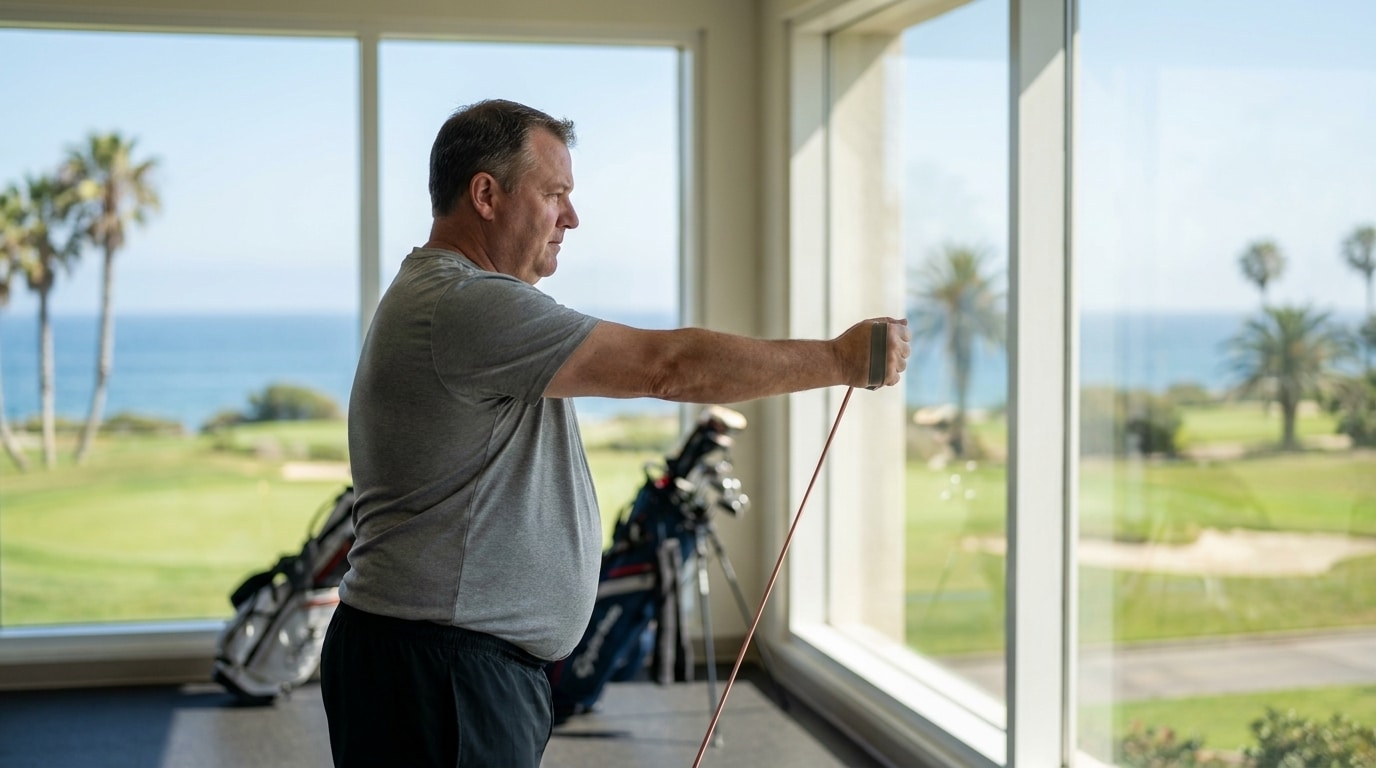
Golf-specific stability training focuses on the rotator cuff muscles, lower trapezius, and serratus anterior. Effective exercises include face pulls, band external rotations, prone Y-T-W raises, and single-arm cable rows. These movements use low loads and high precision, so they work well for golfers across many fitness levels, including those with prior shoulder injuries. PFC’s 3–4 to 1 trainer-to-client ratio allows close form monitoring and individualized progressions.
Lower-body power lets golfers create strong ground reaction forces. Modern swing research shows that vertical and horizontal ground forces from the legs drive clubhead speed. The body then transfers that energy through the kinetic chain. Weak glutes, quadriceps, and hamstrings limit this force production and create an arm-dominated, inefficient swing.
Lower-body power training for golfers includes goblet squats, Romanian deadlifts, lateral lunges, single-leg press variations, and, for appropriate fitness levels, jump squats. These exercises build strength and explosiveness so golfers can push into the ground effectively at the start of the downswing. At Golf Fit, coaches sequence lower-body training across the week to manage fatigue. This approach lets golfers apply new power during afternoon rounds while maintaining movement quality.
This sample schedule shows how Golf Fit blends morning training, afternoon golf, and evening recovery so each day builds on the last without creating excessive fatigue.
| Day | Morning Fitness (7:00 AM – 12:00 PM) | Afternoon Play (1:00 PM – 4:30 PM) | Evening Recovery (5:00 PM – 8:00 PM) |
|---|---|---|---|
| Monday | Health assessment, rotational power intro, mobility screening | 9-hole skills session with La Costa Golf Performance Institute professionals | Group dinner, nutrition education workshop |
| Tuesday | Hip and thoracic mobility training, lower-body strength circuit | 18-hole round on La Costa’s championship course | Spa treatment (included), behavioral health group session |
| Wednesday | Shoulder stability, rotational power progression, TRX suspension training | 18-hole round with on-course coaching and swing feedback | Group dinner, cooking demonstration by PFC wellness chef |
| Thursday | Lower-body power, ground-force drills, interval conditioning | 18-hole competitive round, clubhead speed measurement | Spa treatment (included), one-on-one trainer report card review |
| Friday | Full-pillar integration session, mobility re-screening, fitness re-test | 9-hole skills refinement, video swing analysis | Group dinner, post-camp planning and at-home programming session |
Golf Fit at Premier Fitness Camp combines full-scale fitness and nutrition coaching with elite golf instruction in one location. Every morning, participants complete PFC’s full fitness and nutrition program, which includes 4–5 hours of expert-led training with a 3–4 to 1 trainer-to-client ratio. Afternoons shift to instruction and play on Omni La Costa’s 36-hole course, a former NCAA National Championship host. Evenings feature spa recovery, nutrition education, and behavioral health support, with three spa treatments per week included.
Carlsbad, California supports this model with year-round moderate temperatures and low humidity. Outdoor training and golf remain consistent regardless of the week a client attends. The 450-acre Omni La Costa Resort houses all PFC facilities on-site, so clients avoid shuttles to off-site gyms or outsourced meals. PFC’s wellness chefs prepare all meals fresh with farm-to-fork ingredients, and registered dietitians design each plate to support performance and recovery.
A UCSD case study of multi-week PFC participants found that 94 percent of total weight loss came from body fat, not muscle. Standard dieting programs often show closer to a 60 to 40 fat-to-muscle ratio. For golfers between 40 and 65, preserving lean muscle while reducing body fat supports sustained power output and lowers injury risk. PFC tracks 17 health data points weekly, including body composition, strength metrics, and cardiovascular markers, so clients see objective proof of progress.
Book a free consultation to see how Golf Fit at Omni La Costa can match your current fitness level, injury history, and performance goals.
Fitness level: Golf Fit serves golfers across the full fitness spectrum. Participants range from those who have not trained consistently in years to regular gym-goers. PFC trainers hold bachelor’s and master’s degrees and maintain a 3–4 to 1 client-to-trainer ratio in all sessions. Low-impact options exist for every exercise, and the morning program allows a 400-pound beginner and a seasoned athlete to train side by side while each receives appropriate coaching.
Injury history: Prior shoulder, hip, or lower-back injuries are common among golfers in the 40 to 65 age range and do not exclude participation. PFC conducts a comprehensive health assessment on day one that includes blood work, body composition, and a fitness test. This baseline supports a personalized plan. Trainers then adjust programming in real time based on each client’s history and daily feedback.
Cost and time investment: PFC runs approximately $6,000 per week and is all-inclusive. The price covers luxury accommodations at Omni La Costa, all meals, all fitness sessions, golf instruction and play, spa treatments, health assessments, weekly report cards, and post-camp support. To make this investment more accessible, PFC offers zero-percent financing for up to six months with no down payment, and the program may qualify as a tax-deductible medical expense. These flexible options help explain why the average client stays 11 days instead of a single week, as many guests extend their stay after seeing early results. That pattern of extended stays and repeat visits shows up in PFC’s retention data, where roughly half of annual revenue comes from returning alumni.
Improving swing strength and mobility requires focused training of five physical pillars: rotational power, hip mobility, thoracic spine mobility, shoulder stability, and lower-body power. Golfers need a structured, progressive, golf-specific program that blends on-course play, expert coaching, and deliberate recovery. Generic workouts rarely address all of these pillars together. Golf Fit at Premier Fitness Camp covers each pillar inside a luxury immersive environment and tracks outcomes across 17 data points every week.
PFC’s track record supports this approach. More than 1,200 reviews and a 90 percent plus five-star rating document lasting health transformations. The UCSD case study on 94 percent fat-loss outcomes, the close coaching ratios, the on-site 36-hole championship course, and the post-camp support structure combine to create a comprehensive golf-specific fitness experience for adult golfers.
Book a free consultation with the Premier Fitness Camp team to begin your program. Call (888) 488-8936 or schedule your personalized consultation online.
No minimum fitness level is required. Golf Fit accommodates participants from largely sedentary lifestyles to regular trainees. PFC’s morning fitness program maintains a 3–4 to 1 trainer-to-client ratio, and every exercise includes modifications and progressions so each participant works at an appropriate intensity. A comprehensive health assessment on day one, including blood work, body composition analysis, and a fitness test, establishes each client’s baseline and guides a personalized training plan. Clients with prior injuries or chronic conditions can share details during the free pre-arrival consultation so the team can prepare suitable accommodations.
Golf Fit integrates swing instruction with full-body physical development. A traditional golf academy focuses on technique and on-course instruction alone. Golf Fit addresses the five pillars that support swing performance: rotational power, hip mobility, thoracic spine mobility, shoulder stability, and lower-body power. Each morning, participants complete 4–5 hours of expert-led fitness training, then move to afternoon instruction and play on Omni La Costa’s 36-hole championship course. Evenings include spa recovery, nutrition education, and behavioral health support. This structure improves the physical capacity to execute better mechanics, not just the understanding of those mechanics. Post-camp support with personalized at-home exercise programming and ongoing communication with PFC trainers extends progress beyond the camp week.
Golf Fit participants can expect measurable changes in health and performance, although results vary by starting fitness level, age, injury history, and length of stay. PFC tracks 17 health and fitness data points weekly, including body composition, strength metrics such as push-ups and plank time, cardiovascular fitness such as mile time, and metabolic markers like blood pressure, glucose, and cholesterol. For golfers, mobility re-screening documents changes in hip and thoracic rotation, and video swing analysis before and after the program shows mechanical improvements. Clubhead speed is measured during the Thursday round to quantify power gains. The UCSD case study on PFC’s 94 percent fat-loss outcome supports the program’s ability to preserve lean muscle, which is critical for sustained swing power. Clients who stay two weeks or longer usually see the most significant and lasting changes.
Golf Fit can work well for golfers with lower-back or hip pain when they share their history and current symptoms in advance. Lower-back and hip pain are common in golfers between 40 and 65, and Golf Fit’s curriculum targets the mobility and stability deficits that often drive these issues. Hip capsule tightness, thoracic restriction, and weak glutes frequently contribute to lower-back pain, and the program addresses each factor directly. PFC trainers hold advanced degrees and regularly adapt programming for clients with musculoskeletal limitations. The day-one health assessment captures injury history and pain patterns, and the 3–4 to 1 trainer-to-client ratio allows close monitoring of form and load. Clients can also authorize communication with their physicians during the pre-arrival consultation.
Golf Fit at Premier Fitness Camp is an all-inclusive experience. The program price covers luxury accommodations at the Omni La Costa Resort, all meals prepared on-site by PFC’s wellness chefs, morning fitness sessions, golf instruction and play with La Costa Golf Performance Institute professionals, three spa treatments per week, comprehensive health assessments, weekly 17-point report cards, and workshops in behavioral health and nutrition. Post-camp support includes personalized at-home exercise programming and continued access to PFC trainers. Zero-percent financing for up to six months with no down payment is available, and the program may qualify as a tax-deductible medical expense. Multi-week discounts are also available for extended stays.