 5-star Wellness Resort
 5-star Wellness Resort
Written by: Chris Butt, Certified Personal Trainer & Weight Loss Coach, Premier Fitness Camp
Evaluate any residential wellness program against these five criteria before you commit.
Lasting results depend more on program design than on individual willpower. PFC structures every element around that reality.

A 2006 meta-analysis of 94 studies found that specific “if‑then” plans create medium-to-large improvements in goal achievement. Programs that teach clients to plan for real-world situations, such as work dinners or holidays, produce better long-term outcomes than programs that only shape behavior inside a controlled setting.
No study in the provided evidence matches the described 3,000-participant landmark trial or its 62% versus 23% maintenance rates. PFC’s Think, Eat, Move framework instead focuses on progressive habit-building across three clear pillars.
Mental health gains from retreats correlate most strongly with structured mindfulness, time in nature, and social connection. PFC builds all three into daily life at the 450-acre Omni La Costa Resort. Lasting nervous system change requires repeated practice, so PFC treats post-camp virtual coaching, personalized meal plans, and ongoing trainer communication as core parts of the program.

To see how these principles show up in real programs, the table below compares six leading retreats to Premier Fitness Camp across the five checklist criteria. All data points come from public program descriptions and the context above.
| Program | Education Depth | Behavioral Health Support | Post-Program Coaching | Data Tracking | Staff Credentials |
|---|---|---|---|---|---|
| Premier Fitness Camp (Carlsbad, CA) | Full Think, Eat, Move curriculum with nutrition workshops, cooking demos, behavioral workshops, and psychologist-led sessions | Psychologists and behavioral health professionals on staff, individual and group sessions | Virtual coaching, personalized meal plans, and ongoing trainer communication after departure | Seventeen data points tracked weekly via personalized Report Card, optional DEXA scan, UCSD case study with 94% fat loss | All trainers hold at least a bachelor’s degree, many hold master’s degrees, low staff turnover, registered dietitians and licensed behavioral health professionals on staff |
| Live In Fitness (Arizona) | Exercise and basic diet focus with limited structured education | Not prominently featured in program description | Not prominently featured | Scale weight with limited additional metrics reported | Trainer credentials and turnover not prominently disclosed, food delivered from off-site |
| Canyon Ranch (multiple locations) | Wellness programming with some education, broader spa and retreat focus | Some mental wellness programming available | Limited structured post-retreat coaching reported | Some health assessments, less emphasis on weekly outcome tracking | Credentialed staff, premium positioning, experience-focused rather than strictly results-driven |
| Unite Fitness Retreat (Salt Lake City, UT) | Nutrition education and mindset coaching, GLP-1 program available as add-on | Mindset coaching, but not the same depth as a full psychology team | Post-retreat aftercare via app and monthly check-ins with nurse practitioner partner | Progress tracking via app, biomarker testing in GLP-1 program | Fitness professionals and nutrition staff, downtown hotel location with driving to additional amenities |
| Pritikin (Florida) | Longevity and medical wellness education with structured nutrition programming | Some behavioral support, slower-paced program for older demographics | Some follow-up support, less structured than PFC’s ongoing coaching model | Medical assessments and outcome tracking available | Medical and clinical staff, longevity-focused rather than fitness-and-weight-loss-focused |
| Civana Wellness Resort & Spa (Arizona) | Wellness retreat programming with less structured fitness and weight loss curriculum | Wellness and mindfulness programming without integrated results-focused behavioral health | Not prominently featured | Limited outcome tracking reported | Wellness professionals, retreat-experience focus rather than measurable transformation |
| Hilton Head Health (South Carolina) | Weight loss education focus and GLP-1 Support Experience with cooking demos, behavioral health support, and metabolic health education | Behavioral health support included in GLP-1 program | Some follow-up support, with guests arranging accommodations separately and transportation to facilities | Biomarker testing in GLP-1 program and standard weight loss tracking | Credentialed staff, older-demographic focus, humid South Carolina climate |
PFC is the only program in this comparison with third-party validated outcomes. As noted earlier, the UCSD case study found 94% fat loss, which directly addresses the metabolic damage from muscle loss that often drives weight regain after other programs.
Post-program support often determines whether your results last. Many retreats underdeliver here.
The Diabetes Prevention Program’s intensive lifestyle intervention achieved a mean 5.6 kg loss and 58% reduction in type 2 diabetes incidence after 2.8 years through 16 individual counseling sessions followed by bimonthly contacts. Structured follow-up functioned as a core treatment element, not a bonus.
PFC’s post-camp support model creates a complete transition-to-home system through four integrated components. Virtual coaching sessions maintain accountability after departure, while personalized meal plans translate camp nutrition into the client’s home kitchen. Customized fitness guidance adapts exercise programming to home equipment and schedules, and direct communication with the same trainers clients worked with on-site preserves relationship continuity.
No other program in the comparison table offers this combination of named-trainer continuity, personalized home meal planning, and virtual coaching as a standard feature. This continuity is one reason 50% of PFC’s annual revenue comes from returning alumni who experienced results, maintained them, and chose to return.
PwC data shows that 20% of U.S. households now include at least one GLP-1 weight-loss drug user, up from 9% just a year earlier. Many of these users have lost weight along with lean muscle and metabolic capacity, which makes long-term maintenance difficult without targeted support.
PFC’s approach for GLP-1 users centers on resistance training to rebuild lean muscle, protein-forward nutrition designed by registered dietitians, and behavioral education that prepares clients for life as medication is reduced or discontinued. The UCSD case study’s 94% fat-loss result aligns with this resistance-training-first method and helps counteract the muscle loss often seen with medication-assisted weight loss.
PFC does not require clients to stop GLP-1 medications. The program works alongside them and builds the foundation that keeps results going after medication use changes.
Retreat pricing in California varies by program type, length of stay, and level of service. Typical weekly ranges look like this.
PFC is priced at about $6,000 per week and is fully all-inclusive. The rate covers luxury accommodations at the Omni La Costa Resort, all meals from on-site wellness chefs, all fitness classes and training, nutrition and behavioral health education, weekly 17-point health assessments, three spa treatments per week, and post-camp support. Zero-percent financing for up to six months with no down payment is available, and multi-week discounts apply.

Different guest profiles benefit from different program features. Use the profiles below to clarify what to prioritize.
The Reset Seeker (40–60 years old, 40–70 pounds to lose). Focus on education depth, behavioral health support, and a non-judgmental community. PFC’s Think, Eat, Move curriculum, psychology-led support, and 3–4:1 trainer ratio align closely with this profile. As client Irene Tchaikovsky wrote, “What began as a simple one-week reboot has transformed into a complete lifestyle shift. PFC equips you with the knowledge, tools, and support to make meaningful—and sustainable—changes.”
The GLP-1 Graduate (any age, muscle loss concern). Look for high resistance training volume, protein-focused nutrition, and documented muscle-preservation outcomes. PFC’s UCSD case study result of 94% fat loss with lean muscle preserved or increased offers especially relevant data for this group.
The Concerned Beginner (any age, first-time program). Prioritize low-impact options, small trainer ratios, and a welcoming environment. PFC designs every class so participants at any fitness level, including those with physical limitations, can participate fully. Client Julie Robinson shared, “The trainers, the staff, the chefs—all amazing and work with all levels.”
The Active Optimizer (plateau-breaker, body recomposition focus). Seek higher training volume, variety, and detailed progress tracking. PFC’s 4–5 hours of daily training, 17 weekly data points, and specialty tracks such as Golf Fit, Tennis Fit, Pickleball Fit, and Spa Fit provide the intensity and variety that experienced exercisers need. Client Scott summed it up: “I signed up for two weeks and stayed for eight.”
Social accountability mechanisms show measurable benefits for exercise and dietary habits. PFC’s community, built through shared training, shared meals, and shared experiences at Omni La Costa, is often cited by clients as one of the most meaningful parts of their stay. Client Alex put it simply: “I met some of my best friends here.”
Premier Fitness Camp is the only California wellness retreat that combines a UCSD-validated case study with 94% fat loss, 17 weekly data points, licensed behavioral health support, registered dietitians, degree-holding trainers at a 3–4:1 ratio, and structured post-program virtual coaching, all based at the Omni La Costa Resort & Spa in Carlsbad.
With more than 1,200 reviews, a 90%+ five-star rating, and half of annual revenue coming from returning alumni, PFC’s outcomes show strong long-term impact.
Ready to start your transformation? Book a free consultation with the PFC team to discuss your goals and explore how the program can be tailored to you. Call (888) 488-8936 or visit the consultation booking page to schedule your personalized consultation today.
Lasting results require structured education, behavioral health integration, and post-program support. Education explains why specific habits work and how to apply them at home. Behavioral health support, delivered by psychologists or trained coaches, addresses emotional and psychological patterns that drive overeating, inactivity, and self-sabotage. Post-program coaching maintains accountability after departure, which is when many people regain weight. Programs that deliver all three consistently outperform those focused only on exercise or calorie restriction during the stay. PFC’s Think, Eat, Move framework covers all three pillars, and its virtual coaching, personalized meal plans, and ongoing trainer communication extend the impact well beyond the visit.
Most aggressive weight loss approaches, including standard dieting, produce about a 60/40 ratio of fat loss to lean muscle loss, and some reach a 50/50 split. PFC’s UCSD case study evaluated participants who stayed four or more weeks and received DEXA scans at the start and end of their program. The study found that 94% of total weight loss was purely fat, and most long-term PFC clients preserved or increased lean muscle. This distinction matters for long-term maintenance because lean muscle drives resting metabolic rate, and muscle loss often leads to weight regain. This is a case study rather than a clinical trial, yet it remains the most rigorous published outcome data available for any California fitness retreat.
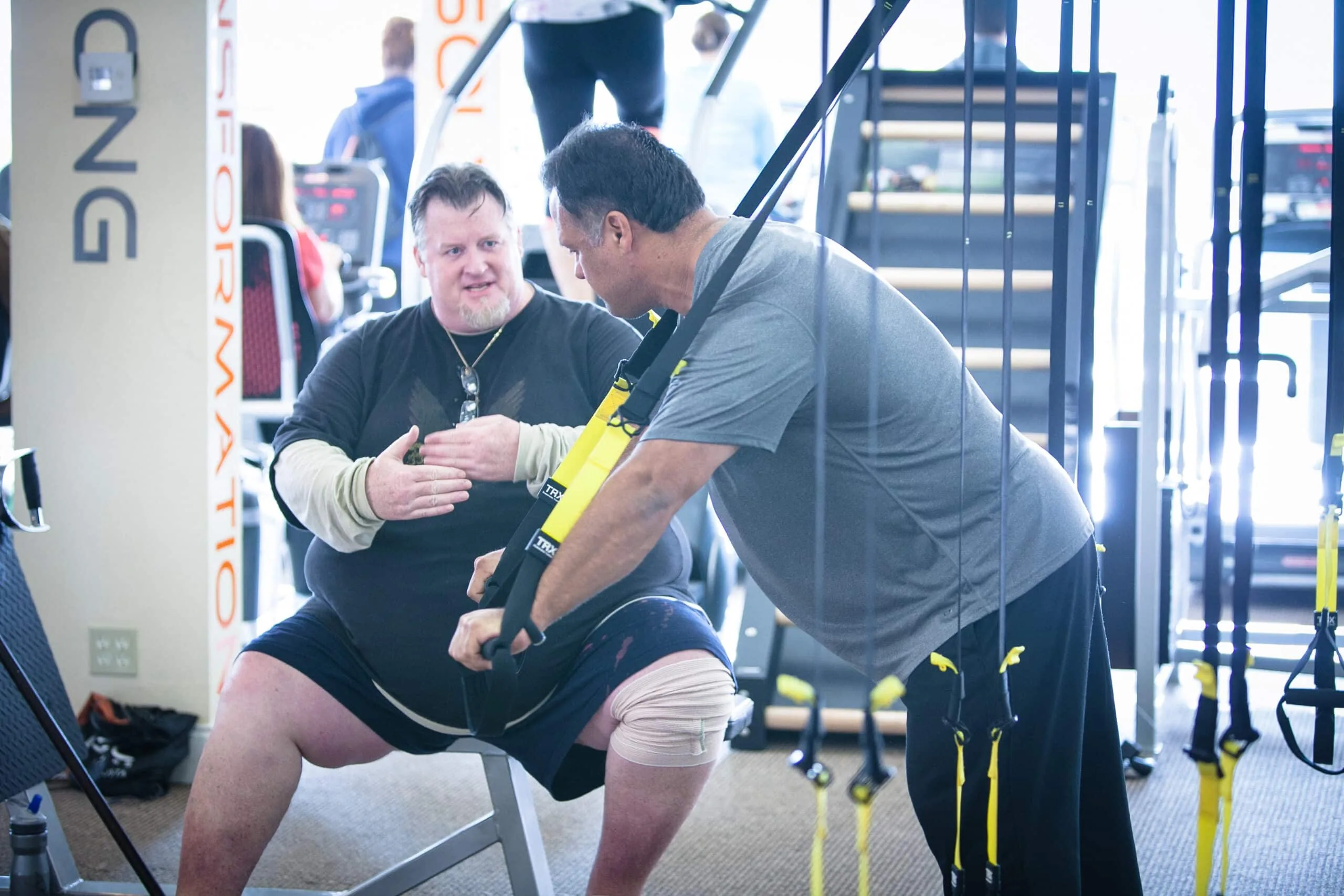
PFC works with clients across the full spectrum of fitness levels, including individuals over 400 pounds who can initially walk only short distances. Every class is structured so that each participant, regardless of fitness level, physical limitations, or prior experience, can participate and benefit. Trainers maintain a 3–4:1 client-to-trainer ratio and provide modifications, progressions, and low-impact alternatives for every exercise. A dedicated low-impact training track supports guests with conditions such as knee pain, back problems, or cardiovascular limitations. The program begins with a comprehensive health assessment, including blood work, body composition, vital signs, and a fitness test, to build a plan suited to each person’s starting point.
PFC’s post-camp support includes virtual coaching sessions for ongoing accountability, personalized meal plans designed for the client’s home kitchen and lifestyle, customized fitness guidance and exercise programming, and direct communication with the same trainers the client worked with on-site. Named-trainer continuity is rare in the industry and reflects PFC’s low staff turnover, with many trainers having been with the program since its founding. Clients can email their trainers at any time after departure. This continuity of relationship supports PFC’s exceptionally high alumni return rate mentioned earlier.
One week provides a strong kickstart and measurable improvements across several health markers for many clients. Two weeks build momentum and allow habit formation to begin in earnest. Three weeks align with behavioral research suggesting that repeated practice and reinforcement help new habits feel more automatic. Four weeks deliver significant body composition change and the deepest educational foundation. PFC’s average stay is about 11 days, and many clients book one week and extend on-site after experiencing the program. Extended stays of up to six months are available, and multi-week pricing discounts apply.