 5-star Wellness Resort
 5-star Wellness Resort

Written by: Chris Butt, Certified Personal Trainer & Weight Loss Coach, Premier Fitness Camp
The accelerated return experienced by previously trained adults reflects a documented physiological mechanism, not motivational language. Research published on PubMed demonstrates that myonuclei, the cellular control centers within muscle fibers, are retained long after detraining, which provides a structural advantage when training resumes. Additional peer-reviewed work confirms that this myonuclear retention enables rapid neuromuscular readaptation, so the nervous system reconnects to dormant muscle fibers far more efficiently than it establishes those connections for the first time.
Detrained lifters returning after months or years away from training can achieve first measurable body-composition changes in 3–4 weeks and noticeable visual transformation in 6–10 weeks, owing precisely to this muscle-memory mechanism. Early strength gains in the first 2–3 weeks are largely attributable to neuromuscular adaptation rather than increases in muscle size, which means the body is already working in your favor before the mirror reflects it.
While muscle memory accelerates the mechanical recovery process, adults over 40 face an additional metabolic challenge. Further research supports that adults over 40 can achieve body recomposition, but at slower rates than younger adults due to anabolic resistance when per-meal protein doses are appropriately scaled and joint recovery between sessions is prioritized. The protocol below addresses both of these variables directly.
The foundation of this protocol is three full-body resistance training sessions per week on nonconsecutive days. Each session uses compound movements performed through a controlled range of motion with 2–3 repetitions in reserve, which means the set ends before technical failure. This frequency aligns with ACSM and NSCA guidelines that recommend resistance training 2–3 nonconsecutive days per week targeting all major muscle groups.
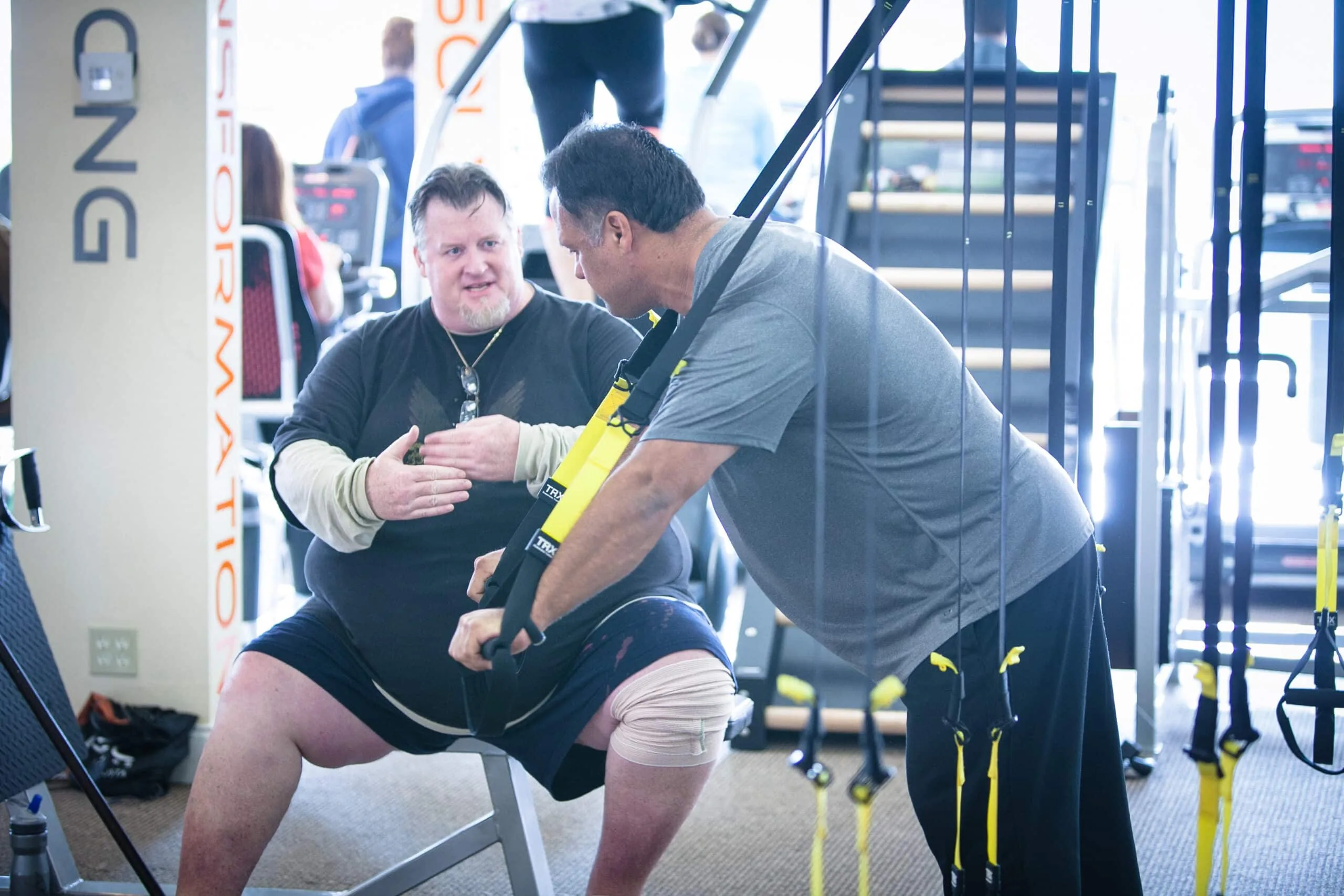
A recommended approach for the first workout after a training break is to finish the session feeling as though a little more could have been done. This conservative intensity allows accurate assessment of recovery and reduces the risk of excessive delayed-onset muscle soreness. The 48-hour windows between sessions are not optional rest periods. They are where the actual adaptation occurs, which makes recovery as important as the training itself.

For injury history, replace bilateral squat patterns with single-leg press or step-ups for knee concerns. Replace overhead pressing with landmine press for shoulder impingement. Replace conventional deadlift with trap-bar deadlift or hip thrust for lower-back sensitivity.
Daily protein intake of 1.4–1.6 g/kg body weight supports muscle retention, with the range rising to 1.8–2.4 g/kg during fat loss in a caloric deficit to protect lean mass. The practical target for this protocol is 1.6–2.2 g of protein per kilogram of body weight per day, distributed across 3–4 meals at the per-meal doses discussed earlier.

An even protein distribution across meals produced a 25% higher 24-hour muscle protein synthesis rate than a skewed distribution with identical total daily protein intake. Distribute intake as evenly as possible across the day rather than concentrating it at dinner.
Practical daily targets by body weight:
Body recomposition after inactivity does not require aggressive caloric restriction. The decision between maintenance calories and a mild deficit depends on sleep, stress, training energy, and your stage in the protocol.
Stay at maintenance calories if two or more of the following apply:
Apply a 200–400 kcal daily deficit if all of the following apply:
Returners and beginners can gain roughly 0.5–2 pounds of muscle per month in early stages while losing 0.5–4 pounds of fat per month in a moderate calorie deficit. A deficit larger than 500 kcal per day during the return phase increases the risk of lean mass loss and training performance decline, which undermines the recomposition goal.
Scale weight ranks as the least useful metric for monitoring body recomposition because muscle tissue is approximately 18% denser than fat, allowing fat loss and muscle gain to offset each other and produce no net change for months. A layered tracking framework captures the full picture of progress.
For the 4-week starter protocol, track these 9 essential metrics weekly: body weight as a weekly average of two morning readings, waist circumference at the navel, hip circumference at the widest point, upper arm circumference when flexed, quad circumference at mid-thigh, maximum push-ups in one set, plank hold duration in seconds, subjective energy levels, and clothing fit.
PFC’s comprehensive tracking framework expands to 17 data points for clients in longer programs. This expanded system adds body fat percentage via bioelectrical impedance, neck, chest, and umbilicus circumferences, and quarterly blood biomarkers including LDL, HDL, triglycerides, fasting glucose, and blood pressure to monitor metabolic health alongside body composition changes.
Mile time serves as an additional conditioning benchmark assessed at the start and end of each program block. A weekly summary should include a two-measurement bodyweight average, a summarized training log with weights, sets, and reps, and a note on clothing fit to capture changes the mirror and scale may miss.
Log all chosen metrics in a printed or digital template at the same time each week, ideally Monday morning before eating. Subjective daily indicators including energy levels, workout recovery quality, sleep, how clothes fit, and confidence often improve weeks before measurable physical changes appear during body recomposition after inactivity. Record these subjective markers alongside the objective data.
Extreme soreness after early sessions is the most common reason adults abandon a return-to-training protocol within the first two weeks. The solution is not to train through severe soreness. Reduce volume in the following session by 30–40% and prioritize active recovery such as 20–30 minutes of walking, swimming, or gentle mobility work. Approximately 50% of sedentary adults who start exercise programs quit within 6 months, which makes gradual progression and consistency over intensity essential for long-term adherence.

Fear of heavy loads is addressed by the 2–3 reps-in-reserve rule. No set in this protocol should approach technical failure. The goal in Weeks 1–2 is movement pattern reactivation, not maximal output. Controlled tempo using 3 seconds lowering, a 1 second pause, and 1 second lifting on every repetition builds connective tissue tolerance and reinforces motor patterns before load increases are introduced.
Motivation dips typically occur at Days 10–14, when initial enthusiasm fades and results are not yet visible. Habit-stacking, which means attaching the training session to an existing daily anchor such as a morning coffee or a work lunch break, reduces the decision burden. A large cohort study found that when sleep quality declined from good to poor, fat mass increased at more than double the rate and skeletal muscle loss also doubled, which makes sleep protection a non-negotiable habit alongside training and nutrition.
For previously trained adults aged 40–60, the first measurable improvements in strength and energy typically appear within 2–3 weeks of consistent training. The timeline follows the muscle memory advantage discussed earlier. Measurable changes in circumference and body fat percentage emerge at 3–4 weeks, while mirror-visible transformation appears between weeks 6 and 10, which is significantly faster than the 12–16 week timeline typical for true beginners.
The fundamental mechanisms such as myonuclear retention, neuromuscular readaptation, and protein synthesis response are the same across sexes. Women in the 40–60 age range may experience additional variables related to perimenopause or menopause, including changes in estrogen that affect fat distribution and recovery speed. These factors do not prevent recomposition; they shape the approach. Women in this age group benefit from prioritizing the higher end of the protein range, closer to 2.0–2.2 g/kg, maintaining resistance training as the primary modality rather than relying on cardio alone, and tracking circumference measurements closely since hormonal shifts can cause scale weight to fluctuate independently of fat or muscle changes.
Adults aged 40–60 without known cardiovascular disease, uncontrolled hypertension, or insulin-dependent diabetes with autonomic neuropathy can generally begin light-to-moderate exercise without physician consultation. Males over 40 and females over 50 are advised to consult a healthcare provider before beginning vigorous exercise. Anyone with a history of cardiac events, orthopedic surgery within the past 12 months, or uncontrolled metabolic conditions should obtain medical clearance before starting any structured resistance training program. When in doubt, a brief conversation with a primary care physician serves as a low-cost safeguard.
GLP-1 medications such as semaglutide suppress appetite and can produce meaningful scale weight reductions, but without structured resistance training and adequate protein intake, a significant portion of that weight loss comes from lean muscle mass rather than fat. This risk means the scale may show progress while body composition deteriorates. The protocol in this guide, which includes three resistance training sessions per week, 1.6–2.2 g protein per kg body weight, and a mild or no caloric deficit, directly counteracts muscle loss during GLP-1 use. Caloric deficit targets should be set conservatively for GLP-1 users, as appetite suppression may already create a deficit larger than intended.
Volume and intensity increases are appropriate when all sets in the current week are completed with good form, 2–3 reps in reserve, and without excessive soreness lasting more than 48 hours. A practical rule states that if you complete all prescribed sets and reps with 2–3 reps clearly remaining, increase the load by 2–5% in the following session. If soreness from a session persists beyond 48 hours, hold load constant and focus on recovery before progressing. After completing the 4-week starter calendar, a trained professional should assess readiness for a more structured intermediate program that introduces periodization, higher weekly volume, and potentially a fourth training day.
Body recomposition after inactivity is a structured, science-backed process, not a punishment for time away. The 4-week calendar above, combined with 1.6–2.2 g of protein per kilogram of body weight, a mild caloric deficit calibrated to your individual recovery capacity, and a tracking framework that moves well beyond the scale, gives previously trained adults aged 40–60 a complete, copy-and-use protocol for regaining lean mass while losing fat.

The UCSD case study finding that 94% of weight lost under a structured, expert-led program was purely fat while lean mass was preserved or increased illustrates what becomes possible when the protocol is executed in an environment built for it. That environment is Premier Fitness Camp at the Omni La Costa Resort in Carlsbad, California, where every element of this protocol is delivered daily: progressive resistance training with a 3–4:1 trainer-to-client ratio, registered dietitian-designed meals calibrated to individual protein targets, weekly report card reviews, and behavioral health support from licensed psychologists. Stays begin at one week, and many clients extend on-site after experiencing the results firsthand.