 5-star Wellness Resort
 5-star Wellness Resort
Written by: Chris Butt, Certified Personal Trainer & Weight Loss Coach, Premier Fitness Camp | Last updated: June 15, 2026
The global wellness tourism market will grow from $974.57 billion in 2025 to $1.06 trillion in 2026, driven by rising demand for preventive healthcare and purpose-driven experiential travel. Providers are shifting focus toward verifiable outcomes and deep specialization in evidence-based protocols rather than generic spa-style relaxation. North America holds over 31% of the wellness tourism market share, defined by high concentrations of affluent consumers seeking medical-wellness integration, yet no U.S.-based residential fitness program has matched this program’s combination of UCSD-validated outcomes, weekly 17-point tracking, and resort-level luxury.
A consistent framework makes it easier to compare any luxury wellness retreat. The table below applies six clear criteria across program types.
| Criterion | What to Look For | Red Flags | Program Standard |
|---|---|---|---|
| Clinical & Educational Rigor | Validated outcomes data, licensed dietitians and psychologists on staff | No published results, exercise-only focus | UCSD case study on fat loss, registered dietitians, licensed psychologists, Think-Eat-Move curriculum |
| Program Design | 4–5 hours daily structured training, multidisciplinary approach | Generic group classes, no behavioral health component | 4–5 hours per day Monday through Friday, boxing, hiking, TRX, beach workouts, nutrition workshops, behavioral coaching |
| Environment & Location | Dedicated on-site facilities, favorable year-round climate | Off-site gyms reached by van, urban or extreme-climate settings | 450-acre Omni La Costa Resort in Carlsbad, California, year-round moderate climate, Pacific coast access |
| Personalization | Day-one health assessment, individualized tracking, low trainer ratio | One-size-fits-all classes, scale weight only | Low trainer-to-client ratio, 17 data points tracked weekly, optional DEXA scan |
| Cost & Value | All-inclusive pricing, transparent breakdown, financing options | Hidden fees, basic accommodations at premium prices | About $6,000 per week all-inclusive, financing options, discounted multi-week stays |
| Aftercare | Post-program coaching, personalized home plans, ongoing staff access | No follow-up after departure | Virtual coaching, personalized meal and fitness plans, direct trainer email access after camp |
Ready to sort through which criteria matter most for you? Schedule a personalized consultation with a program specialist to walk through the framework and your goals.
Retreat pricing spans an enormous range. Prices on major booking platforms range from USD 25 to USD 88,000 depending on duration, location, and program depth. Spa-oriented programs at mid-tier resorts typically run $1,500–$3,500 per week, while medically supervised longevity retreats in Europe can exceed $15,000 per week. Premier Fitness Camp sits at approximately $6,000 per week, all-inclusive, which covers luxury accommodations at Omni La Costa Resort, all gourmet nutritionist-designed meals prepared on-site by wellness chefs, every fitness class and educational workshop, three spa treatments per week, comprehensive health assessments, and weekly report card tracking across 17 data points.
That figure compares favorably when measured against outcomes rather than nightly rates. Physical wellness programs receive considerable emphasis in the wellness tourism market, reflecting where measurable transformation actually occurs. Financing options support longer stays, and multi-week programs carry discounted rates. The program may qualify as a tax-deductible medical expense, so clients should consult a tax professional for individual guidance.
The competitive landscape for adult wellness retreats spans relaxation-focused resorts, medically supervised longevity centers, and immersive fitness programs. Each serves a different purpose, and understanding those differences is essential before committing time and resources.
Kamalaya (Koh Samui, Thailand) is a respected holistic wellness sanctuary offering detox, stress-relief, and emotional balance programs in a tropical setting. Its strength lies in integrative Eastern and Western therapies. It does not provide a structured daily fitness curriculum, U.S.-based access, or data-validated fat-loss outcomes.
Chenot Palace (Weggis, Switzerland) is a medical longevity retreat emphasizing diagnostics, biohacking, and anti-aging protocols. It appeals to executives seeking cellular-level health improvements. Program costs are significantly higher than this program, the focus leans toward longevity science rather than fitness transformation, and it requires international travel.
Sensei Porcupine Creek (Rancho Mirage, California) offers a science-guided wellness experience on a private estate in the California desert. It provides personalized health guidance and spa amenities in a serene environment. It does not match the structured 4–5 hours of daily fitness training, behavioral health curriculum, or published fat-loss case study data that this program provides.
The Ranch Malibu (California) is a fitness-intensive program known for its rigorous daily hiking schedule and plant-based nutrition. It delivers genuine physical challenge. Its approach is highly prescriptive, accommodations are intentionally spartan rather than luxury-resort-level, and it does not offer the multidisciplinary Think-Eat-Move curriculum or post-GLP-1 support framework available at Premier Fitness Camp.
Canyon Ranch (Tucson, AZ and Lenox, MA) is a well-established wellness brand with decades of history. It offers a broad menu of spa, fitness, and health services. Its model is more retreat-and-relaxation oriented than results-driven. It does not publish outcome data comparable to this program’s UCSD case study, and its trainer-to-client ratio and daily training volume are lower.
A consistent gap across all five options emerges. None combines a U.S.-based location, a published university-validated fat-loss case study, weekly 17-point health tracking, a low trainer-to-client ratio, and post-GLP-1 muscle-preservation programming within a luxury resort setting.
Compare Premier Fitness Camp directly to any retreat you are considering by speaking with a program specialist at (888) 488-8936. A specialist can walk through how outcomes, structure, and support differ from other options.
The program operates exclusively at the Omni La Costa Resort & Spa in Carlsbad, California, a 450-acre property in North San Diego County with year-round moderate temperatures, low humidity, and direct access to Pacific coast beaches, Torrey Pines, Double Peak Park, and Batiquitos Lagoon. All facilities, dining, fitness, education, and spa services are on-site. Clients do not spend time in vans shuttling to off-property gyms.
A case study conducted in partnership with the University of California, San Diego (UCSD) evaluated participants who stayed four or more weeks and received DEXA scans, the gold standard for body composition measurement, at program start and end. The results showed that nearly all recorded weight loss came from fat rather than muscle, a pattern that contrasts sharply with the typical mix seen in standard dieting. This distinction matters because preserving muscle mass helps protect resting metabolic rate, which supports lasting weight maintenance. Most long-term participants also maintained bone volume, creating a stronger foundation for long-term health. This is a case study, not a clinical trial, and individual results vary.
Every client’s progress is tracked across 17 weekly data points: weight, body fat percentage, measurements of neck, waist, umbilicus, upper arm, chest, hip, and quad, blood pressure (systolic and diastolic), mile time, plank hold duration, push-up count, and LDL, HDL, triglycerides, and glucose levels. Weekly one-on-one report card reviews with a trainer put every metric in context, not just scale weight. An optional DEXA scan provides gold-standard body composition data at any point during a stay.
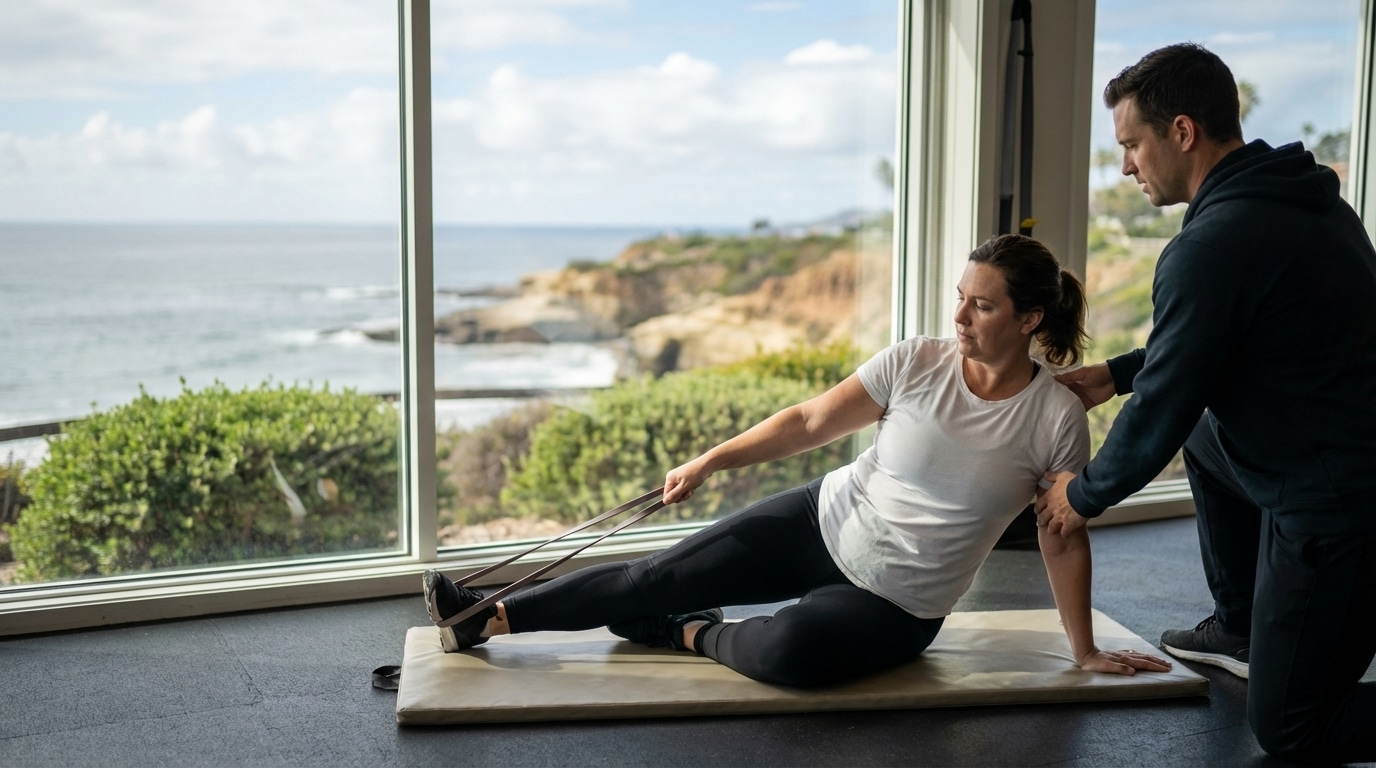
The daily structure runs 4–5 hours of training Monday through Friday, with a half day on Saturday. Activities include bootcamp, boxing, barre, TRX suspension, Tabata, Zumba, spin, interval and resistance training, beach workouts, coastal hikes, kayaking, and stand-up paddleboarding. Sessions maintain a low client-to-trainer ratio, with modifications and low-impact alternatives built into every class. Every trainer holds a minimum bachelor’s degree, and many hold master’s degrees and have been with the program for years.
The Think-Eat-Move curriculum ties the full experience together. Think covers emotional eating, stress triggers, and limiting beliefs through workshops led by licensed psychologists and behavioral health coaches, with one-on-one counseling available. Eat focuses on nutrition, with registered dietitians designing all meals and leading workshops on macros, portion control, and meal planning, while wellness chefs prepare every meal on-site from fresh, farm-to-fork ingredients and conduct cooking demonstrations. Move represents the full daily training program described above.
The 50% alumni return rate, which represents half of annual revenue, reflects sustained satisfaction across more than 3,000 clients served and over 1,200 reviews. This client loyalty positions the program well for the broader market shift ahead. The wellness tourism market is projected to grow at a CAGR of 10.7% from 2025 to 2030, driven specifically by demand for verifiable outcomes. While many competitors rely on anecdotal testimonials, the UCSD case study provides documented evidence that aligns with this growing expectation.
For GLP-1 Graduates: Adults who have used Ozempic, Wegovy, or similar medications often arrive having lost weight but also lean muscle and metabolic capacity. The protocol for this group emphasizes resistance training to rebuild muscle, elevated protein targets designed by registered dietitians, and the behavioral education needed to sustain results after reducing or stopping medication. The program does not judge medication use. It focuses instead on building the foundation that makes any weight-loss intervention sustainable long-term.
For Repeat Alumni: Approximately half of annual revenue comes from clients who return, some annually for more than 15 years. The same trainers, dietitians, and behavioral health coaches remain year after year, which enables continuity of care and deeper relationships. Alumni return for annual resets, body recomposition goals, or simply because the program represents a trusted, high-quality environment where they feel genuinely supported.
Client Irene Tchaikovsky described her experience: “What began as a simple one-week reboot has transformed into a complete lifestyle shift. The program equips you with the knowledge, tools, and support to make meaningful, sustainable changes.” Scott, who signed up for two weeks and stayed for eight, noted: “It is a life-changing experience. I signed up for two weeks and stayed for eight. The facilities and staff are top notch.” Jake Younger added: “I not only lost weight but gained confidence, strength, and a healthier lifestyle.”
North American and European travelers represent a substantial share of the wellness tourism market and are shifting from reactive medical care to proactive, evidence-based wellness regimens. That shift demands more than a beautiful setting. It calls for clinical rigor, transparent outcome data, genuine personalization, and aftercare that extends beyond checkout.
The six-criterion framework in this guide, which covers clinical and educational rigor, program design, environment, personalization, cost and value, and aftercare, provides a consistent basis for comparing any retreat. Applied honestly, it separates programs built around measurable transformation from those built around a pleasant week away. The UCSD case study, detailed weekly tracking, low trainer-to-client ratio, and Think-Eat-Move curriculum together represent a documented standard that few comparable U.S. programs currently match.
Stays begin at one week, with multi-week options available. The average client stays approximately 11 days, and many extend on-site after experiencing their first week’s results.
Ready to start your transformation? Schedule a consultation with the team to discuss your goals and how the program can support lasting results. Call (888) 488-8936 or schedule your consultation online to begin your personalized program discussion today.
Adults over 40 face specific physiological and behavioral challenges such as declining muscle mass, shifting hormones, accumulated stress, and years of competing priorities that generic gym memberships or short-term diets do not address. A luxury wellness retreat earns its value when it delivers three things at once: a structured, immersive environment that removes daily distractions, a multidisciplinary team that addresses fitness, nutrition, and behavioral health together, and measurable, documented outcomes that extend beyond the scale. Premier Fitness Camp tracks 17 health data points weekly, including body fat percentage, blood pressure, cholesterol, glucose, and fitness benchmarks, so clients leave with a clear picture of many dimensions of their health, not just a number on a scale. For adults who have tried other approaches without lasting results, the immersive, education-first model addresses the root causes of weight regain rather than the symptoms.
GLP-1 medications can produce meaningful initial weight loss, yet they frequently come with a significant side effect: muscle loss. When muscle mass declines, resting metabolic rate drops, which makes long-term weight maintenance much harder. The approach for GLP-1 graduates centers on rebuilding what the medication may have reduced. Registered dietitians adjust macronutrient targets, particularly protein, to support muscle synthesis. The daily training program, which runs 4–5 hours, emphasizes resistance and strength-building work alongside cardiovascular training. Behavioral health coaches address the psychological transition away from medication dependency and help clients build sustainable habits that make any weight-loss intervention last. The program does not judge medication use. It is designed to complement it and, for those who choose to reduce or stop their medication, to provide the physiological and educational foundation that supports weight maintenance.
One week provides a powerful reset. Clients typically lose several pounds of fat, see measurable improvements across multiple health markers, and leave with new nutritional knowledge and behavioral tools. Two weeks builds real momentum, with compounding improvements in fitness benchmarks, body composition, and energy. Three weeks aligns with habit formation research that suggests new behavioral patterns begin to solidify. Four weeks or more delivers the most significant transformation, including substantial fat loss, meaningful lean muscle preservation or gain, and deeper education across nutrition, behavioral health, and fitness that supports lasting change at home. The average client stays approximately 11 days, and many who book one week choose to extend on-site after experiencing their first week’s results. Stays of up to several months are available, and financing options and multi-week discounts help make longer programs more accessible.
Mornings start with structured fitness training that runs 4–5 hours and incorporates a rotating mix of activities such as bootcamp, boxing, barre, TRX suspension, Tabata, spin, interval training, beach workouts, and coastal hikes at locations including Torrey Pines and Double Peak Park. All sessions are led by trainers with bachelor’s or master’s degrees, at a low client-to-trainer ratio, with modifications available for every fitness level. Midday includes a gourmet, calorie-controlled lunch prepared on-site by wellness chefs using fresh, farm-to-fork ingredients. Afternoons feature educational workshops such as nutrition classes, cooking demonstrations, behavioral health sessions, or one-on-one counseling, along with optional specialty programs such as Golf Fit, Tennis Fit, Pickleball Fit, or Spa Fit. Dinner is a full, nutritionist-designed meal served at 5:00 PM. Three spa treatments per week at the Omni La Costa Spa are included in the program. The structured schedule removes decision fatigue, since meals, workouts, and education are all organized, which allows clients to focus fully on their transformation.
Lasting transformation requires support beyond the retreat itself. Every departing client receives a personalized meal plan designed by registered dietitians for their home environment, a customized fitness and exercise programming guide, and access to virtual coaching for ongoing accountability. Clients can email their trainers directly at any time after leaving, a level of continued access that reflects low staff turnover and the genuine relationships built during the program. For returning alumni, multi-visit tracking across years of engagement allows the team to monitor long-term health trends and adjust programming accordingly. The high alumni return rate shows that the aftercare model supports real-world results and encourages clients to treat the program as a recurring investment in their long-term health.