 5-star Wellness Resort
 5-star Wellness Resort
Written by: Chris Butt, Certified Personal Trainer & Weight Loss Coach, Premier Fitness Camp | Last updated: June 19, 2026
Seven in ten Americans are currently overweight or obese. Post-GLP-1 medication use has created a new group of adults who have lost scale weight but now face muscle loss, metabolic slowdown, and no sustainable habits to maintain their results. Four main options compete for their attention: traditional weight loss camps that focus on exercise and restriction with little education, gym memberships and personal trainers that provide three to four hours of weekly training instead of four to five hours per day at a residential program, health and wellness resorts that emphasize relaxation rather than measurable outcomes, and digital apps that lack immersive, community-driven accountability. None of these categories consistently addresses clinical rigor, behavioral health, and post-program support at the same time.
Clinical and educational rigor. The Community Preventive Services Task Force recommends individually adapted health behavior change programs based on strong evidence showing a median net increase of 35.4% in time spent in physical activity and 64.3% in energy expenditure. Programs that tailor interventions to each participant’s readiness for change and teach goal-setting, self-monitoring, and relapse prevention consistently outperform generic group curricula.
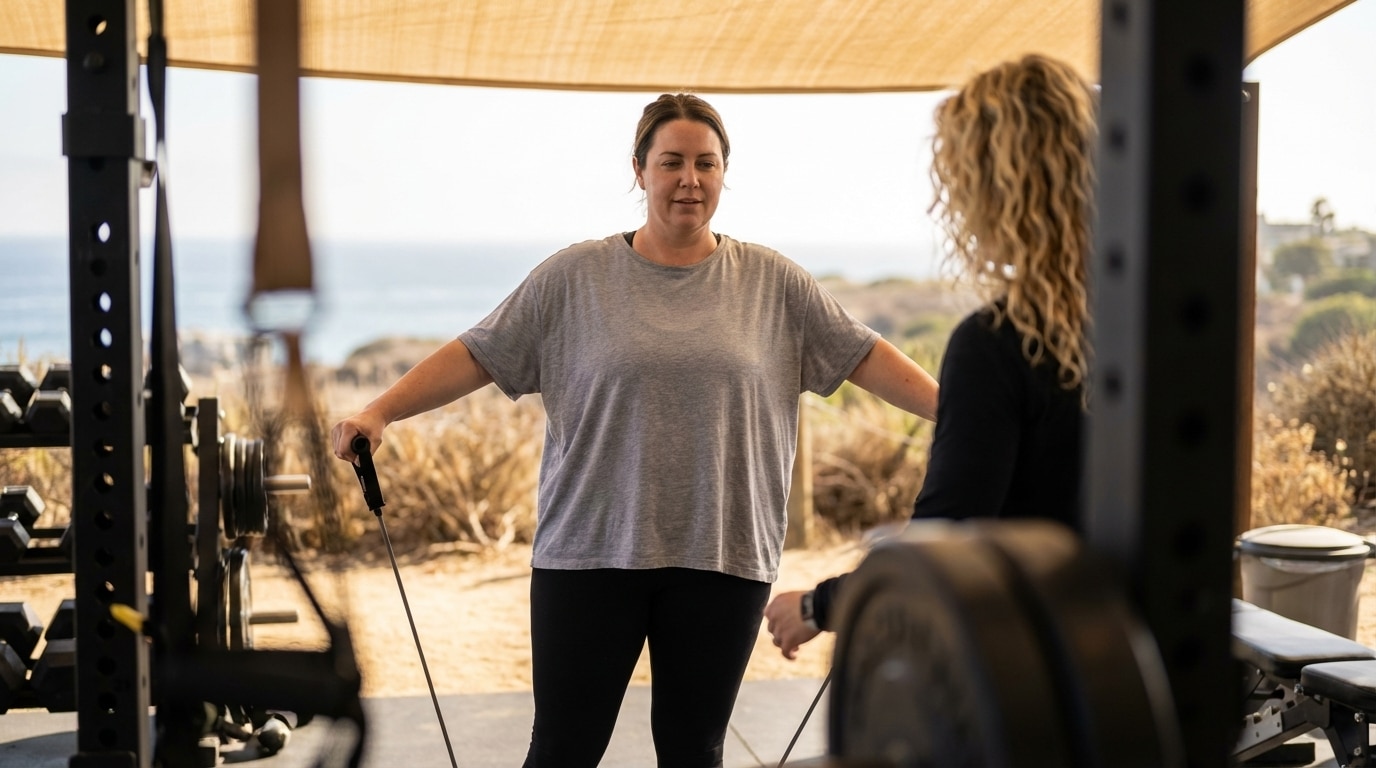
Program design for real body change. Training volume matters. Most adults exercise three to four hours per week. At this program, clients train four to five hours per day, five and a half days per week. That volume, combined with a 3–4:1 trainer-to-client ratio, gives the stimulus needed for genuine body-composition change rather than a short-term drop on the scale.
Environment and location advantages. Year-round moderate temperatures, low humidity, and proximity to the Pacific coast support daily outdoor training that inland or high-humidity locations cannot match. The 450-acre Omni La Costa Resort campus keeps dining, fitness, education, spa, and accommodations in one place. This setup removes the logistical friction of shuttling to off-site gyms by van.
Personalization through multidisciplinary staffing. Top-tier residential programs internationally maintain staff-to-guest ratios between 1:2 and 1:3, with multidisciplinary teams including physicians, nutritionists, and behavioral therapists. The 3–4:1 trainer ratio, on-site registered dietitians, licensed psychologists, and wellness chefs match that benchmark within a results-focused weight loss framework.
Cost and value of an all-inclusive stay. The program runs approximately $6,000 per week, which covers every element needed for transformation: luxury accommodations, all meals prepared by on-site wellness chefs, all fitness sessions, educational workshops, health assessments, and weekly report card tracking. That price also includes three spa treatments per week for recovery and post-camp support to sustain results after you leave, which separates transformation programs from simple weight-loss camps. Zero-percent financing for up to six months with no down payment makes the investment more accessible.
Aftercare that keeps progress going. Lasting behavior change requires focused skill development, habit formation, and self-monitoring tools rather than knowledge alone. These elements allow clients to continue making progress independently after a residential program ends. Post-camp support includes virtual coaching, personalized meal plans, fitness programming, and ongoing direct communication with trainers.
The field’s most effective residential programs share five operational characteristics. First, trainer ratios of 3–4:1 ensure every participant receives individualized cueing and modification, which is critical for a population that ranges from 400-pound beginners who can walk only 250 feet to seasoned athletes. Second, weekly tracking across 17 or more data points, including weight, body fat, seven circumference measurements, blood pressure, four blood markers, mile time, plank hold, and push-up count, reveals progress that the scale alone conceals. Third, on-site wellness chefs preparing fresh, farm-to-fork meals close the quality and caloric-control gaps created when food is prepared off-site and delivered. Fourth, behavioral health integration through licensed psychologists, emotional eating workshops, and one-on-one counseling addresses the psychological drivers of weight gain that exercise alone cannot resolve. Fifth, explicit post-GLP-1 protocols that emphasize resistance training and elevated protein intake preserve lean muscle mass and protect resting metabolic rate for clients transitioning off or reducing GLP-1 medications.
One client summed it up clearly: “What began as a simple one-week reboot has transformed into a complete lifestyle shift. The program equips you with the knowledge, tools, and support to make meaningful and sustainable changes.”
The table below evaluates the program against the most frequently cited alternatives. Competitor descriptions come from publicly available information and direct operational knowledge.
| Evaluation Criterion | Program | Live In Fitness | Canyon Ranch / Civana | Unite Fitness Retreat / Pritikin / Hilton Head Health |
|---|---|---|---|---|
| Location & Climate | Omni La Costa Resort, Carlsbad, CA, year-round moderate temps, low humidity, Pacific coast access | Arizona, extreme heat for roughly half the year | Arizona / Florida, desert heat or high humidity | Downtown Salt Lake City (cold winters) / Florida (high humidity); guests at Hilton Head Health transported to facilities daily |
| Trainer Credentials & Retention | Bachelor’s degree minimum; many hold master’s degrees; extremely low turnover; many staff since program launch | High staff turnover reported; inconsistent trainer quality | Retreat-focused staffing; results-driven fitness credentials not primary differentiator | Varies by program; older-demographic focus; less activity diversity |
| On-Site Food Quality | Wellness chefs; registered dietitians; fresh farm-to-fork meals prepared on-site | Food prepared off-site and delivered | On-site dining; retreat-style rather than transformation-calibrated | On-site dining at Pritikin and Hilton Head Health; Unite Fitness Retreat guests in downtown hotel setting |
| Fat-Loss Proof (Body Composition) | UCSD case study: 94% of weight loss was pure fat; lean muscle preserved or increased | No equivalent published case study data identified | No equivalent published case study data identified | No equivalent published case study data identified |
| GLP-1 Integration Protocol | Explicit post-GLP-1 protocol: resistance training emphasis, elevated protein targets, muscle-preservation focus | No published GLP-1 protocol identified | No published GLP-1 protocol identified | No published GLP-1 protocol identified |
| Post-Camp Support | Virtual coaching, personalized meal plans, fitness programming, direct trainer communication | Limited post-program infrastructure reported | Retreat-model aftercare; not transformation-focused | Varies; Pritikin and Hilton Head Health offer some follow-up resources |
Scott, a client who arrived for two weeks and stayed for eight, put it plainly: “The program is a life-changing experience. The facilities and staff are top notch.”
Use the following five criteria to evaluate any luxury fitness and weight loss program before booking.
High staff turnover. When trainers change frequently, clients cannot build the trust and continuity that drive long-term behavioral change. Low turnover means returning alumni reconnect with the same staff year after year, which helps explain why 50% of annual revenue comes from repeat clients. That relationship stability also supports the next critical element, nutritional precision.
Off-site food preparation. Meals prepared elsewhere and transported to a facility lose nutritional precision and freshness. On-site wellness chefs with registered dietitian oversight set the standard that truly supports transformation. Weak nutrition support then compounds the next pitfall, which involves missing psychological care.
Absence of behavioral health support. Programs that address only exercise and calorie restriction leave the psychological drivers of weight gain, such as emotional eating, limiting beliefs, and stress responses, entirely unaddressed. Without that layer, relapse becomes predictable. When relapse happens, many programs still rely only on the scale, which hides what is really going on in the body.
Measuring only scale weight. Scale weight blends fat loss, muscle loss, water fluctuation, and bone density changes into one number. A program that cannot separate these outcomes cannot claim to deliver body-composition transformation. The 17-point weekly report card, with optional DEXA scan, provides the level of detail that scale-only programs cannot match.
If you want to discuss which program structure fits your specific situation, talk to the team about your goals. Call (888) 488-8936.
The program runs approximately $6,000 per week and is fully all-inclusive. The rate covers luxury accommodations at the Omni La Costa Resort, all meals prepared by on-site wellness chefs under registered dietitian oversight, all fitness sessions and educational workshops, comprehensive health assessments, 17-point weekly report card tracking, three spa treatments per week, access to all resort amenities, and post-camp virtual coaching and meal planning. Zero-percent financing for up to six months with no down payment is available, and multi-week discounts apply for longer stays. The program may also qualify as a tax-deductible medical expense; consult a tax professional for guidance. When evaluating cost, compare it against the cumulative expense of failed diets, unused gym memberships, and the long-term medical costs associated with unmanaged weight and metabolic health.
The program serves clients across the full fitness spectrum, from individuals who have never exercised consistently to those who train four or more times per week. Every fitness session is structured so that all participants, regardless of starting point, can engage safely and progress meaningfully. The trainer ratio mentioned earlier allows for low-impact modifications and progressions tailored to each client. The program has supported clients starting at 400+ pounds who could initially walk only 250 feet, as well as clients with orthopedic limitations, Type 1 Diabetes, and other complex health histories. Each stay begins with a comprehensive health assessment that includes blood work, body composition, a fitness test, and vital signs so every plan is individualized from day one.
The program actively supports GLP-1 users and graduates. The team does not discourage medication use and instead builds the educational and physiological foundation that helps GLP-1 medications work sustainably long-term. For clients currently on GLP-1s, the program emphasizes resistance training to preserve lean muscle mass, elevated protein targets to counteract the muscle-loss risk associated with rapid weight reduction, and behavioral nutrition education to build the habits needed when medication is eventually reduced or stopped. For GLP-1 graduates who have already experienced muscle loss or metabolic slowdown, the UCSD-validated approach that preserves lean muscle while eliminating fat directly addresses the body-composition damage that GLP-1 use without structured exercise can cause.
Post-camp support includes virtual coaching sessions for ongoing accountability, personalized meal plans calibrated to home cooking and real-life schedules, structured fitness programming to continue at a local gym or at home, and direct ongoing communication with trainers via email. The program’s “Think, Eat, Move” curriculum is designed so clients leave not just physically changed but educated and empowered. They understand their nutritional needs, their emotional triggers, and the exercise habits that work for their body. Cooking demonstrations with wellness chefs teach clients how to replicate healthy meals at home. Behavioral health workshops address relapse prevention and problem-solving for real-life disruptions. Fifty percent of annual revenue comes from returning alumni, which reflects both the quality of the experience and the strength of the ongoing relationship between clients and staff.
Adults seeking genuine body-composition transformation, not a temporary scale drop, can rely on clear evaluation criteria. Clinical rigor, individualized tracking across meaningful data points, on-site food quality, behavioral health integration, explicit post-GLP-1 protocols, and a post-camp support structure that extends the program’s impact into everyday life all matter. This program meets every criterion, backed by the UCSD case study’s body-composition findings, 1,200+ reviews with a 90%+ five-star rating, and 50% of revenue from clients who return year after year.
As Lauren M., who lost 140 pounds and was featured on The Today Show, described her experience: “I found myself again; got my confidence back; learned how, for my body type, I needed to eat and exercise; and most importantly, I learned how to adopt a healthy, sustainable lifestyle.”
Ready to start your transformation? Get personalized guidance on how the program can help you achieve lasting results. Call (888) 488-8936 or schedule your consultation online today.