 5-star Fitness
TRANSFORM YOUR LIFE TODAY! 1(888)488-8936
Book a Consult
 5-star Fitness
Last updated: March 30, 2026
The plank builds core stability while engaging shoulders, glutes, and legs at the same time. Core strengthening exercises like planks can be performed with little to no impact on joints, building stability and strength while protecting the lower back.
Proper Form:
Modifications: Beginners: Wall plank or knee plank. Intermediate: Standard forearm plank. Advanced: Single-arm or weighted plank.
Think Tip: Prioritize perfect form for shorter holds instead of chasing longer times with poor alignment.
Squats target the largest muscle groups in your body, which supports a higher metabolism and stronger daily movement. This foundational pattern carries over to standing up from chairs, climbing stairs, and lifting safely.
Proper Form:
Modifications: Beginners: Chair-assisted squats or partial range of motion. Intermediate: Bodyweight squats. Advanced: Jump squats or weighted variations.
Eat Tip: Eat complex carbohydrates 1-2 hours before leg workouts to support steady energy and stronger performance.
Push-ups develop upper body strength while your core stabilizes the entire movement. A 2024 study from the University of São Paulo showed that participants sleeping fewer than 6 hours per night gained 60% less lean mass over 12 weeks, which highlights how recovery affects strength gains from exercises like push-ups.
Proper Form:
Modifications: Beginners: Wall push-ups or knee push-ups. Intermediate: Standard push-ups. Advanced: Decline or single-arm variations.
Lunges improve single-leg strength, balance, and hip mobility while training the entire lower body. This unilateral movement helps correct muscle imbalances that often develop in desk workers.
Proper Form:
Modifications: Beginners: Stationary lunges with support. Intermediate: Forward or reverse lunges. Advanced: Jumping lunges or weighted variations.
Move Tip: Build confidence with stationary lunges first, then progress to walking or jumping versions for more challenge.
Mountain climbers combine cardio and core work, which makes them ideal for time-efficient boot camp circuits. A 2024 study from the Norwegian School of Sport Sciences found that high-frequency full-body training produced similar muscle hypertrophy results with lower perceived fatigue, supporting the use of dynamic moves like mountain climbers.
Proper Form:
Modifications: Beginners: Step one foot in at a time. Intermediate: Standard mountain climbers. Advanced: Cross-body mountain climbers.
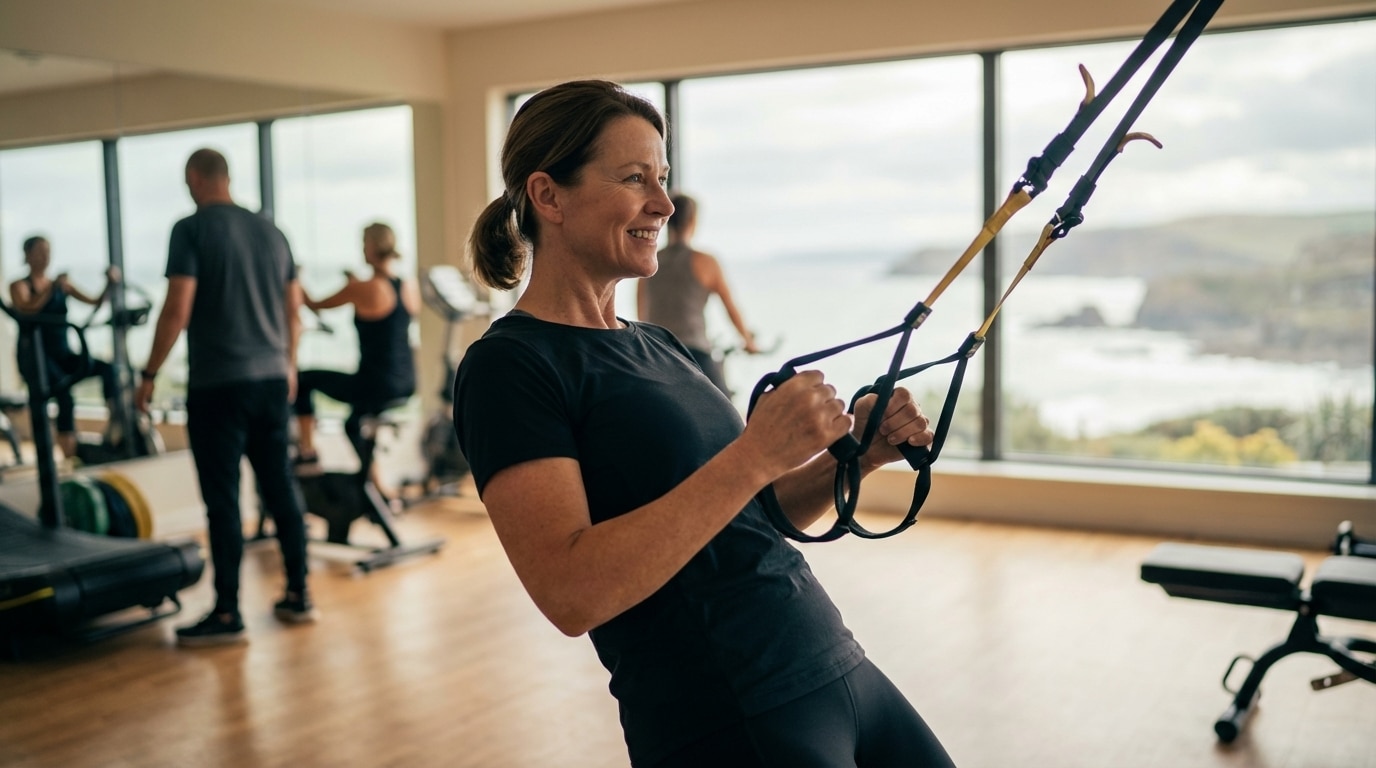
TRX rows strengthen the back of your body and help counter rounded shoulders from long hours at a desk. This pulling pattern balances push-focused exercises for more complete upper body development.
Proper Form:
Modifications: Beginners: More upright body angle. Intermediate: About a 45-degree angle. Advanced: Single-arm rows or feet elevated.
Kettlebell swings build explosive hip power and challenge your cardiovascular system at the same time. This ballistic pattern supports athletic performance and stronger everyday lifting.
Proper Form:
Modifications: Beginners: Goblet squats or deadlifts. Intermediate: Two-handed swings. Advanced: Single-arm swings or heavier weights.
Think Tip: Drive the movement from your hips and glutes. Your arms guide the kettlebell but do not lift it.
Burpees combine strength and cardio in one movement, which makes them a powerful full-body exercise. Tony Howes demonstrates a joint-friendly modified burpee for adults over 50 and beginners: place two fists on the mat to reduce wrist strain, step back instead of jumping, and perform knee push-ups.
Proper Form:
Modifications: Beginners: Step-back burpees with no jump. Intermediate: Standard burpees. Advanced: Burpee box jumps or weighted variations.
These progressive circuits match different fitness levels and time limits while still delivering strong results. Each circuit uses the eight foundational exercises with specific work and rest periods to support fat loss and muscle maintenance. The table below shows how work-to-rest ratios, duration, and equipment change as you advance, so you can see how intensity and calorie burn increase over time.
|
Circuit Level |
Duration |
Work/Rest |
Equipment |
|
Beginner (20-min) |
4 exercises, 3 rounds |
30s work/30s rest |
Bodyweight only |
|
Intermediate (30-min) |
6 exercises, 4 rounds |
45s work/15s rest |
Basic equipment |
|
Advanced (45-min) |
8 exercises, 5 rounds |
50s work/10s rest |
Full gym access |
Beginner Circuit: Wall push-ups, chair squats, modified planks, step-back burpees. This no-equipment routine burns about 150-200 calories and builds basic strength patterns.
Intermediate Circuit: Standard push-ups, bodyweight squats, mountain climbers, lunges, planks, TRX rows. Expect roughly 250-300 calories burned with better cardiovascular fitness.
Advanced Circuit: All eight exercises at full intensity with short rest periods. This Premier Fitness Camp-style workout can burn 400 or more calories while building serious strength and endurance.
For live coaching on these circuits, book a free consultation and learn how Premier Fitness Camp’s small-group attention supports safe form and faster progress.
Long-term fitness success comes from more than hard workouts. It grows from a complete approach that includes mindset, nutrition, and smart training progression. Premier Fitness Camp’s “Think, Eat, Move” philosophy brings these three pillars together so changes last.
Think: Behavioral workshops help you identify emotional eating triggers and build coping strategies that do not rely on food. Strong mental preparation reduces burnout and keeps you engaged with your plan.
Eat: Once mindset feels more stable, nutrition becomes the next focus. Post-GLP-1 clients especially need solid macronutrient balance to protect muscle mass. Aim for 0.8-1 g of protein per pound of body weight, use complex carbohydrates around workouts, and include healthy fats to support hormone production.
Move: Progressive overload applied week to week with methods like double progression and planned deload weeks every 4-6 weeks supports long-term adherence by driving steady improvement while limiting injury risk. With mindset and nutrition in place, this structure turns exercise into a sustainable habit instead of a short-term push.
This systematic approach to progression is exactly what produces measurable results. The UCSD case study validating Premier Fitness Camp’s approach showed 94% of weight loss came from pure fat, with 50% of alumni returning annually, which demonstrates how education-based programs support lasting change.
These exercises work well at home, yet performing them inside Premier Fitness Camp’s immersive setting at the Omni La Costa Resort can accelerate your progress. Beach boot camps, Torrey Pines hikes, and personalized attention from small group coaching support excellent form and strong safety.
With more than 1,200 reviews and over 90% five-star ratings, PFC has helped clients like Lauren M. lose 140 pounds and helped Irene Tchaikovsky create a complete lifestyle shift. Unlike many fitness retreats that shuttle guests to off-site gyms, PFC’s on-resort location gives you direct access to world-class facilities all day.
Program quality shows up in the details. Trainers hold bachelor’s and master’s degrees, wellness chefs prepare fresh meals on-site, and in-depth education helps you keep results for life instead of chasing temporary weight loss.
These eight exercises use basic movement patterns that fit any starting point. Each one includes several progressions, from wall push-ups for brand-new exercisers to advanced versions for experienced athletes. Start with a level that allows solid form and then increase difficulty gradually. Premier Fitness Camp’s 3-4:1 trainer ratio means every client receives tailored modifications, whether they are just starting or already very active.
Avoiding burnout requires the right mix of intensity, recovery, and progression. Begin with 2-3 sessions per week and keep form as your top priority. Schedule regular recovery periods where you reduce intensity by 20-30%; this is the deload strategy mentioned earlier that prevents overtraining. Pay attention to your body, since soreness can be normal but sharp pain signals the need to rest. Address stress, sleep, and realistic goals as well, which is why Premier Fitness Camp includes behavioral health coaching with physical training.
These exercises pair well with GLP-1 medications because they focus on preserving muscle while you lose weight. Emphasize strength-focused moves like squats, push-ups, and rows, and support them with adequate protein intake to offset muscle loss that can occur with rapid weight changes. Treat exercise as protection for your muscle tissue, not just a way to burn calories. Premier Fitness Camp works with many GLP-1 clients and helps them build habits that continue to work even after medication ends.
Results depend on your starting point, consistency, and nutrition, yet many people see 3-4 pounds of fat loss per week when they have 40-70 pounds to lose, along with better cardiovascular fitness within 2-3 weeks and clear strength gains within 4-6 weeks. More importantly, you build routines and knowledge that support lifelong fitness. Premier Fitness Camp tracks 17 data points beyond weight, including body fat percentage, measurements, blood pressure, and fitness benchmarks, which gives a complete picture of your health improvements.
Home workouts using these exercises create a strong base and can deliver meaningful results when you stay consistent. Professional programs add expert form checks, structured progression, accountability, and deeper education. At Premier Fitness Camp, clients train 4-5 hours daily instead of the typical 3-4 hours per week at home, which speeds up results and habit building. The immersive environment, expert coaching, and holistic “Think, Eat, Move” approach address root causes of weight gain, not just surface symptoms, which supports the exceptional fat-loss outcomes mentioned earlier.
Transform your approach to fitness with expert support. Book a free consultation with Premier Fitness Camp to discuss your goals and learn how this comprehensive program can help you create lasting results. Call (888) 488-8936 today.
These eight full-body boot camp exercises create a strong foundation for sustainable fitness when paired with smart progression, nutrition guidance, and mindset work. Home workouts offer convenience, while Premier Fitness Camp’s “Think, Eat, Move” philosophy adds the structure, coaching, and education that help changes stick. Book your free consultation today and see why half of PFC clients return year after year to continue their transformation.