 5-star Wellness Resort
 5-star Wellness Resort
Written by: Chris Butt, Certified Personal Trainer & Weight Loss Coach, Premier Fitness Camp | Last updated: June 20, 2026
All-inclusive fitness and wellness programs in California span a wide price range based on program depth, staff credentials, and accommodation quality. Entry-level wellness retreats typically start around $100–$300 per night. Mid-tier programs add structured fitness and basic nutrition guidance at higher nightly rates. Luxury, results-driven programs price their stays to reflect a full package of services and amenities.
The all-inclusive rate at the Omni La Costa program covers luxury accommodations, all meals prepared by on-site wellness chefs, every fitness class and training session, nutrition and behavioral health workshops, cooking demonstrations, comprehensive health assessments, a 17-point weekly report card, three spa treatments per week, and post-program support. To make this investment more accessible, financing is available at 0% interest for up to six months with no down payment, and multi-week discounts apply for longer stays. Because the program includes medical oversight and detailed health assessments, it may qualify as a tax-deductible medical expense.
The difference between a spa-focused retreat and a fitness-intensive residential program matters when you compare value. Fitness-intensive programs feature cardiovascular work, resistance training, flexibility development, functional movement, and nutrition matched precisely to training demands, while traditional wellness retreats emphasize diagnostics, therapeutic treatments, meditation, and sleep support. For adults with 40–70 pounds to lose or those transitioning off GLP-1 medications, the fitness-intensive model produces a different and more measurable outcome.
Ready to understand what a stay would look like for your goals? Schedule a personalized consultation to discuss pricing and program options, or call (888) 488-8936.
Understanding the cost is only half the equation; the other half is knowing what that investment delivers. The average client with 40–70 pounds to lose achieves 3–4 pounds of fat loss per week. That number stands out on its own, and the quality of that weight loss is what truly differentiates this program from other California options.
A case study conducted with the University of California, San Diego (UCSD) evaluated participants who stayed four or more weeks and received DEXA scans, the gold standard for body composition measurement, at the start and end of their program. The findings showed that 94% of total weight loss was purely fat. Many aggressive weight-loss programs produce roughly a 50/50 split between fat and lean muscle loss. Standard dieting often yields about a 60/40 fat-to-muscle ratio. The 94% fat-loss rate stands far above both benchmarks.
The same case study found that most long-term clients preserved or increased lean muscle mass and maintained bone volume and metabolic capability. Because lean muscle drives resting metabolic rate, clients who keep it are far less likely to regain weight after leaving. That protection against rebound weight gain is where many other programs fall short over the long term.
Spa-focused competitors such as Canyon Ranch and Civana offer wellness experiences with some fitness components, yet they do not publish UCSD-validated body composition data or track outcomes across 17 weekly data points. For Reset Seekers and GLP-1 Graduates who want evidence-based reassurance, this case study provides a level of scientific credibility that other California programs currently do not match.
This program supports clients who range from those who can only walk 250 feet to seasoned athletes who train four times per week. Every fitness class is structured so that all participants, regardless of starting fitness level, receive appropriate challenge and modification. A 3–4:1 client-to-trainer ratio keeps sessions closely supervised, and low-impact alternatives are available for clients with joint issues, back problems, or post-surgical recovery needs.
For GLP-1 Graduates, meaning adults who have used medications such as Ozempic or Wegovy and now face muscle loss, metabolic slowdown, or medication-exit planning, this program offers a science-backed framework that directly addresses those concerns. The program emphasizes resistance training to rebuild lean muscle, registered dietitian guidance on protein intake and macronutrient balance, and behavioral health support to build sustainable habits that maintain results after reducing or stopping medication. The program does not discourage GLP-1 use. It provides the educational and physical foundation that helps those medications create durable change rather than short-term scale movement followed by rapid regain.
Fitness-intensive residential programs generally work best at a minimum of two weeks. During that time, participants learn how to structure nutrition and training in ways that support continued progress at home. For beginners, this window gives the body and mind time to adapt to new patterns without the pressure of changing everything at once.
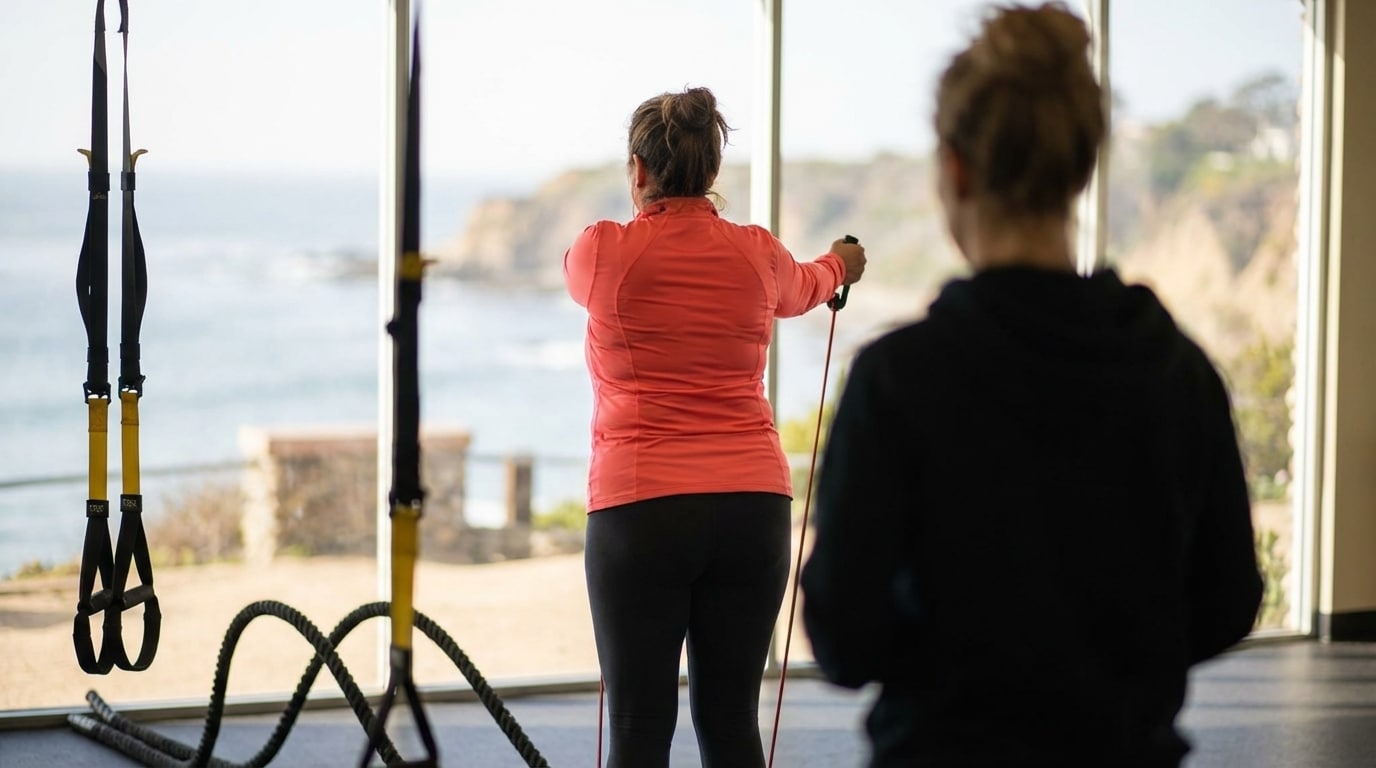
At this program, a standard weekday includes 4–5 hours of structured training delivered across multiple sessions. Activities rotate through bootcamp, boxing, barre, TRX suspension, Tabata, Zumba, interval and resistance training, beach workouts on the Pacific coast, and hikes through Torrey Pines, Double Peak Park, and Batiquitos Lagoon. Stand-up paddleboarding and kayaking also appear in the outdoor rotation. Saturday operates as a half-day program.
Training follows the foundational “Think, Eat, Move” philosophy. The “Think” pillar includes workshops led by licensed psychologists on emotional eating, behavioral triggers, and life-work balance, along with one-on-one counseling sessions. The “Eat” pillar covers nutrition education with registered dietitians, cooking demonstrations by wellness chefs, and gourmet calorie-controlled meals prepared fresh on-site using farm-to-fork ingredients. The “Move” pillar delivers the daily training volume described above, with all trainers holding at least a bachelor's degree and many holding master's degrees, and several having been on staff since the program's founding.
Evenings include dinner at 5:00 PM and access to the full Omni La Costa Resort, including the La Costa Spa. Three spa treatments per week are included in the program rate, with more than 30 treatment options available. Specialty afternoon programs such as Golf Fit, Tennis Fit, Pickleball Fit, and Spa Fit allow clients to combine fitness training with a specific recreational interest.
Spa-focused California competitors typically offer one to two hours of optional fitness classes per day within a schedule centered on treatments and relaxation. For adults whose primary goal is measurable body composition change, the difference in daily training volume has a major impact on results.
Post-program support often receives little attention during research, yet it strongly influences long-term success. This program stands out in that area. After leaving the Omni La Costa campus, clients receive access to virtual coaching for ongoing accountability, personalized meal plans designed for home preparation, fitness guidance and exercise programming, and direct communication with trainers via email with no time limit on that access.
The impact of that post-program structure appears clearly in the business metrics. Half of annual revenue comes from returning alumni. That figure reflects satisfaction with the on-site experience and confidence that the habits, relationships, and education built during the stay translate into lasting change at home. Many alumni return annually for a reset, and some have been coming back for more than 15 years.
Irene Tchaikovsky, a client, described the experience this way: “What began as a simple one-week reboot has transformed into a complete lifestyle shift. The program equips you with the knowledge, tools, and support to make meaningful, sustainable changes.”
Wellness tourism continues to grow quickly. Wellness tourism reached $894 billion globally in 2024, up from $439 billion in 2012. Within that market, programs that deliver post-stay support and measurable long-term outcomes are positioned to attract the most discerning travelers.
To learn how the post-program support structure would apply to your specific situation, speak with a program advisor about your goals, or call (888) 488-8936.
The table below evaluates programs on criteria that matter most to adults seeking measurable, sustainable results. Competitors appear where comparable public data exists. Where it does not, the comparison is addressed in the surrounding sections.
| Evaluation Criteria | Program at Omni La Costa | Canyon Ranch | Civana Wellness Resort | Live In Fitness |
|---|---|---|---|---|
| Daily Training Hours | 4–5 hours/day, Mon–Fri, half-day Saturday | Varies, fitness classes optional within a spa-and-wellness schedule | Fitness classes available, retreat-focused scheduling | Structured daily fitness, specific hours not publicly disclosed |
| Client-to-Trainer Ratio | 3–4:1 in fitness sessions | Not publicly disclosed | Not publicly disclosed | Not publicly disclosed |
| Education Depth | Full Think-Eat-Move curriculum: licensed psychologists, registered dietitians, wellness chefs, cooking demos, behavioral workshops | Wellness programming with some nutrition and fitness education | Wellness-focused programming, limited structured fitness education | Nutrition and fitness education included, curriculum depth not publicly detailed |
| Data Tracking | 17-point weekly report card, optional DEXA scan, UCSD-validated body composition study | Not publicly disclosed | Not publicly disclosed | Not publicly disclosed |
| Location & Setting | Omni La Costa Resort & Spa, 450-acre luxury campus, Carlsbad, CA, all facilities on-site, Pacific coast outdoor access | Multiple locations, Tucson flagship in desert climate | Carefree, Arizona, desert climate, retreat-focused campus | Arizona, residential home setting, off-site gym access required |
| Repeat-Client Rate | 50% of annual revenue from returning alumni | Not publicly disclosed | Not publicly disclosed | Not publicly disclosed |
Note: Where competitor data is not publicly available, cells reflect that limitation rather than an assumed value. Figures are drawn from internal program data and the UCSD case study referenced throughout this guide.
The data above tells one story, and the lived experience of clients who have completed the program adds another layer. Jake Younger, a client, wrote: “The staff is incredibly supportive, knowledgeable, and truly passionate about helping you reach your goals. I not only lost weight but gained confidence, strength, and a healthier lifestyle.”
Scott, who originally booked two weeks, described his experience this way: “It is a life-changing experience. I signed up for two weeks and stayed for eight. The facilities and staff are top notch.”
Alex, who lost 97 pounds, offered this perspective: “This journey has been more than weight loss for me. I've been able to find the root of my binge eating disorder and progress towards recovery through healthy cooking. The program has given me the tools I've needed to lose over 100 pounds and cope with emotions in a healthy way rather than binge eating. I keep coming back.”
These accounts reflect a consistent pattern across 1,200+ reviews, 90% of which carry a five-star rating. Clients arrive expecting a fitness program and leave with an education, a community, and a framework for sustaining their results independently.
Wellness is a “top” or “important” priority for 84% of U.S. consumers, and the growth of immersive wellness travel reflects that demand. Not every program, however, offers the same depth of programming, staff quality, or measurable outcomes.
When you evaluate all-inclusive fitness and wellness resorts in California, focus on daily training volume, trainer attention, education across nutrition and behavioral health, data-driven progress tracking, post-stay support, and the quality of the physical environment. Fitness-intensive programs are distinguished from spa-oriented retreats by their emphasis on structured daily training and nutrition calibrated to physical demands. That distinction strongly influences whether results last after you return home.
On each of those criteria, the program at the Omni La Costa Resort in Carlsbad, California, holds a measurable advantage. It delivers 4–5 daily training hours, a close trainer-to-client ratio, the Think-Eat-Move curriculum, 17-point weekly tracking, body composition outcomes validated by UCSD, and a 50% alumni return rate that reflects sustained real-world results.
Whether you are a Reset Seeker ready to reclaim your health, a GLP-1 Graduate looking for a sustainable exit ramp, or someone who has tried many approaches without lasting success, this program offers a structured, evidence-based, and genuinely luxurious path forward.
Ready to take the next step? Talk with the team in a free consultation to discuss your goals, ask questions, and explore how the program can match your starting point. Call (888) 488-8936 or visit our consultation booking page to schedule your personalized consultation today.
A standard wellness spa in California typically centers its programming on therapeutic treatments, relaxation, and light fitness options such as yoga or guided walks. An all-inclusive fitness resort structures the day around measurable physical training, nutrition education, and behavioral health support. At this program, clients train 4–5 hours per day under a close trainer-to-client ratio, attend nutrition workshops led by registered dietitians, participate in behavioral health sessions with licensed psychologists, and receive a 17-point weekly report card tracking metrics such as body fat percentage, blood pressure, and mile time. The goal extends beyond rest and recovery to a documented, data-backed transformation in body composition and lifestyle habits that continues after the program ends.
Every fitness class is designed so that participants at all fitness levels, including complete beginners and experienced athletes, can participate and benefit. Trainers hold at least a bachelor's degree and maintain a small-group ratio in every session, which allows for real-time modification, progression, and low-impact alternatives for clients with joint issues, back problems, or other physical limitations. The program begins with a comprehensive health assessment that includes blood work, body composition analysis, and a fitness test, so trainers understand each client's baseline before the first session. No one is expected to keep up with anyone else. The program meets each person where they are and builds from there.
GLP-1 medications such as Ozempic and Wegovy can produce meaningful scale-weight reduction, yet they often do so at the cost of lean muscle mass and metabolic rate, which drive long-term weight maintenance. At this program, GLP-1 Graduates receive a plan calibrated to address these concerns. The approach includes resistance training to rebuild muscle, registered dietitian guidance on protein intake and macronutrient balance, and behavioral health support to establish the sustainable habits needed to maintain results after reducing or stopping medication. The program does not discourage GLP-1 use. It functions as the educational and physical foundation that helps those medications remain effective over the long term rather than a temporary intervention followed by rapid regain.
Stays start at one week, and many first-time clients book a single week before extending on-site after experiencing the program. The average client stay is approximately 11 days. One week provides a powerful reset and measurable initial results. Two weeks build real momentum in both fitness capacity and nutritional habits. Three weeks align with behavioral research on habit formation. Four weeks or more deliver the kind of body composition change, documented through DEXA scans and the 17-point weekly report card, that the UCSD case study validated. Extended stays of up to several months are available for clients with more significant goals.
Post-program support includes virtual coaching for ongoing accountability, personalized meal plans designed for home preparation, fitness guidance and exercise programming, and direct email access to trainers with no expiration date on that communication. The relationships clients build with staff during their stay, including trainers who hold bachelor's and master's degrees and have often been with the program for years, continue well beyond departure. This continuity is one reason 50% of annual revenue comes from returning alumni, many of whom treat an annual stay as a cornerstone of their long-term health strategy rather than a one-time intervention.