 5-star Wellness Resort
 5-star Wellness Resort

Written by: Chris Butt, Certified Personal Trainer & Weight Loss Coach, Premier Fitness Camp
Returning to consistent exercise after a long break depends on structure more than willpower. Most adults who have tried and stopped multiple times did not fail because they lacked motivation. They struggled because their programs were not built to withstand job changes, family demands, health setbacks, and the daily friction of a busy schedule.
The four-quarter framework solves this by treating your fitness restart as a year-long cycle instead of a single event. Each quarter has its own objective, intensity level, and behavioral focus. Across all four, three pillars stay constant: Think (behavioral health and psychological triggers), Eat (nutrition education and protein targets), and Move (progressive physical training). Every phase includes all three pillars, and each pillar matters.

Early consistency has an outsized impact on long-term success. A 2026 observational study analyzing data from 389,481 adult Fitbod users found that training consistency during the first 28 days after the initial workout was the strongest predictor of long-term adherence. The same study found that the median dropout time was 19 weeks for beginners, which highlights why short-term challenges usually create short-term results. The first quarter of an annual program therefore becomes the highest-leverage period in the entire cycle.
The first quarter, roughly weeks one through thirteen, serves as your foundation phase. This period is not about peak performance. It focuses on establishing a baseline, increasing behavioral awareness, and building low-impact movement consistency.
The Think pillar takes the lead in Q1. Before you change what you eat or how you train, identify the behavioral triggers that have disrupted past attempts. Common triggers include stress eating, all-or-nothing thinking after a missed session, and social environments that conflict with health goals. The Korean Society for the Study of Obesity’s 2024 Clinical Practice Guidelines do not reference identifying high-risk triggers, revising plans after lapses, or using social support as essential tools for long-term self-management. An annual reset fills that gap by putting these elements at the center of Q1.

On the Move side, Q1 keeps intensity modest. For adults over 40 restarting exercise after a break, the first four to six weeks should prioritize physiological adjustment and reconnection of strength, coordination, and endurance rather than performance improvement. Two to three full-body sessions per week using compound movements such as squat, hinge, push, pull, and carry at a moderate intensity are enough to begin rebuilding neuromuscular patterns that detraining erases.
To turn these ideas into a simple plan, use this Q1 goal-setting template.
A realistic initial goal is a 5%–10% reduction in baseline body weight over about six months. Translate that target into specific plans that spell out when, where, and how behaviors will happen. This approach fits naturally into the Q1-to-Q2 transition of the annual program.
Quarters two and three, roughly weeks fourteen through thirty-nine, shift the focus to the Eat and Move pillars. The behavioral groundwork from Q1 now supports more demanding nutrition and training.
On the Eat side, protein becomes the main nutritional driver. For optimal health outcomes, a daily protein intake of approximately 0.7 grams per pound of target body weight is suggested, and increasing protein intake from approximately 0.5 g/lb/day to 0.7 g/lb/day in resistance-training individuals is associated with roughly 30% greater muscle growth and 10% greater strength gains. For a 180-pound adult, this equals about 126 grams of protein per day.

On the Move side, Q2 introduces structured progressive resistance training. A 2026 meta-analysis of 29 studies found that periodized resistance training, whether linear or undulating, produced meaningful improvements in body composition, glucose regulation, and lean body mass, with undulating periodization showing particular advantages for increasing lean body mass among individuals with obesity. In practice, this means you vary training stimulus across weeks instead of repeating the same workout every time.
The body-recomposition results of this approach have been measured in real clients. A UCSD case study evaluating Premier Fitness Camp participants who stayed four or more weeks and received DEXA scans found that 94% of total weight loss was purely fat, compared to the 60/40 fat-to-muscle ratio typical of standard dieting programs. Most long-term participants not only maintained lean muscle stores but increased them during weight loss. This outcome reflects the combined effect of structured resistance training and registered-dietitian-designed nutrition that defines the Q2–Q3 phase.
To apply this structure in daily life, use the following Q2–Q3 habit-stacking template.
Quarter four, roughly weeks forty through fifty-two, shifts the focus from building more to locking in what you have gained. After three quarters of progressive training, your body needs strategic recovery to protect the adaptations built across Q1 through Q3. Without this recovery period, many programs run into overtraining and burnout in the final stretch. Q4 also becomes your planning phase, where you turn a full year of data into clear targets for the next cycle instead of guessing where to start.
Deload weeks, which reduce training volume while keeping intensity similar, serve as the main recovery tool in Q4. Research indicates that one to two sessions per week at 50–60% of normal volume can maintain most aerobic and strength adaptations for several weeks during periods of reduced training, so a structured deload maintains progress far better than complete rest.
Q4 also asks you to step back and review the entire year. Look at all tracked data points, including weight, body composition, strength benchmarks, cardiovascular markers, and behavioral metrics, then use them to set Q1 targets for year two. The 2026 Korean Society for the Study of Obesity consensus describes obesity management as a continuous circular cycle of sustained practice, adjustment to setbacks, and ongoing health improvement rather than a single endpoint. That perspective aligns directly with the annual reset model.
Use this Q4 recovery protocol as a guide.
Once the four-quarter framework is in place, the next question is which support structure helps adults follow it consistently. App-based programs struggle here, and the limitations show up clearly in adherence data. The 19-week median dropout time mentioned earlier illustrates how often motivation fades before long-term habits form. A 2025 randomized trial also found that adherence was substantially higher in supervised programs than in self-guided programs that used identical training plans. The plan stayed the same. The accountability structure changed.
In-person immersive programs close this accountability gap through design rather than willpower. The single biggest predictor of whether training happens is whether it is on the calendar with a person waiting for the client, because an app requires willpower every day while a booked session requires it only once. When sessions are scheduled with a coach and a group, follow-through becomes far more reliable.
Premier Fitness Camp serves as the in-person luxury anchor for this annual reset cycle. Located at the Omni La Costa Resort & Spa in Carlsbad, California, Premier Fitness Camp delivers 4–5 hours of expert-led training per day, five days per week, which often exceeds a typical week of training in a single morning. Every meal is prepared on-site by registered dietitians and wellness chefs using fresh, farm-to-fork ingredients. Licensed psychologists and behavioral health coaches support the Think pillar through group workshops and individual sessions. The client-to-trainer ratio stays around 3–4:1 across fitness sessions, and progress is tracked weekly across 17 data points, including weight, body fat, seven body measurements, blood pressure, four blood markers, push-ups, plank time, and mile time.
The body-composition results documented in the UCSD case study reflect what happens when structured resistance training, registered-dietitian nutrition, and behavioral health support work together instead of separately. Clients see measurable fat loss, preserved or increased lean mass, and clearer insight into which habits drive those changes.
Premier Fitness Camp clients also describe benefits that go beyond numbers. One client shared, “What began as a simple one-week reboot has transformed into a complete lifestyle shift. Premier Fitness Camp equips you with the knowledge, tools, and support to make meaningful and sustainable changes.” Half of Premier Fitness Camp’s annual revenue comes from returning alumni, which signals both the quality of the experience and the staying power of the results.
To anchor your annual reset with expert-led, immersive support, discuss your goals and timeline with the Premier Fitness Camp team. You can also call (888) 488-8936 or schedule your consultation online.
Every annual program encounters friction at some point. Programs that last do not avoid obstacles. They build a system for handling them.
Motivation dips in Q2: Motivation dips follow a predictable pattern rather than reflecting personal failure. University College London research indicates that forming a new habit takes an average of 66 days, with wide variation depending on the individual and behavior. The Q2 window, roughly weeks six through twelve, often lands in the gap where novelty has faded and automaticity has not yet formed. Scheduled accountability check-ins, community support, and pre-booked training appointments provide the structure that carries you through this phase. Committing to a goal with another person raises completion probability to 65%, and scheduling a specific recurring accountability appointment increases it to 95%.
Plateaus in Q3: Plateaus in body composition reflect normal adaptation, not program failure. The solution is to vary training stimulus by changing rep ranges, exercise selection, or training modality, then reassess protein intake and sleep quality. Tracking 17 data points instead of relying on scale weight alone keeps progress visible in strength, measurements, or blood markers even when the scale stalls.
Time constraints: Short, repeatable bouts of physical activity distributed across the day have been associated with improvements in cardiorespiratory fitness and physical function in sedentary adults, so they work well during high-demand weeks. Two sessions per week at maintained intensity also preserve most adaptations when your schedule tightens.
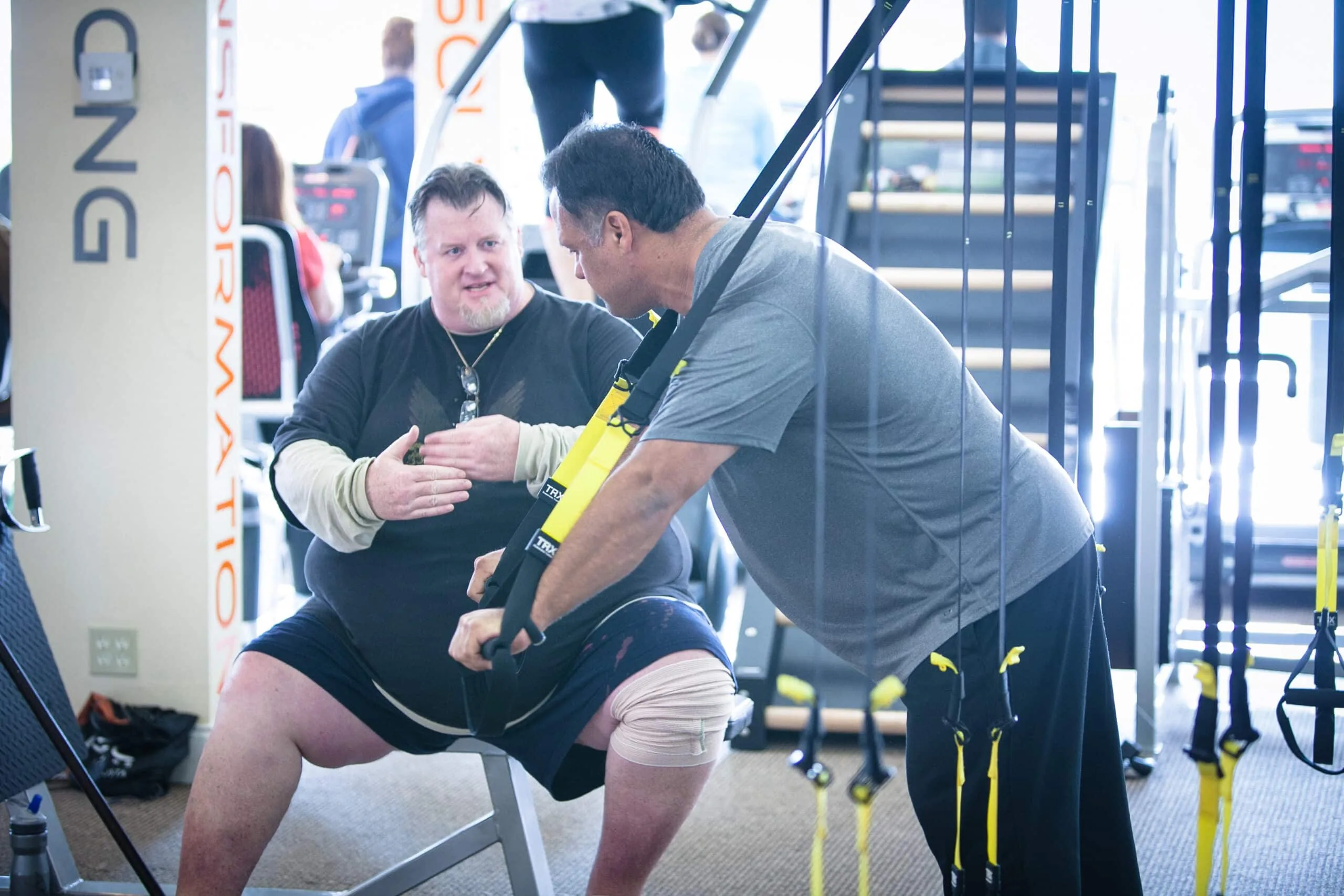
Fear of not fitting in: Many adults returning to structured fitness after years away worry they will not belong. Professional in-person support can resolve this quickly. At PFC, every class is designed so that participants ranging from 400-pound beginners to seasoned athletes receive appropriate challenge and modification. No one is left behind, and no fitness level becomes a reason for judgment.
A realistic timeline for returning to a meaningful fitness baseline after a long period of inactivity is four to six months of consistent, structured training. The first two to four weeks rebuild neuromuscular patterns and connective tissue tolerance. Weeks five through twelve establish progressive overload and measurable strength gains. Months four through six consolidate those gains and begin producing visible body composition changes. Reversing a sedentary lifestyle remains an ongoing process rather than a single event. Adults who complete a full year of structured quarterly training start year two measurably fitter than they began year one, and that compounding effect grows over time.
A medical check-up is recommended before starting a structured exercise program after a long period of inactivity, especially for adults over 40 or anyone with risk factors such as high blood pressure, diabetes, smoking history, or family history of heart disease. Adults should tell their physician about any history of heart disorders, chest pain, unusual shortness of breath, palpitations, joint pain or swelling, or dizziness before they begin. Most healthy adults over 40 do not need an exercise stress test before starting a gradually progressive program. A baseline health assessment that includes blood work, blood pressure, and body composition still provides a valuable data foundation that keeps the annual program measurable and safe.
Adults using GLP-1 medications can follow an annual fitness reset program, and structured programming becomes especially important for them. GLP-1 agonists can produce weight loss that includes significant muscle loss alongside fat loss, which lowers resting metabolic rate and raises the risk of weight regain when medication is reduced or stopped. A structured annual program that emphasizes resistance training and adequate protein intake directly counters this effect by preserving and building lean muscle during weight loss. At PFC, GLP-1 users receive adjusted protocols that focus on resistance training volume and protein targets, with no judgment about medication use and a clear plan for building sustainable habits that support long-term results beyond the drug.
Progression between quarterly phases should rely on objective markers rather than dates alone. Before moving from Q1 to Q2, confirm that you complete training sessions consistently two to three times per week without significant post-session soreness lasting more than 48 hours, that meal timing stays consistent, and that you have identified and addressed at least one behavioral trigger. Before moving from Q2 to Q3, confirm that you have applied progressive overload by increasing loads or reps at least twice in the previous four weeks and that you hit protein targets on most days. If these markers are not in place, extending the current phase by two to four weeks usually works better than advancing early. The annual framework serves as a guide, not a rigid calendar.
Adults over 50 benefit from more recovery time between training sessions, a slower initial progression of load, and a stronger focus on balance and mobility work alongside resistance training. Muscle and bone strength begin declining meaningfully around age 50, which makes resistance training the highest-priority component of an annual program for this age group. Protein needs also rise relative to younger adults, reaching approximately 0.7 to 0.8 grams per pound of target body weight daily to support muscle protein synthesis, which becomes less efficient with age. Warm-ups should last 10–15 minutes so connective tissue reaches working temperature before load is applied. The quarterly structure remains the same, but progression within each phase becomes more gradual, and deload weeks in Q4 play a larger role in long-term joint health.
An annual fitness reset program works because it mirrors how real behavioral change happens. Progress builds gradually across multiple phases, with structured support at each transition point. The four-quarter framework, with foundation in Q1, habit-building and body recomposition in Q2 and Q3, and maintenance plus planning in Q4, creates a repeating cycle that compounds improvement year after year instead of resetting to zero after every short-term challenge.
The Think, Eat, and Move pillars keep every dimension of health connected. Behavioral triggers addressed in Q1 support the nutritional consistency required in Q2. The muscle preserved through structured resistance training in Q3 protects the metabolic rate that makes Q4 maintenance sustainable. Data tracked across 17 markers throughout the year keeps progress visible even when the scale moves slowly.
For adults ready to anchor their annual program with comprehensive in-person support, Premier Fitness Camp offers an immersive foundation phase that home programs and apps cannot match. You receive 4–5 hours of expert-led daily training, registered-dietitian meals, licensed behavioral health support, a 3–4:1 trainer ratio, and a UCSD-validated case study showing that 94% of weight loss came from fat. With more than 1,200 reviews and a 90%+ five-star rating, Premier Fitness Camp has set a clear standard for what an annual fitness reset anchor looks like in practice.
Schedule your consultation to design your annual program with the Premier Fitness Camp team. Call (888) 488-8936 or start your consultation online to begin your next annual cycle with a clear plan and expert support.