 5-star Wellness Resort
 5-star Wellness Resort
Written by: Chris Butt, Certified Personal Trainer & Weight Loss Coach, Premier Fitness Camp
The adult weight loss camp category spans a wide spectrum, from basic exercise-and-calorie-restriction programs to medically supervised, luxury residential experiences. To navigate this spectrum effectively, prospective participants need a consistent evaluation framework that compares what a program promises with what it delivers over time. That framework includes six dimensions: clinical rigor, program design, environment, personalization, cost and value, and aftercare.
At the premium end of this spectrum sits a leading program located at the Omni La Costa Resort & Spa in Carlsbad, California. Its “Think, Eat, Move” philosophy structures every element of the program around behavioral health, nutrition education, and physical training, delivered by licensed psychologists, registered dietitians, wellness chefs, and certified trainers with bachelor's and master's degrees. This comprehensive staffing model shows what full-spectrum coverage looks like in practice.
By contrast, most programs address only one or two of the six evaluation dimensions. The most effective programs address all six simultaneously. That is why immersive residential formats consistently outperform standalone gym memberships or diet apps for adults seeking meaningful, lasting change.
Program value depends on what a camp actually delivers, not just what it advertises. The case for immersive programs rests on measurable outcomes. A UCSD case study of participants who stayed four or more weeks found that 94% of total weight loss was purely fat, compared to the 60/40 fat-to-muscle ratio typical of standard dieting. Lean muscle mass was preserved or increased, and resting metabolic rate was protected, which is the primary mechanism behind long-term weight maintenance.
Lower-quality programs tell a different story. Programs that focus only on calorie restriction without education, behavioral support, or personalized tracking produce short-term results that rarely persist. The Obesity Action Coalition notes that managing obesity is a lifelong process and that effective care requires regular check-ins, ongoing access to resources, and adjustments over time. One-dimensional programs do not provide that level of care.
For adults who have tried diets, gym memberships, and apps without lasting results, a well-designed immersive program addresses root causes such as emotional eating patterns, nutritional knowledge gaps, and sedentary habits. That focus on underlying drivers, rather than symptoms, separates a program worth the investment from one that is not.
Comparing an adult weight loss camp to other options requires honest measurement across the dimensions that drive results. Training volume provides the clearest starting point because it directly shapes physical change and is easy to quantify.
The average gym member trains three to four hours per week. Clients at this program train four to five hours per day, five days a week, with a half day on Saturday. That volume difference alone creates a fundamentally different physiological stimulus. Gym memberships also place full responsibility for nutrition, behavioral health, and accountability on the individual, without the structured environment that supports lasting habit change.
Wellness retreats and spas occupy a different position. They offer relaxation and some fitness programming, but they are not results-driven programs. They lack the clinical assessments, weekly data tracking, behavioral health support, and post-program sustainability plans that define a serious weight loss camp.
Online programs and apps offer convenience but cannot replicate the immersive, community-driven environment that research consistently identifies as a driver of lasting habit formation. Without expert counseling, real-time personalization, and peer accountability, these tools often fall short for adults with significant weight loss goals.
A comprehensive support team for obesity management should include a primary care provider or obesity medicine specialist, a registered dietitian, a psychologist or counselor, and an exercise professional. This program's staff structure follows that model, so participants receive coordinated care across medical, nutritional, psychological, and fitness domains.
Regular check-in touchpoints help participants stay engaged, troubleshoot challenges early, celebrate victories, and make adjustments when needed. This program brings that to life through weekly one-on-one report card reviews with trainers, using a detailed multi-metric tracking system for each client.
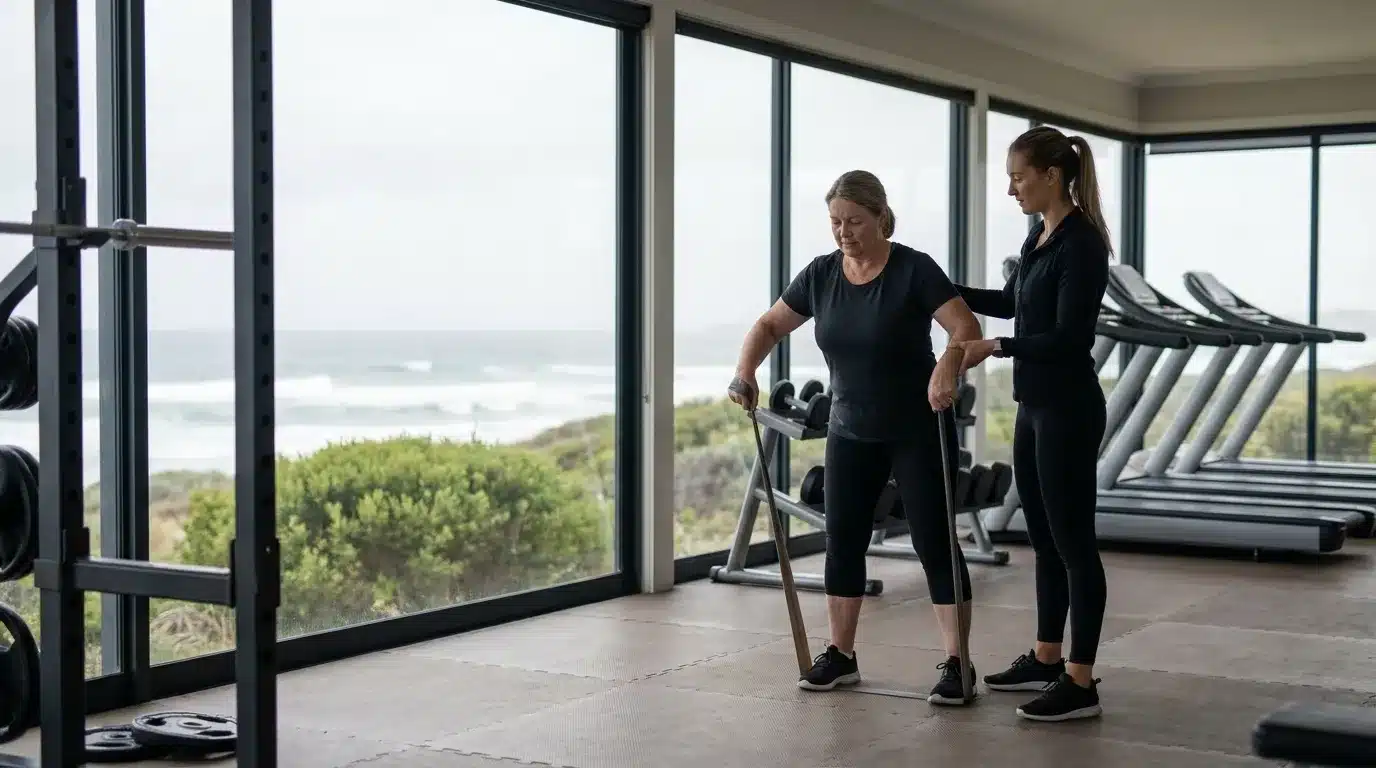
Effective programs adapt to individual needs and experience levels, creating shame-free environments focused on health rather than comparison. This program maintains a 3–4:1 client-to-trainer ratio in every session, with low-impact modifications available for every exercise so beginners and advanced participants can train together safely.
Post-program follow-up also qualifies as a non-negotiable best practice. GLP-1 medications like Wegovy work best as part of a broader plan that includes building habits around nutrition, movement, sleep, and stress. This program applies that framework to all participants, including those transitioning off medication.
Before selecting any program, a brief self-assessment clarifies whether an immersive residential format fits your current season of life and goals:
Lasting change happens when someone is personally motivated and prepared to invest in their health. A free consultation offers a direct way to discuss readiness, logistics, and goals before committing.
Talk with the Premier Fitness Camp team about your situation and schedule a free consultation.
Several recurring patterns consistently undermine outcomes at adult weight loss programs. Recognizing them helps you evaluate options through the six-dimension framework.
At this program, a standard weekday follows a structured schedule that balances high-volume training with education, recovery, and resort amenities. A typical day looks like this timeline:
Saturday operates as a half day. Outdoor activities include hikes at Torrey Pines, Double Peak Park, and Batiquitos Lagoon, along with stand-up paddleboarding and kayaking.
“I signed up for two weeks and stayed for eight. The facilities and staff are top notch.” — Scott, alumni
“What began as a simple one-week reboot has transformed into a complete lifestyle shift. This program equips you with the knowledge, tools, and support to make meaningful and sustainable changes.” — Irene Tchaikovsky, alumni
This program is priced at approximately $6,000 per week, and that figure is all-inclusive. The table below compares what is covered at this program versus typical extras charged by other programs:
| Inclusion | This Program | Typical Competitor |
|---|---|---|
| Luxury resort accommodations | Included (Omni La Costa Resort) | Basic or off-site; varies |
| All meals and snacks | Included (on-site wellness chefs, farm-to-fork) | Often delivered from off-site; quality varies |
| Fitness training (4–5 hrs/day) | Included (3–4:1 trainer ratio) | Included at lower ratios |
| Nutrition education and cooking demos | Included | Often extra or absent |
| Behavioral health and psychology | Included (licensed psychologists on staff) | Rarely included |
| Spa treatments | 3 per week included (La Costa Spa) | Extra cost or unavailable |
| Weekly health tracking | Included with a detailed multi-metric report card | Scale weight only or minimal |
| Post-program virtual coaching | Included | Rarely included |
This program offers 0% financing for up to six months with no down payment, and multi-week discounts are available. The program may qualify as a tax-deductible medical expense; consult a tax professional. Fifty percent of this program's annual revenue comes from returning alumni, which reflects the program's perceived value relative to its cost.
The 94% fat-loss ratio mentioned earlier was validated through DEXA scans, the gold standard for body composition measurement, conducted at the start and end of each participant's program. This result is substantially superior to the 50/50 split most aggressive weight loss programs produce and directly addresses the primary cause of post-program weight regain: metabolic damage from muscle loss.
Every client receives a weekly health report card that tracks progress across multiple data points, including:
“This program exceeded all my expectations. I not only lost weight but gained confidence, strength, and a healthier lifestyle.” — Jake Younger, alumni
GLP-1 Graduates: For participants transitioning off or managing GLP-1 medications such as Ozempic or Wegovy, this program's structure is specifically designed to address the two most common post-medication challenges: muscle loss and habit formation. Adequate protein intake, resistance training, and structured habit-building are essential components of a sustainable plan for GLP-1 users. This program's resistance training volume, protein-optimized meal design, and behavioral health support provide exactly this foundation.
The period immediately following an immersive program is when most participants face their greatest challenge. This program's post-camp support structure is designed to bridge the gap between the residential environment and independent life at home.
Post-program resources include:
Long-term success requires regular follow-up visits to review progress, address challenges, and adjust care plans as needed. Low staff turnover means participants return to the same trainers and dietitians they worked with during their stay, which provides continuity that most programs cannot match.
“I've been to this program 3 times because I am such a fan of the program! Their trainers are knowledgeable, inspiring and make hard work fun.” — Lin Vela, alumni
No minimum fitness level is required. This program works with participants ranging from individuals who can only walk 250 feet to seasoned athletes who train four or more times per week. Every class is structured so that all fitness levels participate in the same session, with trainers providing modifications, progressions, and low-impact alternatives for every exercise. The 3–4:1 client-to-trainer ratio ensures that no participant is overlooked or left behind.
The average participant with 40–70 pounds to lose can expect approximately 3–4 pounds of fat loss per week. The UCSD case study confirmed that 94% of weight lost is pure fat, compared to the 60/40 fat-to-muscle ratio typical of standard dieting. Individual results vary based on starting weight, gender, age, hormones, and medications. Weight is also just one of many data points tracked weekly. Many participants see significant improvements in blood pressure, cholesterol, glucose, body measurements, and functional fitness even when scale movement is slower.
Yes. This program does not discourage GLP-1 use. The program is structured to complement medication by addressing the two areas where GLP-1s alone fall short: muscle preservation and sustainable habit formation. This program's resistance training volume, protein-optimized meal design, and behavioral health support provide the foundation that makes GLP-1 use effective long-term and prepares participants to maintain results if and when they reduce or discontinue medication.
This program is fully all-inclusive at approximately $6,000 per week. This covers luxury accommodations at the Omni La Costa Resort, all meals and snacks prepared on-site by wellness chefs, all fitness training sessions, nutrition education workshops and cooking demonstrations, behavioral health and lifestyle coaching, comprehensive health assessments, weekly report card tracking across multiple metrics, three spa treatments per week at the La Costa Spa, access to all resort amenities, and post-camp virtual coaching and meal planning. There are no hidden fees. Zero-percent financing for up to six months with no down payment is available.
Stays start at one week. The average client stays approximately 11 days. One week provides a meaningful kickstart. Two weeks build real momentum. Three weeks mark the threshold at which new habits become more durable. Four or more weeks deliver the most significant body composition changes, as validated by the UCSD case study. Many participants book one week and choose to extend their stay on-site after experiencing the program firsthand. Extended stays of up to several months are available for those seeking deeper transformation.