 5-star Wellness Resort
 5-star Wellness Resort

Written by: Chris Butt, Certified Personal Trainer & Weight Loss Coach, Premier Fitness Camp
Talk With A PFC Coach About Your Post-Divorce Plan
Divorce produces a cluster of stressors that most generic fitness plans ignore. Grief, disrupted sleep, financial strain, custody logistics, and identity loss follow you into every workout. Chronic stress keeps the body’s fight-or-flight response turned on, causing prolonged exposure to cortisol and other stress hormones that can disrupt almost all of the body’s processes. That state makes motivation harder to sustain and slows recovery from exercise.
Regular physical activity can reduce the risk of depression and anxiety and help you sleep better, and the type, intensity, and order of that activity matter when your nervous system already feels overloaded.
The revenge-body trap often appears here. Research links self-presentation motives, particularly physical attractiveness and weight control, with exercise dependence, a compulsive pattern that can interfere with daily life. Appearance-driven goals can spark action, yet they rarely provide a stable base for rebuilding identity unless they sit inside a sense of autonomy, competence, and connection.
Premier Fitness Camp’s (PFC’s) “Think, Eat, Move” philosophy addresses these root causes directly. Licensed psychologists, registered dietitians, and expert trainers work together so mental health, nutrition, and movement support the same outcome.

For a deeper look at weight-related changes after divorce, see PFC’s guide to weight loss after divorce and its companion piece on stopping divorce weight gain in 90 days. This article focuses on goal-setting and identity rebuilding.
The Stabilize, Rebuild, Redefine framework sequences 12 weeks of goals so regulation and consistency come before intensity and body composition. Each phase builds on the last, and research on habit formation and stress physiology supports starting at the beginning. The table below shows how the goal focus, weekly movement target, and primary outcome shift across the three phases.
| Phase | Goal Focus | Weekly Movement Target | Primary Outcome |
|---|---|---|---|
| Stabilize (Weeks 1–4) | Nervous-system regulation | 10–20 min daily walks; build toward 150 min/week moderate activity | Consistent routine; improved sleep and mood |
| Rebuild (Weeks 5–8) | Strength and consistency | Continue walking plus 2 strength sessions/week | Metabolic health; confidence through mastery |
| Redefine (Weeks 9–12) | Intrinsic, identity-based goal | Maintain routine; add variety or a challenge | Habits becoming automatic (median 59–66 days) |
Phase 1 focuses on nervous-system regulation instead of body composition. The aim is to establish movement as a daily anchor before you add intensity or complex structure.
Concrete actions for this phase include daily 10–20 minute walks, a consistent sleep schedule, and one anchor habit attached to a fixed daily cue. That cue might be a morning stretch, an evening walk around the block, or five minutes of slow breathing before bed. The CDC recommends building toward 150 minutes of moderate aerobic activity per week, and in Phase 1 the emphasis is movement for regulation rather than calorie burn.
Many people notice more anger or anxiety after intense workouts early on. High-intensity exercise can briefly raise cortisol and other stress hormones in an already dysregulated system. Low-impact, rhythmic activity such as walking, gentle yoga, or swimming tends to activate the parasympathetic nervous system more reliably during this window. Research often ranks mind-body exercise (yoga, Tai Chi, Qigong) and aerobic exercise among the more effective modalities for reducing depression and anxiety symptoms, with mind-body practice showing lower heterogeneity in some analyses, though evidence certainty remains low and differences among top modalities are not statistically significant.

Explore How PFC Supports Phase 1 Stabilization
With a baseline of daily movement in place, Phase 2 adds strength and reinforces consistency. The target is two strength-training sessions per week, consistent with CDC guidance on muscle-strengthening activity, alongside continued walking and, when possible, one social or community-based activity.
Strength training supports metabolic health and builds confidence through mastery. Research describes resistance training as uniquely effective at targeting anhedonia and feelings of helplessness by increasing muscle strength and elevating self-efficacy and sense of mastery. These psychological states are often depleted after divorce.
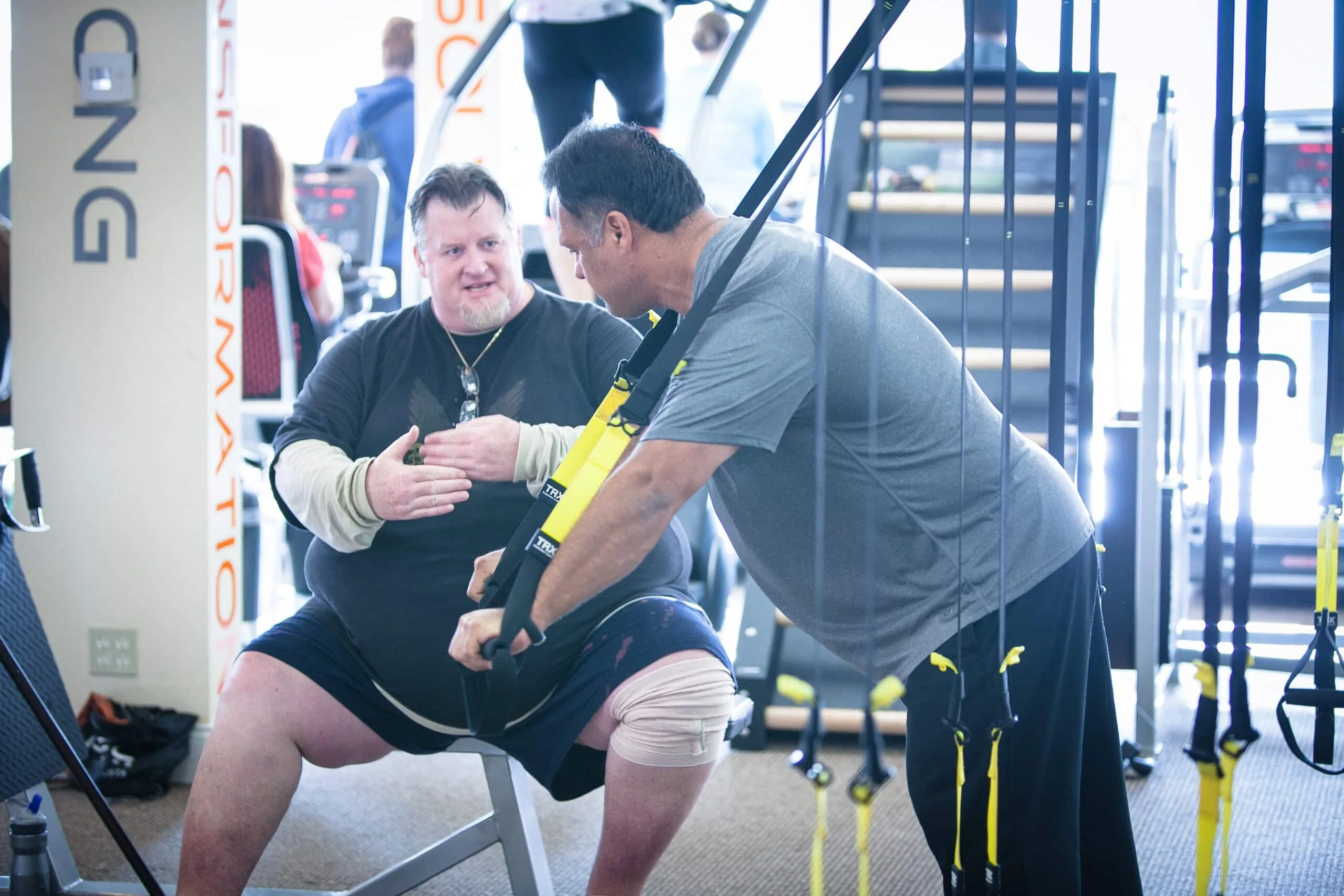
The all-or-nothing trap peaks in this phase. A missed session does not erase your progress. A single missed opportunity does not materially alter the longer habit-formation curve. What matters most is returning to the next scheduled repetition. Habit research supports progress over perfection as a practical strategy, not just a slogan.
PFC’s small-group client-to-trainer ratio allows trainers to adapt sessions for many fitness levels, with low-impact options available. Every class at PFC is structured so complete beginners and seasoned athletes can work at their own level.

For more on building strength after divorce, see PFC’s guide to building muscle after divorce weight loss.
Phase 3 shifts the focus from simple consistency to identity. The target becomes an intrinsic, identity-based goal such as “I am someone who prioritizes my health,” “I want to hike with my kids,” or “I want to feel strong in my own body.” These goals tend to last because they are self-endorsed.
The widely repeated 21-day habit rule is not an evidence-based finding. It traces to a plastic surgeon’s 1960 observations about psychological adjustment to appearance changes. A 2024 systematic review found medians of 59–66 days and individual estimates from 4 to 335 days. By week 9, with consistent repetition, new habits begin to feel more automatic for many people.
An immersive environment can speed this process. PFC offers stays starting at one week, with luxury accommodations at the Omni La Costa Resort in Carlsbad, California, expert-led programming across fitness, nutrition, and behavioral health, and a supportive community of peers in similar transitions. As Michael R. shared, “Walking into Premier Fitness Camp was the start of a life-changing journey. It’s more than just a retreat, it’s everything I needed to rediscover myself.”
SMART goals, which are Specific, Measurable, Achievable, Relevant, and Time-bound, work especially well after divorce when scaled to your worst day. Instead of “I will get in the best shape of my life,” write “I will walk 20 minutes three times this week.” The first goal is vague and depends on perfect conditions. The second stays realistic during a hard custody week or a stressful legal appointment.
Use these six connected steps for post-divorce fitness goals:
When grief, single parenting, or legal stress reduce your capacity, scaling the goal down keeps the habit alive. A minimum viable behavior, a stripped-down version of a habit performable even on the worst days, maintains the context-behavior association in the brain. Two minutes of stretching counts. A ten-minute walk counts. The continuity matters more than the duration.
Talk To A PFC Coach About Your SMART Goals
Exercise can ease anxiety after divorce, yet no single modality works best for everyone. A 2026 network meta-analysis found that all eight studied modalities showed beneficial effects on depression or anxiety compared with controls, with no statistically significant differences among the top-ranked options. Your dominant symptoms, tolerance, and preferences should guide the choice.
Research clarifies how different modalities help:
Relaxation exercises such as yoga, deep breathing, massage, or meditation can be used as stress-management tools, and Mayo Clinic notes that chronic stress keeps the fight-or-flight response turned on, which makes these practices a clinical priority.
A practical starting routine includes a 20–30 minute walk most days, 10 minutes of yoga or stretching, and two strength sessions per week. PFC offers low-impact options for every fitness level, along with behavioral health support from licensed psychologists and group workshops on emotional regulation and stress management.
Single parenting after divorce compresses available time, yet the minimum effective dose of physical activity is lower than many people think. There is no minimum amount of physical activity required to achieve some health benefits, and small bouts accumulated over the day and week provide benefits.
A 15-minute minimum viable routine for time-constrained days might include:
Involving children in physical activity through family walks, bike rides, or backyard movement games addresses both time constraints and the relational side of recovery. Consistency matters more than duration. A short walk every day builds the habit curve more effectively than a long session once a week.
PFC’s flexible stay lengths, starting at one week, and robust post-camp support through virtual coaching, personalized meal plans, and ongoing communication with staff help clients build routines that hold up in real life. For more on community-based approaches, see PFC’s guide to group fitness for post-divorce healing.
The Revenge Body. Pursuing a revenge body after divorce feels understandable because appearance can seem controllable when everything else feels uncertain. Yet pursuing a revenge body can keep your ex at the centre of your body relationship, which makes self-worth depend on appearance and external evaluation. As noted earlier, appearance-driven motives are linked to exercise dependence. The practical reframe is to set intrinsic goals, track non-scale victories, and let body changes follow consistent behavior.
All-Or-Nothing Restart. The all-or-nothing mindset treats a single missed workout as proof of failure and a reason to stop. A single missed day has no measurable impact on long-term habit progress, and the greater concern is the second consecutive miss, which can begin a new habit of skipping. The counter-strategy is to resume at the next feasible opportunity, scale the behavior to current capacity, and protect the cue-behavior link even on hard days.
Exercise As Punishment. Using exercise to “make up for” eating, to punish yourself for how your body looks, or to earn rest turns movement into a negative experience and predicts dropout. Movement should be evidence of what your body can do. Reframing exercise as self-care, as proof of capability, and as a source of mood regulation aligns with research on intrinsic motivation and long-term adherence.
Get Help Reframing Your Goals With A PFC Coach
A self-guided plan works well as a starting point. It becomes insufficient when low mood makes it hard to initiate any movement, when the all-or-nothing cycle keeps restarting, when accountability is missing and the routine collapses, or when the emotional weight of divorce requires more support than a fitness app can provide.
PFC is designed for this moment. PFC is located at the Omni La Costa Resort in Carlsbad, California. Clients train 4–5 hours daily, eat meals prepared by wellness chefs using fresh, farm-to-fork ingredients, and receive behavioral health support from licensed psychologists. The structured program removes the decision fatigue of building a routine from scratch.

The numbers are concrete. Seventeen data points are tracked weekly, including weight, body fat, blood pressure, cholesterol, glucose, strength, and cardiovascular fitness. Clients train in the same low client-to-trainer ratio mentioned earlier. PFC has 1,200+ reviews with a 90%+ five-star rating, and a UCSD case study showed that 94% of client weight loss was pure fat, compared with the 60/40 fat-to-muscle ratio typical of standard dieting programs. Fifty percent of PFC’s annual revenue comes from returning alumni, which reflects both experience quality and result durability.
Paula L., who arrived during a period of low confidence and high anxiety, described her outcome this way: “My lack of self confidence, self-doubt and anxiety were at an all time high. I am now off of my anti-depressants and have a whole new outlook on life physically, mentally and spiritually.”
Stays start at one week and extend up to six months. The average client stays 11 days. PFC runs approximately $6,000 per week, all-inclusive, with 0% financing available for up to six months. If you are weighing whether a structured program is the right next step, these are the questions clients ask most often.
Discuss Whether PFC Is The Right Level Of Structure
A gym membership or online program fits into a busy life, which means it competes with every other demand. The typical gym-goer trains 3–4 hours per week total. At PFC, clients train 4–5 hours per day in an immersive environment with no competing priorities. Every meal is prepared by wellness chefs and designed by registered dietitians. Licensed psychologists provide behavioral health support for emotional eating, grief, and divorce-related stress. Seventeen data points are tracked weekly, compared to scale weight alone at many gyms. The immersive, all-inclusive structure helps behavioral change stick by changing the environment around you.
PFC works with clients across the full spectrum of fitness levels, from individuals who weigh 400+ pounds and can only walk 250 feet to seasoned athletes who train four times a week. Every class is structured so each participant can work at their own level. Trainers use the same small-group ratio described earlier and adapt every session, with low-impact options for health limitations such as bad knees and back pain. The program begins with a comprehensive health assessment, including blood work, body composition, fitness tests, and measurements, to build a personalized plan from day one.
PFC addresses emotional eating and grief through the “Think” pillar. Licensed psychologists lead group workshops on emotional eating, triggers, and limiting beliefs, and one-on-one counseling is available for deeper issues including divorce, grief, and childhood trauma. Meditation and inner connection sessions are also part of the program. The goal is to understand emotional responses to food and stress and to build behavioral tools that support different choices. Most fitness programs skip this dimension, yet it often determines whether results last.
The average PFC client stays 11 days. Stays start at one week and can extend up to six months, and many first-time clients book one week and extend on-site after experiencing the program. PFC runs approximately $6,000 per week, all-inclusive. The rate covers luxury accommodations at the Omni La Costa Resort, all meals and snacks, all fitness classes and training, educational workshops, health assessments, weekly report card tracking, three spa treatments per week, and post-camp support. Zero-percent financing is available for up to six months with no down payment.
Post-camp support includes virtual coaching for ongoing accountability, personalized meal plans for home, fitness programming and exercise guidance, and ongoing communication with PFC staff. Clients can email their trainers at any time. Low staff turnover means returning alumni reconnect with the same people year after year, which contributes to the high rate of repeat clients. The goal is empowerment, so clients leave PFC with the knowledge, tools, and habits to sustain their transformation independently.
Fitness goals following a divorce support identity rebuilding. The three-phase framework of Stabilize, Rebuild, and Redefine sequences that project in a way that aligns with nervous-system physiology and habit-formation research. You regulate first, then build strength and consistency, then create identity-based goals that belong to you.
Begin with small steps. Attach movement to a fixed daily cue. Scale your goals to your worst day. Track what the scale cannot measure. When a day is missed, return to the next repetition and keep the habit alive.
For deeper support, start by consulting your healthcare provider about your readiness for increased activity. From there, explore what a structured program like PFC offers and decide whether an immersive reset fits your situation. When you feel ready, you can take the first step by talking with the PFC team about your plan.
Plan Your 90-Day Reset With A PFC Specialist