 5-star Wellness Resort
 5-star Wellness Resort
Written by: Chris Butt, Certified Personal Trainer & Weight Loss Coach, Premier Fitness Camp
Book a free consultation at Premier Fitness Camp
Adult weight loss camps and residential weight loss retreats operate across the United States. They serve adults at every fitness level and with a wide range of health goals. The category has matured considerably, and today’s programs differ from the calorie-restriction-and-exercise-only camps of earlier decades.
Program types vary meaningfully:
Well-known residential programs include Premier Fitness Camp (PFC) in Carlsbad, California; Unite Fitness Retreat in Salt Lake City, Utah; Hilton Head Health; Canyon Ranch; Pritikin; and Live In Fitness. Regional searches like “adult weight loss camps Virginia” reflect how people search. The strongest programs tend to be destination programs that people travel to, because an immersive, away-from-home environment supports focus and consistency.
Premier Fitness Camp (PFC) is a leading luxury adult weight loss camp located at the Omni La Costa Resort & Spa in Carlsbad, California (North San Diego County). The 450-acre resort offers year-round moderate temperatures, low humidity, and direct access to Pacific coast beaches, coastal hiking trails, and open water. These outdoor training assets differ from what a downtown hotel or desert location can provide.
Residential adult weight loss retreat pricing ranges from roughly $3,500 to $6,500 or more per week depending on the program. A 2026 comparison guide identifies a range of approximately $3,500 to $6,500+ per week for single occupancy, with premium resort-based programs at the higher end of that range.
PFC runs approximately $6,000 per week. The program offers 0% financing for up to six months with no down payment required, plus multi-week discounts for longer stays. The price reflects what is actually included:
Industry guidance advises confirming exactly what is and is not included before booking, since unexpected charges for personal training, assessments, spa services, or post-camp coaching can add thousands of dollars to an advertised rate. At PFC, the program is genuinely all-inclusive, with no surprise add-ons.
The program may also qualify as a tax-deductible medical expense when a physician prescribes it for a diagnosed condition such as obesity or hypertension. Consult a tax professional for guidance specific to your situation. For a deeper look at whether the investment makes financial sense, see Are Weight Loss Camps Worth The Money For Adults? If the upfront cost feels high, the next step is to explore whether insurance or tax rules can offset any of it.
Insurance generally does not cover the full cost of a residential weight loss retreat. Most insurers classify these programs as elective wellness rather than medical treatment, which places the full cost outside standard coverage.
Partial reimbursement or tax deductibility becomes possible under specific conditions. Under IRS Publication 502, the cost of a weight loss program can be included in medical expenses if it is a treatment for a specific disease diagnosed by a physician, such as obesity, hypertension, or heart disease. Obesity itself qualifies as a diagnosable disease under IRS rules, meaning a physician’s documented diagnosis and recommendation of a structured program to treat it can make enrollment fees and program costs eligible for HSA or FSA reimbursement, or deductible on Schedule A.
Medical expenses are deductible only to the extent they exceed 7.5% of adjusted gross income and only if the taxpayer itemizes deductions. Amounts reimbursed by insurance or paid from an FSA or HSA cannot be deducted again on Schedule A.
To support a potential deduction or reimbursement claim, ask your physician for:
PFC begins every client with a comprehensive health assessment that includes blood work, vital signs, body composition, BMI, measurements, and a fitness test. This assessment supports the documentation a physician or tax professional may need. The IRS does not require documentation to be attached when filing, but the burden of proof falls on the account holder if audited, so both the receipt and the Letter of Medical Necessity should be kept in durable storage. Always consult a tax professional before claiming these deductions.
For more on medically supervised programs and what to look for, see Best Adult Weight Loss Camp With Medical Supervision.
A structured day at PFC is designed so that assessment, training, nutrition, and behavioral support reinforce one another. The week begins with a baseline assessment, then builds through daily training and workshops that turn that data into personalized habits:
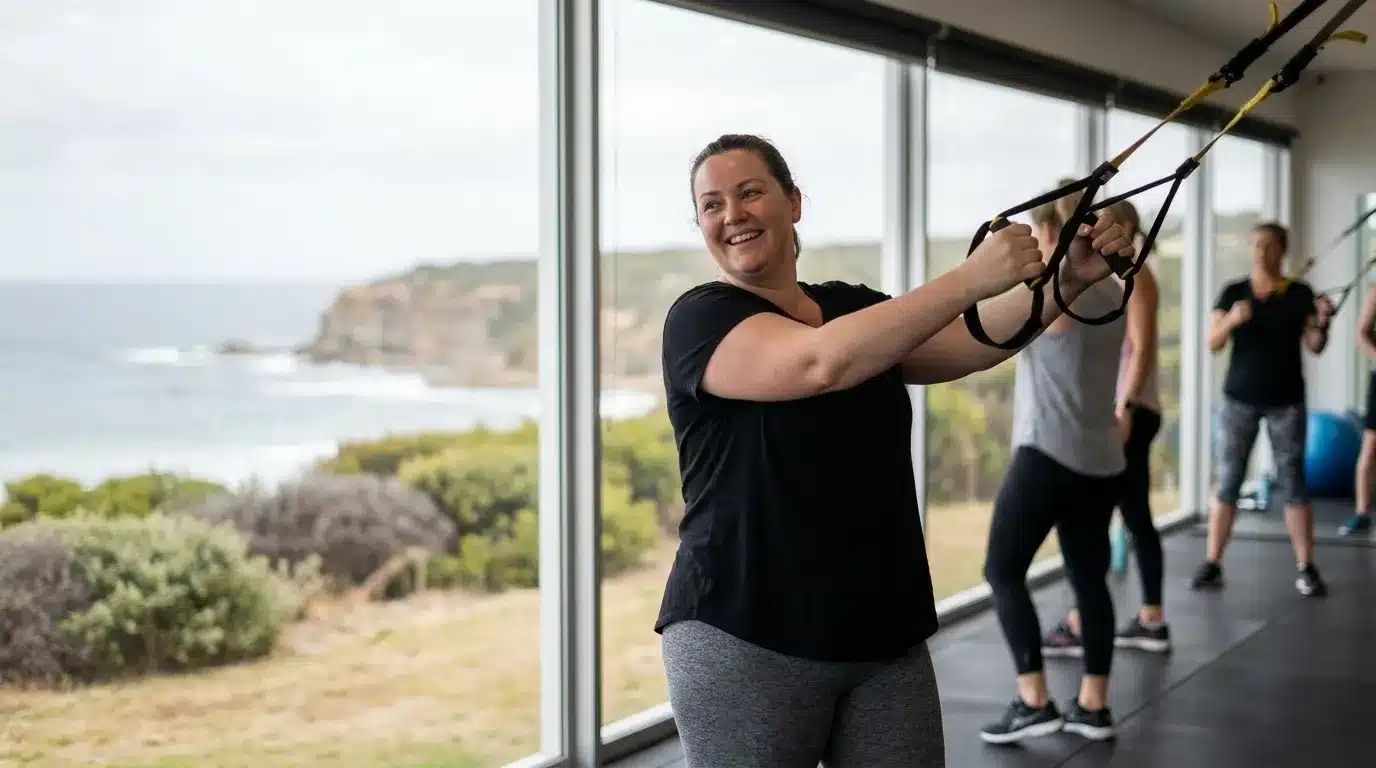
Many first-time clients worry about keeping up. PFC maintains a 3–4:1 client-to-trainer ratio and adapts every class for every fitness level, from 400-pound beginners to seasoned athletes. Trainers offer low-impact options for those with health limitations, and the culture emphasizes support. As client Julie Robinson wrote in her Google review: “The trainers, the staff, the Chefs! All amazing and work with all levels.”

For a fuller picture of the daily experience, see What Is An Adult Weight Loss Camp Like?
See what a week at PFC looks like — book your consultation
The search for the best fat camp for adults works better as a decision framework than a ranked list. The right program depends on specific, verifiable criteria you can check.
Choosing a program comes down to a few connected factors: who leads the program, how safely it manages your health, how it measures progress, what you eat, where you train, and what support continues after you leave.
Staff credentials. PFC trainers hold a minimum of a bachelor’s degree, and many hold master’s degrees. Many staff members have been with PFC since its founding, with extremely low turnover. Clients build real relationships with the same people year after year, which creates continuity that high-turnover competitors cannot match.
Medical oversight and health assessments. A program that skips a baseline health assessment before training begins cannot safely serve adults with obesity, hypertension, diabetes, or joint limitations. Patients managing type 2 diabetes, hypertension, high cholesterol, sleep apnea, or PCOS alongside excess weight require medical oversight during weight loss because blood sugar medication may need adjustment and blood pressure may shift as weight is lost. PFC’s day-one assessment captures blood work, vital signs, body composition, BMI, measurements, and a fitness test.
Data tracking. PFC tracks 17 data points weekly in a personalized Report Card. These include weight, body fat, seven body measurements, blood pressure, mile time, plank hold time, push-ups, and four blood markers (LDL, HDL, triglycerides, and glucose). An optional DEXA scan, the gold standard for body composition measurement, is also available.
Post-camp support. A program that ends at checkout leaves clients on their own during the hardest phase. PFC provides virtual coaching, personalized meal plans for home, fitness guidance and exercise programming, and ongoing communication with staff. Clients can email their trainers anytime.
Food quality and on-site preparation. PFC’s wellness chefs prepare all meals on-site using fresh, farm-to-fork ingredients. Programs that deliver food from off-site kitchens have less control over freshness and nutritional precision than an on-site culinary team.
Environment and location. PFC operates at the Omni La Costa Resort & Spa, a 450-acre property in North San Diego County with a year-round moderate climate, dedicated on-site facilities, and access to Pacific coast beaches and coastal hiking. Programs located in downtown hotels, desert heat, or high-humidity climates offer a different and often more limited outdoor training environment.

Empowerment versus codependency. The original adult camp business model often relied on codependency, where clients kept returning because they never learned sustainable habits. That model benefits revenue but does not support long-term health. PFC’s Think, Eat, Move philosophy focuses on education and empowerment so clients can succeed independently.

On the evidence side, a case study conducted in partnership with the University of California, San Diego (UCSD) evaluated PFC participants who stayed four or more weeks and received DEXA scans at the start and end of their program. The case study found that 94% of total weight loss was purely fat, compared with the 60/40 fat-to-muscle ratio typical of standard dieting. Lean muscle mass was preserved or increased, bone volume was maintained, and metabolic capability was protected. These outcomes address a primary reason weight regain occurs after other programs: metabolic damage from muscle loss.
PFC has earned 1,200+ reviews with a 90%+ five-star rating, and 50% of annual revenue comes from returning alumni, which reflects genuine satisfaction. For a broader comparison of programs, see Best Weight Loss Camps For Adults In 2026: A Practical Guide and Best Adult Fat Camps With Holistic Weight Loss Programs.
The maintenance phase determines whether the investment pays off over time. Behavioral interventions typically yield effects that attenuate over time, and sustained weight-loss maintenance requires ongoing effort. That reality means the weeks after camp matter as much as the weeks on-site. The programs that produce lasting results are the ones that prepare clients for life after camp, not only the time they spend on property.
Three factors drive long-term outcomes:
For a detailed look at how PFC’s approach supports maintenance, see How Adult Weight Loss Camps Help You Keep Weight Off. One group faces a particularly steep maintenance challenge: people who lost weight on GLP-1 medications and are now tapering off.
A growing population has lost weight on GLP-1 medications such as semaglutide (Ozempic, Wegovy) or tirzepatide (Mounjaro, Zepbound) and is now dealing with the consequences of stopping or reducing the drug. In the STEP 1 extension trial, participants who discontinued semaglutide regained approximately two-thirds of their lost weight within one year, accompanied by partial reversal of metabolic improvements.
The mechanism is well documented. Without structured nutritional intervention, a clinically significant portion of GLP-1-induced weight loss may occur at the expense of fat-free mass, which can exacerbate declines in energy expenditure and facilitate weight regain after treatment cessation. Approximately 20–30% of total weight lost through GLP-1 and GIP/GLP-1 receptor agonist therapies is typically derived from lean mass, including muscle.
PFC supports clients who use these medications. The program helps clients use them in a way that protects muscle by emphasizing resistance training, higher protein intake, and sustainable habits for the tapering period and beyond. Expert consensus recommends combining nutrition therapy with structured resistance exercise or combined aerobic-plus-resistance training to preserve muscle mass and metabolic outcomes. That is exactly what PFC delivers.
Think of PFC as the education and lifestyle foundation that helps GLP-1 results last, rather than a short-term fix that leaves clients vulnerable when the medication stops.
PFC works with clients ranging from 400+ pounds who can only walk 250 feet to seasoned athletes who train four times a week. Every class is structured so that every participant, regardless of fitness level, gets what they need. Trainers maintain a 3–4:1 client-to-trainer ratio and offer modifications, progressions, and low-impact alternatives for every exercise. A dedicated low-impact training track supports those with health limitations such as bad knees, back problems, or cardiovascular conditions. Nobody is left behind.
PFC’s average client stays 11 days. One week provides a powerful kickstart. Two weeks build real momentum. Three weeks create the repetition that supports more permanent habit change. Four weeks deliver significant, measurable fat loss. Extended stays of up to six months are available for clients who want the deepest possible change. Many first-time clients book one week and extend their stay on-site once they experience the program firsthand.
PFC is all-inclusive. The weekly rate covers luxury resort accommodations, all meals prepared on-site by wellness chefs, all fitness classes and workshops, a comprehensive health assessment with ongoing Report Card tracking, spa treatments, access to resort amenities, and post-camp virtual coaching and support. There are no extra fees for assessments, personal training sessions, or post-camp guidance. Financing and multi-week discounts are available.
The relevant comparison is the cost of PFC versus a lifetime of failed diets, unused gym memberships, and the compounding medical costs of untreated obesity-related conditions. PFC’s UCSD case study showed a high proportion of fat loss with lean muscle preserved or increased and metabolic capability protected. With 1,200+ reviews at a 90%+ five-star rating and 50% of annual revenue from returning alumni, the program’s track record is verifiable. Client Lauren M. lost 140 pounds and had her story featured on The Today Show. Client Scott signed up for two weeks and stayed for eight. The program may also qualify as a tax-deductible medical expense, subject to professional advice. For an honest assessment of the value equation, see Are Weight Loss Camps Worth The Money For Adults?
Book a free consultation to discuss your goals
An adult weight loss camp is a significant investment of time and money. The programs that deliver lasting results combine medical supervision, expert-led education, data-driven tracking, and a real post-camp maintenance plan. Premier Fitness Camp (PFC) brings these elements together at the Omni La Costa Resort & Spa in Carlsbad, California, with the UCSD case study results mentioned earlier, 1,200+ reviews at a 90%+ five-star rating, and a 50% alumni return rate.
The cost structure is transparent. The insurance and tax documentation path is clear. The daily experience is immersive, expert-led, and built for every fitness level. The post-camp support focuses on helping results last and building independence.
For more on what makes PFC a leader in this category, see Honest Reviews Of Adult Weight Loss Camps: What Really Works, Best Fitness Retreats For Adults: Top Programs Compared, and Best Adult Weight Loss Boot Camp In Southern California.
To speak with the PFC team about your goals, call (888) 488-8936 or use the consultation link below.
Start your PFC consultation today