 5-star Wellness Resort
 5-star Wellness Resort
Written by: Chris Butt, Certified Personal Trainer & Weight Loss Coach, Premier Fitness Camp
Body recomposition is the process of reducing fat mass while increasing or preserving lean muscle mass through progressive resistance training, adequate protein intake (0.8–1.2 g per pound of body weight daily), and a modest calorie deficit. Traditional weight loss often strips away muscle along with fat, while recomposition focuses on improving what your weight is made of, not just lowering the number on the scale. A UCSD case study of participants who stayed four or more weeks found that 94% of total weight loss was purely fat, which stands in sharp contrast to the 60/40 fat-to-muscle ratio seen in most dieting programs.
Ready to start your transformation? Schedule your personalized consultation with the Premier Fitness Camp team to discuss your goals. Call (888) 488-8936 or visit the link to reserve your session.
A successful recomposition program rests on four clear steps.
This 8-week plan starts with a 3-day full-body split in weeks 1–4, then progresses to a 4-day upper/lower split in weeks 5–8. The 2026 ACSM Position Stand shows that a wide range of loads can build muscle when sets are taken close to failure, and that accumulating enough hard sets per muscle group each week is key for hypertrophy.
The table below outlines the six core exercises you will perform each session, along with target sets, reps, and load percentages that create your initial training stimulus.
| Exercise | Sets | Reps | Load (% of 1RM) |
|---|---|---|---|
| Goblet Squat | 3 | 10–12 | 60–70% |
| Dumbbell Romanian Deadlift | 3 | 10–12 | 60–70% |
| Dumbbell Bench Press | 3 | 10–12 | 60–70% |
| Seated Cable Row | 3 | 10–12 | 60–70% |
| Dumbbell Shoulder Press | 2 | 10–12 | 60–70% |
| Plank Hold | 3 | 20–30 sec | Bodyweight |
This phase increases weekly training volume by moving to an upper/lower split, which allows more focused work for each muscle group while still respecting recovery needs.
| Day | Exercise | Sets | Reps |
|---|---|---|---|
| Upper A | Barbell or DB Bench Press | 4 | 8–10 |
| Upper A | Lat Pulldown or Pull-Up | 4 | 8–10 |
| Upper A | Overhead Press | 3 | 10–12 |
| Upper A | Dumbbell Row | 3 | 10–12 |
| Lower A | Barbell Back Squat or Leg Press | 4 | 8–10 |
| Lower A | Romanian Deadlift | 4 | 8–10 |
| Lower A | Walking Lunge | 3 | 12 per leg |
| Lower A | Calf Raise | 3 | 15–20 |
Progression should feel steady, not reckless. When you can perform extra repetitions beyond the target range with solid form, increase the load slightly. For adults over 35, progressive overload should advance one variable at a time, with repetitions increasing before load, because tendons adapt more slowly than muscle. Add reps first, then increase weight once you consistently hit the top of the rep range, and drop back to the lower end of the range.
A 2026 systematic review and meta-analysis suggests that undulating periodization works well for increasing lean body mass in individuals with obesity and for short-term body recomposition. In practice, you vary rep ranges across sessions within the same week. For example, use heavier sets of 6–8 reps on Monday and moderate sets of 10–12 reps on Friday instead of repeating the same workout every time.
Measurable adaptations in muscle strength and size can appear within 1–4 weeks of consistent resistance training. Visible changes in body composition, confirmed by photos, measurements, and how clothing fits, typically show up at 8–12 weeks when you follow a plan with 3–4 weekly resistance sessions and progressive overload.
For adults 35–55, an 8-week program serves as a powerful starting block rather than a final destination. The first four weeks focus on neuromuscular efficiency and movement quality. Measurable hypertrophy and fat loss usually accelerate in weeks 5–8 as training volume and load increase. Sustained recomposition, especially meaningful muscle gain alongside fat loss, compounds over 12–24 weeks and beyond when you keep the program in place.
A 47-year longitudinal study from Karolinska Institutet published in the Journal of Cachexia, Sarcopenia and Muscle found that physical ability and strength begin to deteriorate as early as age 35. Starting and then maintaining a resistance program becomes one of the most consequential health decisions an adult can make.
The ACSM 2026 Position Stand recommends that healthy adults train each major muscle group at least twice per week, which makes a 3-day full-body split not only sufficient but also one of the most practical evidence-based options for adults over 35. A 2016 meta-analysis found that training muscle groups twice weekly produces better muscle growth than training them once weekly, and three full-body sessions per week meet this standard for every major muscle group.
Three gym sessions per week create a strong foundation. For most adults, the real bottlenecks are intensity, volume, and consistency rather than days in the gym. Many people training on their own accumulate only 3–4 total hours of weekly exercise. PFC clients train 4–5 hours per day, five days per week, under expert supervision, which creates a structural advantage for faster results.
Ready to experience what structured, supervised training can do for you? Speak with a PFC specialist about your goals. Call (888) 488-8936 to connect with the team.
Recovery becomes slower after age 40, so a deliberate recovery plan matters as much as the workouts themselves. Adaptation to exercise happens during sleep, rest, and recovery, not during the workout, because that is when your body repairs microscopic damage, builds new proteins, and strengthens the neuromuscular system.
Key recovery priorities for adults over 35 include sleep, active recovery, planned deloads, and simple monitoring tools.
Nutrition determines whether your training produces recomposition or just leaves you tired. Research consistently shows that total protein intake and how you spread it across the day matter more than any specific diet style.
Longland et al. (2016) found that recreationally active men in a 40% caloric deficit who consumed approximately 1.1 g protein per pound of body weight per day gained 1.2 kg of lean body mass over 4 weeks while performing resistance training plus HIIT 6 days per week. The control group, who consumed about 0.55 g per pound, maintained lean mass but lost less fat.
Practical nutrition targets for body recomposition in adults 35–55 include protein, a moderate calorie deficit, and smart meal distribution.
Sample daily protein targets by body weight:
| Body Weight | Protein at 0.8 g/lb | Protein at 1.0 g/lb | Protein at 1.2 g/lb |
|---|---|---|---|
| 150 lbs | 120 g | 150 g | 180 g |
| 180 lbs | 144 g | 180 g | 216 g |
| 210 lbs | 168 g | 210 g | 252 g |
GLP-1 receptor agonists such as semaglutide and tirzepatide are now common tools for weight management, yet their impact on body composition needs careful planning. Research shows that part of the total weight loss from GLP-1 medications can come from lean mass.
A 2026 retrospective cohort study using Fitbit data from adults with obesity found that starting GLP-1 medications was associated with reduced physical activity, which works against muscle preservation.
For adults on GLP-1 medications, resistance training several times per week plus adequate protein intake becomes essential for limiting lean mass loss. GLP-1 receptor agonists can reduce appetite and overall food intake so much that protein intake becomes inadequate unless you plan it carefully with structured nutrition support.
The University of Pittsburgh’s STRONG pilot study (NCT07652333, begun May 2026) is testing whether resistance exercise preserves muscle mass and improves mental health in adults taking GLP-1 medications. Early findings will add to the growing consensus that resistance training is non-negotiable for anyone using these medications.
For GLP-1 graduates who have lost weight on medication and now worry about muscle loss, metabolic slowdown, or long-term maintenance, the 8-week plan in this guide provides the resistance training and protein framework needed to rebuild lean tissue and protect metabolic rate.
Self-directed programs can work well for some adults, while others prefer faster, supervised, data-tracked results, especially during GLP-1 transitions, after age-related hormonal shifts, or following years of inconsistent training. Premier Fitness Camp (PFC) offers a very different structure from a typical gym routine.
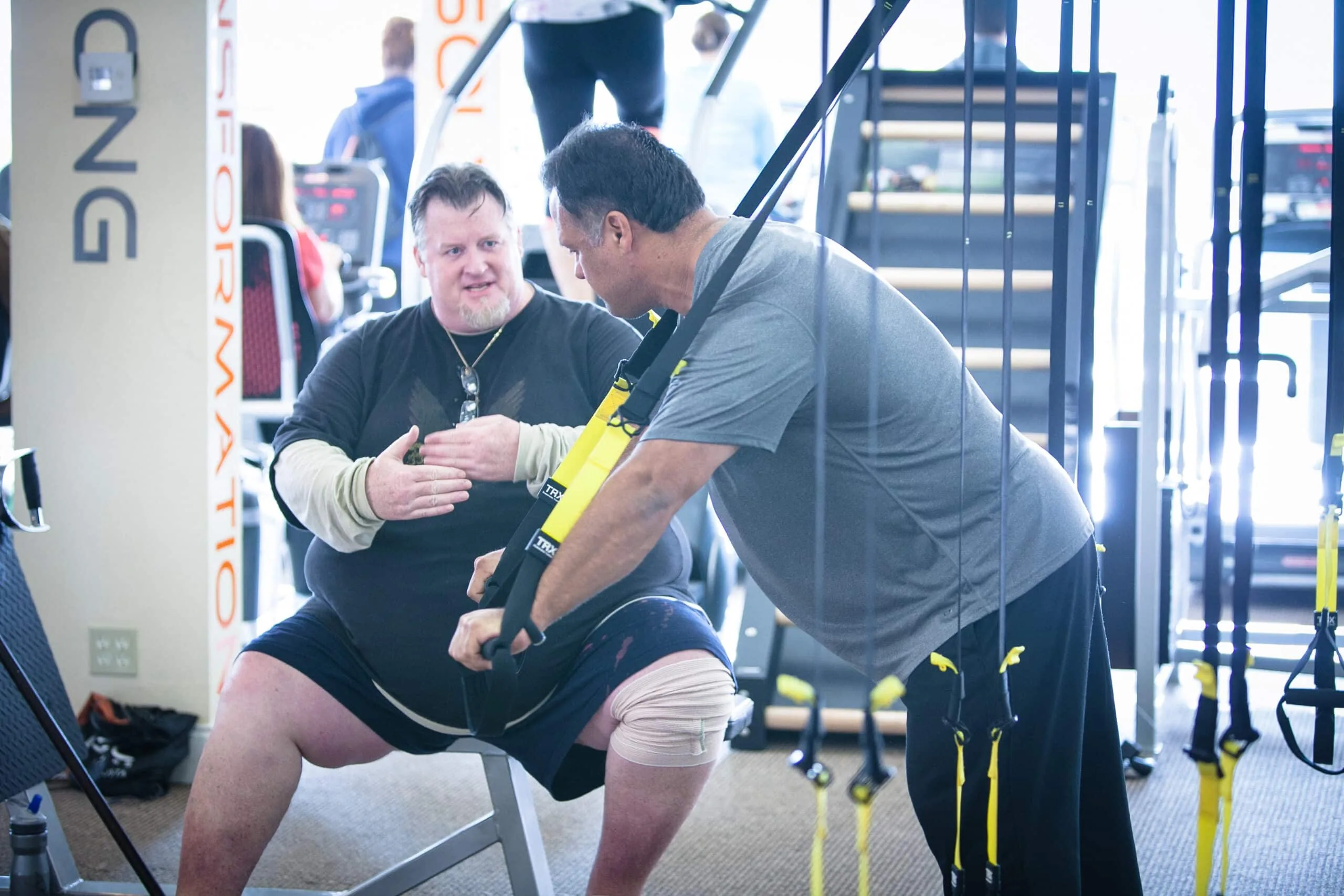
Where many gym-goers log 3–4 hours of training per week, PFC clients train 4–5 hours per day, five days per week, with a 3–4:1 trainer-to-client ratio. Every trainer holds at least a bachelor’s degree, many hold master’s degrees, and a large portion of the staff has been with PFC for more than a decade. Progress is tracked across 17 data points weekly through a personalized report card, including body weight, body fat percentage, circumference measurements, blood pressure, blood glucose, cholesterol panels, push-up count, plank time, and mile time. Optional DEXA scans provide gold-standard body composition data.
The UCSD case study of PFC participants confirmed what the program’s structure predicts: 94% of client weight loss was purely fat, with lean muscle mass preserved or increased. Bone volume and metabolic capability were also maintained, which addresses two of the most common long-term problems seen with aggressive weight loss programs.

PFC operates at the Omni La Costa Resort & Spa in Carlsbad, California, with 450 acres of facilities, a year-round moderate climate, and access to beach workouts, coastal hikes, paddleboarding, and kayaking, all integrated into the full “Think, Eat, Move” curriculum. Registered dietitians design every meal. Licensed psychologists support the behavioral side of lasting change. Three spa treatments per week are included. Post-camp virtual coaching, personalized meal plans, and ongoing trainer communication extend results long after you leave.
With more than 1,200 reviews, a 90%+ five-star rating, and half of annual revenue coming from returning alumni, PFC’s outcomes are consistent. As one client, Scott, shared, “I signed up for two weeks and stayed for eight. The facilities and staff are top notch.”

Ready to accelerate your results in a supervised, data-driven environment? Book a free consultation with Premier Fitness Camp. Call (888) 488-8936 or visit the link to schedule your personalized consultation.

The 2026 ACSM Position Stand, which synthesizes 137 systematic reviews with over 30,000 participants, recommends accumulating enough hard sets per muscle group each week to support hypertrophy. For adults over 35 who are new to structured training or returning after a break, starting at the lower end of recommended volumes and progressing gradually is the most sustainable strategy. Intermediate trainees can work toward higher weekly set volumes per muscle group over time. Most working sets should end with about 1–3 technically sound repetitions still possible, rather than pushing every set to failure, to limit unnecessary fatigue and joint stress while still delivering a strong growth stimulus.
Protein targets stay the same on rest days as on training days, and you should maintain the ranges outlined in the nutrition section above, spread across 3–4 meals. Muscle protein synthesis continues for 24–48 hours after a resistance training session, so rest days still count as active rebuilding periods, not nutritional off-days. Total calorie intake on rest days can be slightly lower than on training days, by about 100–200 calories, if you prefer, but protein should remain steady. Carbohydrate intake can come down a bit on rest days because glycogen demands are lower, although this adjustment is optional for most adults in the 35–55 age range.
Body recomposition remains achievable at any age when you combine progressive resistance training, sufficient protein, and a moderate calorie deficit. Adults over 40 experience anabolic resistance, which means they need a higher per-meal protein dose, around 40 g, to trigger the same muscle-building response seen in younger adults. This factor is manageable with planning rather than a hard barrier. Recovery also takes longer after 40, so sleep quality, training frequency, and regular deload weeks matter more than they do for younger lifters. The UCSD case study of participants, many between 40 and 60, showed that lean muscle mass was preserved or increased during the program, which demonstrates that meaningful recomposition is realistic in this age group with the right structure and support.
GLP-1 receptor agonists reduce appetite significantly, which can make it challenging to eat enough protein, the most important nutritional factor for preserving muscle during a calorie deficit. Without deliberate protein tracking and consistent resistance training, a meaningful portion of the weight lost on GLP-1 medications can come from lean mass instead of fat. The practical solution is to treat resistance training as non-negotiable, with at least 3 sessions per week that target all major muscle groups, and to monitor protein intake closely so it stays within your target range. Working with a registered dietitian who understands GLP-1 physiology is strongly recommended, especially for managing gastrointestinal side effects that can further reduce protein intake. Premier Fitness Camp’s registered dietitians and licensed trainers work directly with GLP-1 users and graduates to design individualized plans that protect muscle, support fat loss, and build the sustainable habits needed for long-term success after medication.