 5-star Wellness Resort
 5-star Wellness Resort
Written by: Chris Butt, Certified Personal Trainer & Weight Loss Coach, Premier Fitness Camp | Last updated: August 26, 2026
Adults between 40 and 60 face a compounding set of cardiovascular risks. Resting heart rate often rises, arterial flexibility declines, and years of sedentary habits leave the heart less efficient at delivering oxygen to working muscles. A June 2026 American Heart Association scientific statement confirms that regular physical activity improves blood pressure, insulin sensitivity, cholesterol levels, and cardiorespiratory fitness in adults with overweight or obesity, independent of weight loss.
The AHA recommends at least 150 minutes per week of moderate-intensity aerobic activity or 75 minutes per week of vigorous aerobic activity, combined with muscle-strengthening on two or more days per week, a target most adults never reach. CDC data show that 46.9% of U.S. adults meet aerobic activity guidelines, and 24.2% meet guidelines for both aerobic and muscle-strengthening activity.
Nervousness about exercise makes sense for someone who has been sedentary, carries extra weight, or has received a health warning from a physician. Overweight or deconditioned adults reach their target heart rate more quickly and with less effort than athletic individuals, so generic programs that ignore this reality create real risk. The safer path is supervised exercise that accounts for each person’s starting point.
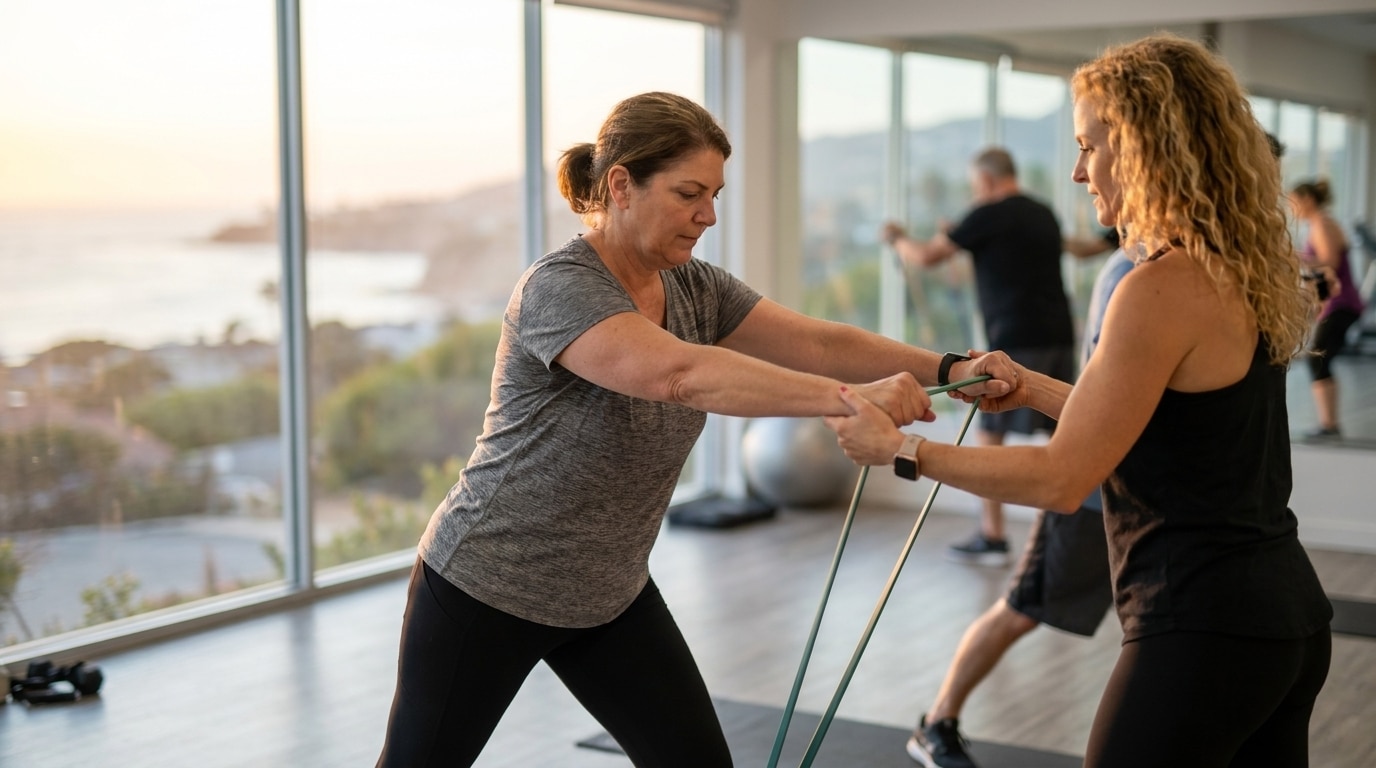
Trainer supervision is the single most important safety variable in any exercise program. At our program, every fitness session operates at a 3–4:1 client-to-trainer ratio. A trainer stays close enough to observe breathing pattern, posture, and movement quality in real time and can intervene before a form breakdown becomes an injury.
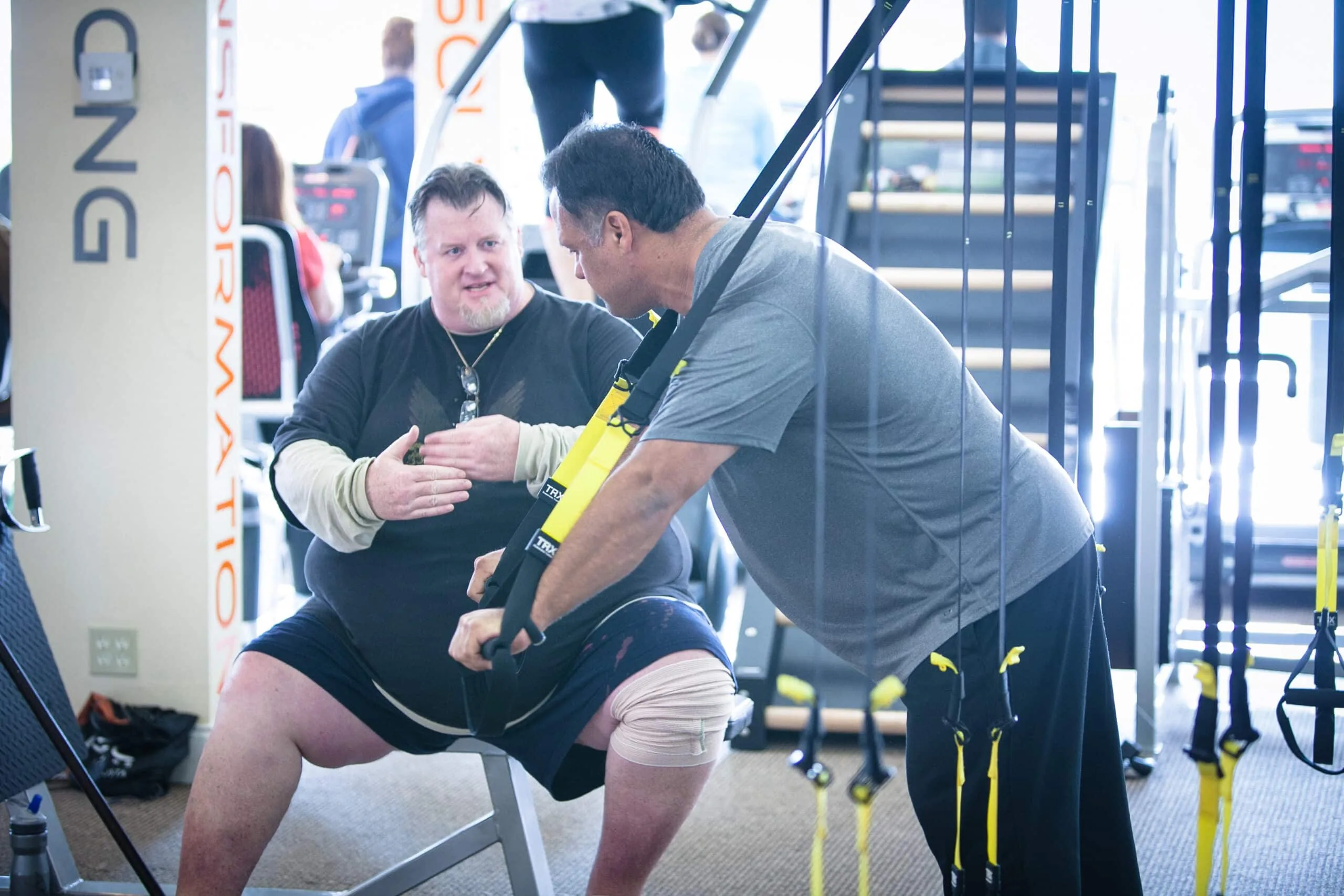
All trainers hold a minimum bachelor’s degree, and many hold master’s degrees. They have been with the program for years, often since its founding. That continuity helps them recognize individual patterns across returning clients and build on prior progress instead of starting from scratch.
Every class is structured so participants at every fitness level receive an appropriate challenge. A client who can currently walk only 250 feet and a seasoned athlete can share the same session without sharing the same workload. Low-impact modifications are available for every exercise, and trainers adapt progressions in real time based on observed response rather than a fixed script.
For patients with osteoarthritis, which is common among U.S. adults with obesity, low-impact modalities such as cycling, swimming, or elliptical training reduce joint loading while preserving cardiovascular benefit. Our activity menu includes these options alongside beach workouts, hiking, kayaking, and stand-up paddleboarding.
Ready to experience supervised cardio in a luxury setting? Book a free consultation with our team today at (888) 488-8936.
Progressive loading means increasing exercise demand gradually so the cardiovascular system and muscles adapt without being overwhelmed. NASM defines progressive overload as gradually increasing the demands placed on muscles, the cardiovascular system, or movement patterns over time and recommends that trainers consider the client’s current fitness level, movement quality, recovery capacity, and training history before making any increase.
At our program, the first days of any stay establish a baseline. Clients complete a comprehensive health assessment that includes blood work, body composition, blood pressure, and a fitness test. From that baseline, trainers build a personalized progression that respects each client’s capacity.
To reduce overuse injury risk, intensity or duration should not increase by more than 10% per week, with a deload week reducing training load by 30–40% every four to six weeks to allow adaptation to consolidate. Our structured weekly schedule of 4–5 hours of training per day, Monday through Friday, with a half day Saturday, follows this periodized approach.
Muscle preservation sits at the center of our method. Exercise training upregulates PGC-1α expression 3–5-fold, driving mitochondrial biogenesis and improving oxidative capacity in cardiomyocytes, which makes the heart more efficient over time. This muscle-preserving approach produces measurable results.
A UCSD case study of our participants who stayed four or more weeks found that 94% of total weight loss was purely fat, compared to the 60/40 fat-to-muscle ratio typical of standard dieting programs. Most long-term clients not only maintained lean muscle stores but increased them during their weight loss. These outcomes protect resting metabolic rate and long-term weight maintenance because muscle tissue drives caloric expenditure even at rest.
The American Heart Association recommends heart-rate targets of 50% to 70% of maximum heart rate for moderate exercise and 70% to 85% for vigorous exercise, with maximum heart rate estimated as 220 minus age. For a 50-year-old, that places the moderate zone between approximately 85 and 119 beats per minute. This range produces meaningful cardiovascular adaptation without overloading a deconditioned heart.
Moderate exercise intensity is characterized by breathing that quickens but does not leave a person out of breath, light sweating after about 10 minutes, and the ability to talk but not sing. Trainers use this talk test alongside heart-rate data during every session as a practical field check.
Several signs show that exercise intensity has exceeded a safe threshold:
In supervised exercise settings, exercise must be stopped immediately for chest discomfort, new or worsening dyspnea disproportionate to effort, dizziness, or a systolic blood pressure drop of 10 mmHg or more with increasing workload, followed by evaluation. Our trainers are trained to recognize and act on all of these signals.
For clients on GLP-1 medications or those with joint limitations, our program adjusts modality and intensity accordingly. Many older adults take medications such as beta blockers that make age-predicted maximum heart-rate formulas unreliable, so perceived exertion and movement quality should guide early-stage programming rather than the heart-rate monitor alone. We track 17 data points weekly, including blood pressure, glucose, LDL, HDL, triglycerides, and mile time, so progress is visible across multiple dimensions, not just heart rate or scale weight.
Cardiovascular adaptation happens during recovery, not during the workout itself. Every session begins with a structured warm-up and ends with a cool-down, which allows heart rate to transition gradually instead of spiking or dropping abruptly. A typical aerobic exercise recommendation includes 5-minute warm-up and cool-down periods to support safe cardiovascular transitions.
Nutrition at our program is designed by registered dietitians and prepared on-site by wellness chefs using fresh, farm-to-fork ingredients. Every meal is calorie-controlled and macro-balanced to support recovery, muscle preservation, and sustained energy across 4–5 hours of daily training. Sleep quality receives focused attention through behavioral health coaching and the comfort of luxury accommodations at the Omni La Costa Resort in Carlsbad, California.

Beyond nutrition and sleep, passive recovery modalities play a direct role in cardiovascular adaptation. Three weekly spa treatments are included in every stay. Frequent sauna bathing is associated with cardiovascular benefits through improved blood vessel relaxation, arterial flexibility, and increased blood volume, which resemble some effects of regular cardio exercise. Treatments available at the La Costa Spa, ranked among the top wellness spas in North America, include massage, body wraps, and red light therapy. These services support muscular recovery and parasympathetic restoration after high-volume training days.

The cardiovascular gains built during a stay are designed to persist. High levels of consistent physical activity, such as 200–300 minutes per week of moderate-intensity activity, are associated with long-term weight-loss maintenance and can protect cardiovascular health even if some weight regain occurs, helping preserve earlier improvements in blood pressure and insulin sensitivity. We prepare clients for this by providing personalized meal plans, fitness programming, and ongoing access to trainers via email after departure.
Adults over age 40 starting an exercise program should report any heart disorders, arthritis, chest pain, shortness of breath, leg pain while walking, palpitations, joint pain, or family history of sudden cardiac death before age 50 to their physician for pre-exercise screening. We recommend that all prospective clients with known cardiovascular, metabolic, or renal conditions obtain medical clearance before arrival. Our team works directly with clients and their physicians to ensure the program is appropriately calibrated from day one.
Ready to take the first step toward lasting cardiovascular health? Book a free consultation with our team at (888) 488-8936 and receive a personalized plan built around your health history and goals.
For most deconditioned adults, a properly supervised fitness camp is not only safe but significantly safer than exercising alone. Our program begins every stay with a comprehensive health assessment, including blood work, blood pressure, body composition, and a fitness test, to establish an accurate baseline. Trainers maintain a 3–4:1 ratio and monitor intensity, form, and recovery in real time throughout every session.
Clients with known cardiovascular conditions are encouraged to obtain medical clearance from their physician before arrival, and we coordinate with healthcare providers to ensure the program is appropriately calibrated. Low-impact modifications are available for every exercise, and no client is pushed beyond what their current capacity safely allows.
Measurable improvements in cardiovascular markers can appear within the first one to two weeks of consistent supervised exercise. Blood pressure reductions, improved resting heart rate, and better performance on timed fitness tests are among the earliest indicators. We track 17 data points weekly, including blood pressure (systolic and diastolic), glucose, LDL, HDL, triglycerides, mile time, plank hold, and push-up count, so clients see objective evidence of progress that goes well beyond the scale.
Clients who stay four or more weeks tend to see the most significant and durable cardiovascular adaptations, which aligns with the muscle-preservation outcomes documented in our UCSD case study.
Our program’s approach is built to accommodate a wide range of physical limitations. Every class includes low-impact alternatives, and trainers adapt exercises in real time based on each client’s needs. For clients with knee or back issues, low-impact modalities such as cycling, swimming, elliptical training, and water-based activities are incorporated to maintain cardiovascular benefit while reducing joint stress.
Clients on GLP-1 medications receive additional attention to protein intake and resistance training to protect muscle mass. The 3–4:1 trainer ratio means no client is left to navigate modifications alone, because a trainer is always close enough to observe and adjust.
Generic gym programs and high-intensity boot camps are designed for a broad population, not for deconditioned adults in the 40–60 age range who may have cardiovascular risk factors, joint limitations, or no prior exercise history. Our program is individualized from day one, built on a comprehensive health assessment, and progressed systematically based on each client’s response.
The 3–4:1 trainer ratio, 17-point weekly tracking, registered dietitian-designed nutrition, behavioral health coaching, and structured recovery protocols, including three weekly spa treatments, create a level of oversight and personalization that standard gyms or boot camps rarely match. The UCSD research validating our muscle-preserving approach reflects the measurable difference that this integrated model produces.
No minimum fitness level is required. PFC has worked with clients ranging from those who can walk only 250 feet to competitive athletes. The program is structured so that every participant, regardless of starting point, receives an appropriate challenge and meaningful progress.
Trainers meet each client exactly where they are and build from there, day by day. The goal is not to keep up with anyone else; the goal is to be measurably better than you were the day before.
Improving cardiovascular health after 40 does not require extreme intensity or pushing through pain. It requires the right structure: professional oversight, progressive loading, heart-rate monitoring, recovery protocols, and a program that treats each person as an individual. Our program delivers all of that within a luxury resort setting that makes the process sustainable and measurable for the more than 3,000 clients who have been through the program.
With over 1,200 reviews and a 90%+ five-star rating, and with 50% of annual revenue coming from returning alumni, our results show consistent client success. The UCSD research validating our muscle-preserving approach provides the scientific foundation. The daily experience at the Omni La Costa Resort in Carlsbad, California, with its 450 acres, world-class spa, Pacific coast access, and farm-to-fork nutrition, turns that science into a lived transformation.
Ready to start your safe heart-health transformation? Book a free consultation with our team today. Call (888) 488-8936 or schedule your personalized consultation online at no cost.