 5-star Wellness Resort
 5-star Wellness Resort
Written by: Chris Butt, Certified Personal Trainer & Weight Loss Coach, Premier Fitness Camp | Last updated: August 20, 2026
The most important number in any boot-camp evaluation is not total pounds lost, but how much of that loss comes from fat instead of lean tissue. Diet-induced weight loss without exercise results in approximately 75% fat tissue and 25% fat-free mass loss, and aggressive deficits push that ratio further in the wrong direction. A program that combines structured resistance training with a dietitian-designed caloric deficit can preserve or even increase lean mass while maximizing fat loss. A UCSD case study of participants who stayed four or more weeks and received DEXA scans found that 94% of total weight loss was purely fat, compared with the 60/40 fat-to-muscle ratio typical of standard dieting programs.
When evaluating programs, ask specifically for body-composition data, not just scale-weight averages. This distinction matters because a realistic and sustainable fat-loss rate for adults with 40–70 pounds to lose is 3–4 pounds per week under a well-structured program. Faster rates of weight loss can increase lean-mass loss and cause greater drops in resting energy expenditure, which is why programs promising dramatically faster results warrant scrutiny. Request DEXA scan data or peer-reviewed case study documentation before committing.
Trainer quality determines whether exercise programming preserves muscle, prevents injury, and adapts to individual limitations. Resistance training performed regularly with progressive overload can be an effective intervention for preserving muscle in adults over 50, but only when experts program and supervise it correctly. A trainer without a degree in exercise science or kinesiology is unlikely to apply progressive overload safely across a population that includes clients with hypertension, orthopedic limitations, and metabolic conditions. Look for programs where all trainers hold a minimum bachelor's degree, with master's-level staff available for specialized populations.
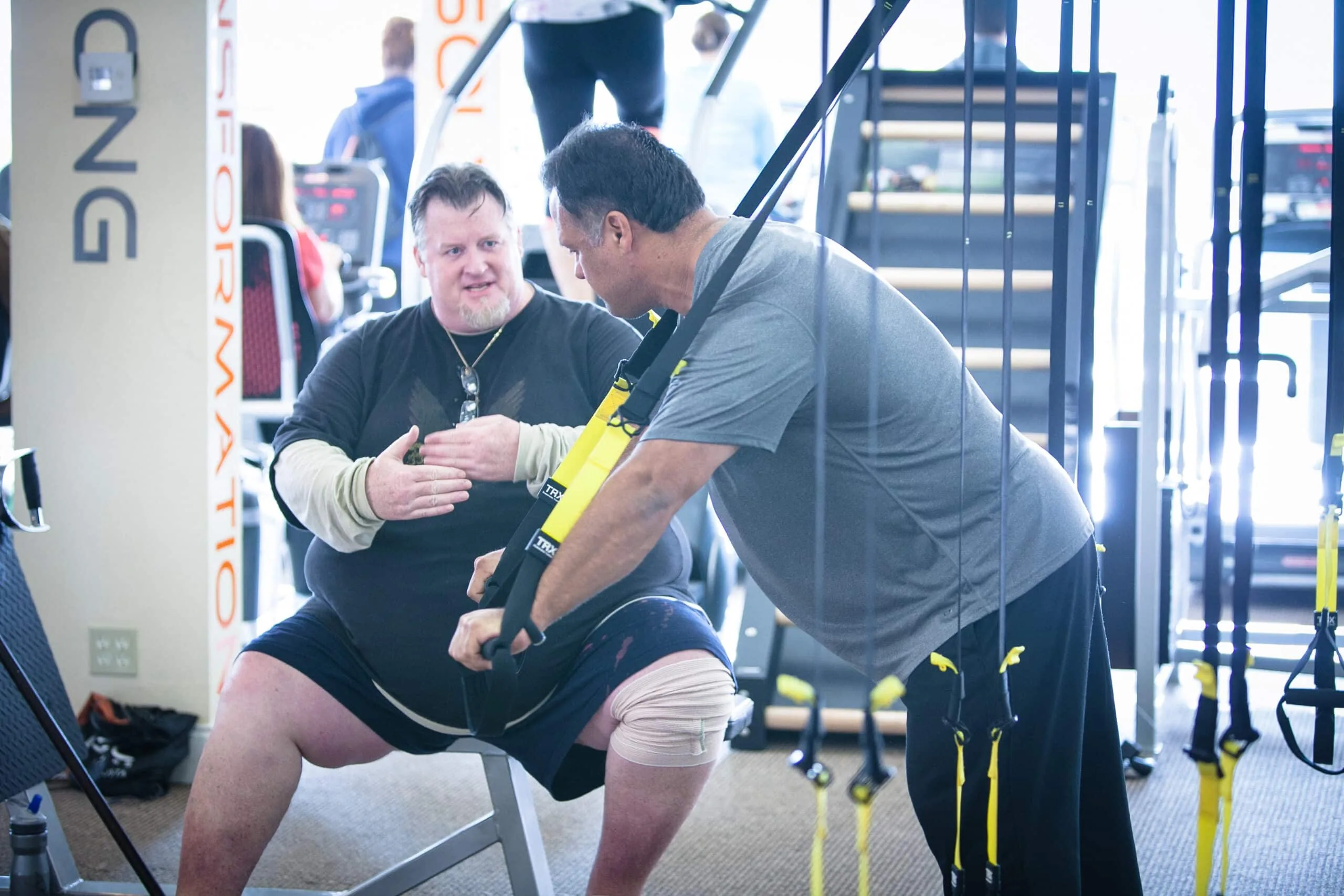
Client-to-trainer ratio carries equal weight. A 3–4:1 ratio allows trainers to observe form, provide real-time modifications, and build the individualized relationship that drives accountability. Ratios above 10:1, common at lower-cost programs, make meaningful supervision impossible. Before booking, ask for the ratio in writing and confirm whether it applies to all sessions or only to premium add-ons.
See how our trainer credentials translate to your results, then schedule a free consultation to discuss your fitness level and goals.
A 2026 narrative review in Pharmaceuticals identifies resistance training as the primary exercise strategy for preserving lean mass and function during GLP-1RA-assisted weight loss, and precision protein nutrition as the key nutritional countermeasure. Programs that do not explicitly address GLP-1 users are likely to produce the muscle-loss outcomes that make medication-assisted weight loss unsustainable. Studies recommend protein intake of 1.2–2.0 g/kg/d based on adjusted body weight for GLP-1 users on hypocaloric diets to help preserve muscle mass, distributed across 4–5 eating occasions to maximize muscle protein synthesis.
A qualified program should offer GLP-1-aware meal planning that front-loads protein, provides liquid and semi-solid protein options for days when appetite suppression peaks, and schedules resistance-training sessions 3–4 days per week using progressive overload. To verify this, ask whether registered dietitians follow specific protocols for GLP-1 users and whether trainers can document the resistance-training progressions applied to that population.
Weight regain after structured programs is primarily a behavioral failure, not a physiological one. Emotional eating, environmental triggers, and the absence of coping strategies account for the majority of post-program relapses. Research on habit formation indicates that new behavioral patterns require consistent repetition over an extended period, commonly cited as a minimum of 21 days, before they become automatic responses independent of willpower. Programs shorter than three weeks may produce fitness improvements without producing durable habit change.
Evaluate whether a program employs licensed psychologists or behavioral health coaches, not just motivational speakers. Group workshops on emotional eating, one-on-one counseling availability, and structured sessions on identifying personal triggers signal a program built for lasting change rather than temporary compliance. The presence of behavioral health staff on-site, rather than as a referral resource, shows that the program treats psychology as a core component of weight management, not an optional add-on.

Nutrition education that stays in the classroom and never reaches the kitchen produces knowledge without skill. Adults who leave a program knowing what to eat but not how to prepare it often revert to familiar patterns within weeks. Programs with on-site wellness chefs who conduct cooking demonstrations, explain ingredient substitutions, and model portion control in a real kitchen setting produce graduates who can replicate healthy meals at home. This structure separates education-based programs from exercise-only camps.

Food quality also affects outcomes directly. Meals prepared off-site and delivered, a common cost-cutting measure at lower-price programs, are harder to control for macronutrient accuracy, freshness, and caloric precision. On-site preparation by registered dietitians working alongside culinary staff allows for real-time adjustments based on individual health assessments, GLP-1 protocols, food intolerances, and weekly data. Ask whether the program employs its own chefs and dietitians or contracts food service from a third party.

Scale weight is a poor proxy for program effectiveness. A client who loses fat, gains lean mass, lowers blood pressure, and improves glucose levels may show modest scale movement in a given week, and without additional data points, that week looks like a failure. Programs that track only weight systematically underreport their own results and deprive clients of the motivational feedback that sustains effort during plateaus.
A rigorous tracking system should capture at minimum 17 data points weekly, including body fat percentage, circumference measurements at multiple sites, blood pressure, blood glucose, lipid markers, and functional fitness metrics such as mile time, push-up count, and plank duration. Weekly one-on-one report card reviews with a trainer translate raw numbers into clear guidance and celebrate non-scale victories that keep clients engaged. Ask any program to show you a sample weekly report card before enrolling.
The cost of an all-inclusive fitness boot camp includes more than the weekly rate, because the real cost includes regaining lost results if post-program support is absent. Programs that end at departure without virtual coaching, personalized home meal plans, or ongoing trainer access produce a predictable outcome: clients return to their previous environment without the structure that produced their results. Post-program support functions as a clinical necessity for sustainable outcomes, not a luxury upgrade.
Total cost of ownership also includes hidden fees. Some programs advertise a base rate that excludes meals, airport transfers, gratuities, or specialty sessions. Premium programs can charge several thousand dollars per week for single-occupancy stays, with optional paid upgrades for private services, medical weight loss, and longevity programs beyond the base rate. Confirm in writing what is included before comparing programs on price alone.
The two tables below compare six leading programs across key structural factors and provide a plain-language reality check on each.
| Program | Location & Climate | Trainer Education Requirement | Client-to-Trainer Ratio | On-Site Culinary Team | Behavioral-Health Staff | Weekly Data Points | Post-Program Support | 2026 Starting Price (per week) |
|---|---|---|---|---|---|---|---|---|
| Live In Fitness | Arizona (extreme heat May–Sep) | Not publicly disclosed | Not publicly disclosed | Food delivered from off-site | Not publicly disclosed | Not publicly disclosed | Not publicly disclosed | Positioned as lower-cost; contact for quote |
| Canyon Ranch | Multiple U.S. locations; varies by property | Not publicly disclosed | Not publicly disclosed | Yes, resort dining | Yes, wellness-focused | Not publicly disclosed | Limited; retreat-focused model | Contact for quote |
| Unite Fitness Retreat | Salt Lake City, UT (cold winters, urban setting) | Not publicly disclosed | Max 30 guests per session | Chef-prepared; dietary customization noted | Group life coaching included | 21-point health assessment at intake | Lifetime app access with workouts and recipes | Contact for quote |
| Pritikin | Florida (high humidity) | Not publicly disclosed | Not publicly disclosed | Yes, longevity-focused dining | Yes, longevity-focused | Not publicly disclosed | Available; longevity-model follow-up | Contact for quote |
| Civana Wellness Resort | Carefree, AZ (desert heat) | Not publicly disclosed | Not publicly disclosed | Yes, resort dining | Yes, retreat-focused | Not publicly disclosed | Limited; retreat-focused model | Contact for quote |
| Hilton Head Health | Hilton Head, SC (high humidity; off-site lodging required) | Not publicly disclosed | Not publicly disclosed | Yes, weight-loss-focused dining | Yes | Not publicly disclosed | Available | Contact for quote |
The table below summarizes a plain-language reality check for each program based on publicly available information.
| Program | Primary Strength | Primary Limitation |
|---|---|---|
| Live In Fitness | Lower price point makes access broader | Residential-home setting with off-site gym access and delivered food limits quality control and outdoor programming |
| Canyon Ranch | Established brand with comprehensive wellness amenities | Retreat orientation prioritizes experience over structured, results-driven fat-loss outcomes |
| Unite Fitness Retreat | Transparent pricing with lifetime app access included | Urban downtown location requires van transport to additional amenities, and cold winters limit outdoor programming |
| Pritikin | Decades of longevity research and medical integration | Slower pace and older-demographic focus may not suit adults seeking high-intensity fitness variety |
| Civana Wellness Resort | Strong spa and mindfulness programming | Wellness-retreat model is not structured around measurable fat-loss or body-composition outcomes |
| Hilton Head Health | Weight-loss focus with behavioral programming | Guests must be transported daily from off-site lodging to central facilities, which adds logistical friction |
Research shows that approximately 30% of weight lost on GLP-1 therapy can come from lean muscle mass rather than fat, which compromises insulin sensitivity and metabolic rate. The structural solution requires two simultaneous interventions: elevated protein intake and progressive resistance training. As noted earlier, the 1.2–2.0 g/kg protein target should be distributed across 3–5 meals or snacks to maximize muscle protein synthesis.
On the exercise side, GLP-1 users should perform 3–4 resistance training sessions per week with progressive overload. Metabolic preservation strategies include distributing protein across smaller, more frequent eating occasions, particularly when appetite suppression is highest in the 1–3 days following a weekly injection, and monitoring body composition rather than scale weight alone to detect muscle loss early. Any program claiming to serve GLP-1 users should be able to articulate these protocols specifically, not generically.
For adults who have tried diets, gym memberships, and apps without lasting results, an immersive all-inclusive program addresses structural gaps those approaches leave open, including behavioral education, supervised exercise, dietitian-designed nutrition, and post-program accountability. The value depends entirely on program quality. A program that tracks 17 data points weekly, employs licensed psychologists and registered dietitians, maintains a 3–4:1 trainer ratio, and provides post-departure virtual coaching delivers a fundamentally different product than one that offers exercise classes and calorie restriction alone. The real question becomes whether the specific program you are evaluating has the structural components that produce durable results.
The primary downsides are cost, time commitment, and the risk of selecting a program that does not teach sustainable habits. Premium programs start at several thousand dollars per week and require leaving work and family obligations for one to several weeks. Programs that rely on the immersive environment to produce results, without building the behavioral skills and nutritional knowledge clients need at home, create dependency rather than independence. A second downside is physical: adults over 40 with orthopedic limitations or cardiovascular conditions need programs that offer genuine low-impact modifications, not just verbal reassurance. Confirm that the program has a documented low-impact track and that trainers are qualified to adapt programming for your specific health history.
For adults with 40–70 pounds to lose, a well-structured program combining resistance training, aerobic exercise, and dietitian-designed nutrition produces approximately 3–4 pounds of fat loss per week. The critical distinction is the composition of that loss. Standard dieting produces roughly a 60/40 fat-to-muscle ratio. As the UCSD case study showed, well-structured programs can achieve fat-only loss while preserving or building muscle, which contrasts sharply with typical dieting outcomes. Scale weight is one data point, while body fat percentage, circumference measurements, blood pressure, glucose, and functional fitness metrics tell a more complete and motivating story, particularly in weeks when the scale moves slowly.
Adults over 40 can keep up safely when the program is structured to accommodate every fitness level. Adults with no recent exercise history, orthopedic limitations, or significant weight to lose can participate when trainers maintain low client-to-trainer ratios, offer documented low-impact modifications for every exercise, and conduct a comprehensive health assessment before programming begins. Programs that work with clients ranging from 400+ pounds who can walk only short distances to seasoned athletes demonstrate genuine capacity for individualization. Key questions to ask include trainer-to-client ratio, the presence of a dedicated low-impact track, and whether you can see a sample modification for someone with your specific limitations.
Post-program support is the single most important predictor of whether results last. At minimum, a qualified program should provide virtual coaching sessions to maintain accountability, a personalized home meal plan developed by a registered dietitian, written exercise programming for independent training, and ongoing access to staff for questions. Programs where clients can email their trainers directly, and where the same staff members are present year after year, produce stronger long-term outcomes because the relationship itself becomes a source of accountability. Before enrolling, ask what post-program support is included in the base price, what is available as a paid add-on, and how long that support continues.
Seven evidence-based factors separate all-inclusive adult fitness boot camps that produce lasting results from those that do not:
The program that quantifies all seven factors with published data includes a UCSD case study documenting 94% fat-only loss, 17 weekly data points per client, a 3–4:1 trainer ratio with bachelor's and master's degree requirements, licensed psychologists and registered dietitians on staff, on-site wellness chefs, and post-program virtual coaching. All of this is delivered at the Omni La Costa Resort & Spa in Carlsbad, California, with over 1,200 reviews and a 90%+ five-star rating. Fifty percent of annual revenue comes from returning alumni, which is one of the most reliable indicators of program quality available.
Ready to see whether this program fits your goals? Schedule a free consultation with a program specialist, with no obligation and no pressure. Call (888) 488-8936 or schedule online to book your personalized conversation today.